Text and photos by Ante Hamersmit
November is a time for letting go. The trees have shed their leaves, nature is retreating, and the bees are huddling closer together. For me as a beekeeper, this month is about trust. Trust that the preparations were good. That the colonies are strong enough. That they can make do with what they have.
And this is where an insight that has particularly occupied me this year comes in: less is often more. Not just in a philosophical sense, but in a very concrete, measurable way.
Statistically speaking, apart from Varroa damage, one of the main causes of bee deaths in winter is running out of food. The standard recommendation is 20 kilograms of winter feed per colony. My colonies have less than half that amount – and even make it through the winter with reserves to spare.
How does that work? Insulation. Most beehives are lightweight, handy and portable. But they are anything but well insulated. The colder it gets outside, the more honey the bees consume to maintain the temperature in the winter cluster. That is simple physics. And that is exactly where I focus my efforts.
I use cork panels intended for terrariums. They are lightweight and quick to cut to size, and even a two-centimetre-thick cork panel almost triples the insulation provided by the hive wall. The result: the bees need to expend considerably less energy to stay warm. They consume less food, get through the winter more comfortably – and I not only save money on supplementary feeding, but also improve their chances of survival.
A tip from experience: the cork should be attached to the outside. Bees love shaving off organic material. Believe me, otherwise you will end up with it all in your combs. Nothing complicated – but a small difference that makes a big impact.
It is this kind of simplicity that fascinates me more and more. It is not the most complicated solution that wins, but the one that works in harmony with nature. The bees show us every day: less can work better when what little there is is used wisely.
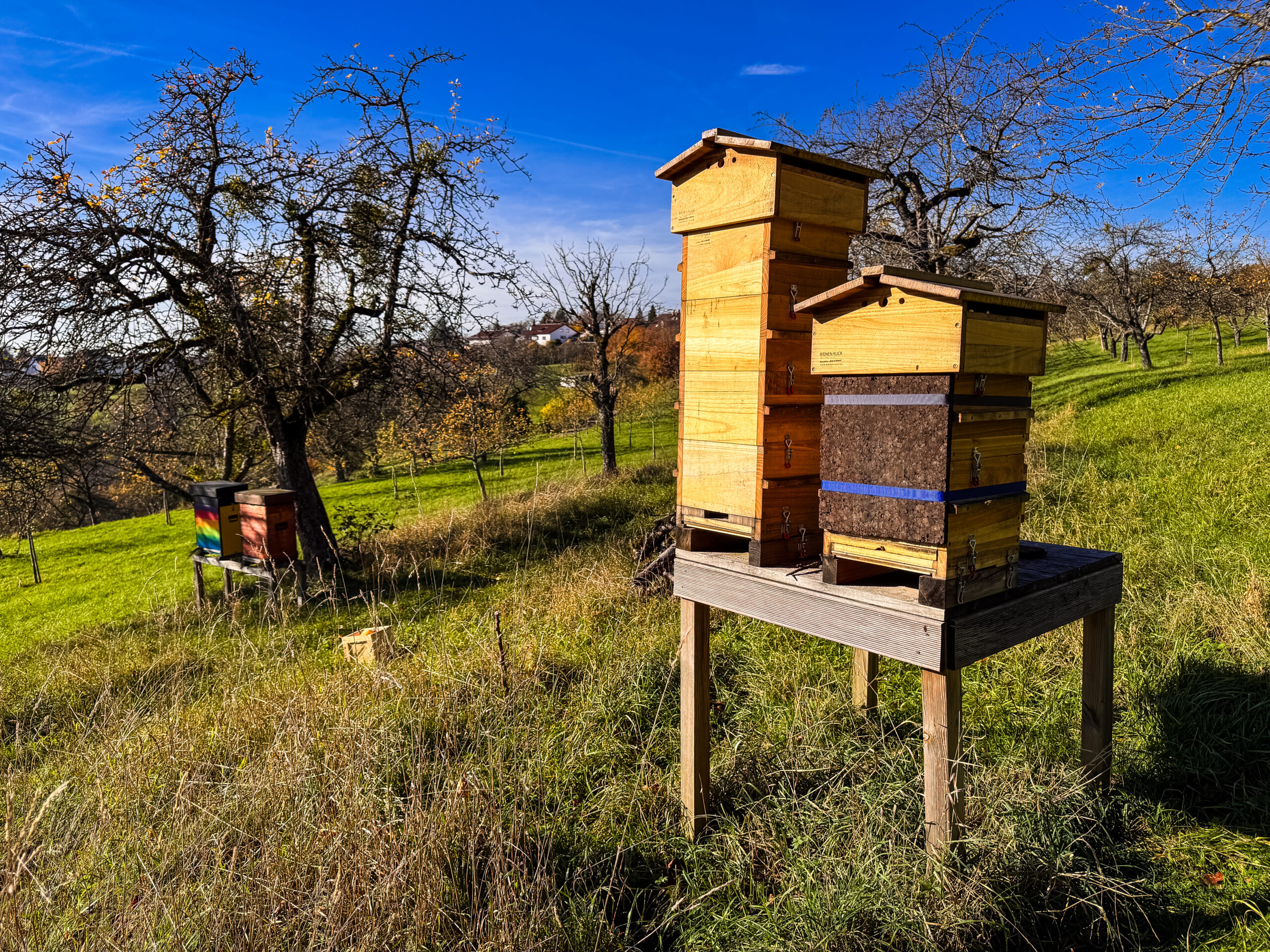
Warre hive additionally insulated with a cork panel next to an empty, uninsulated Warre hive
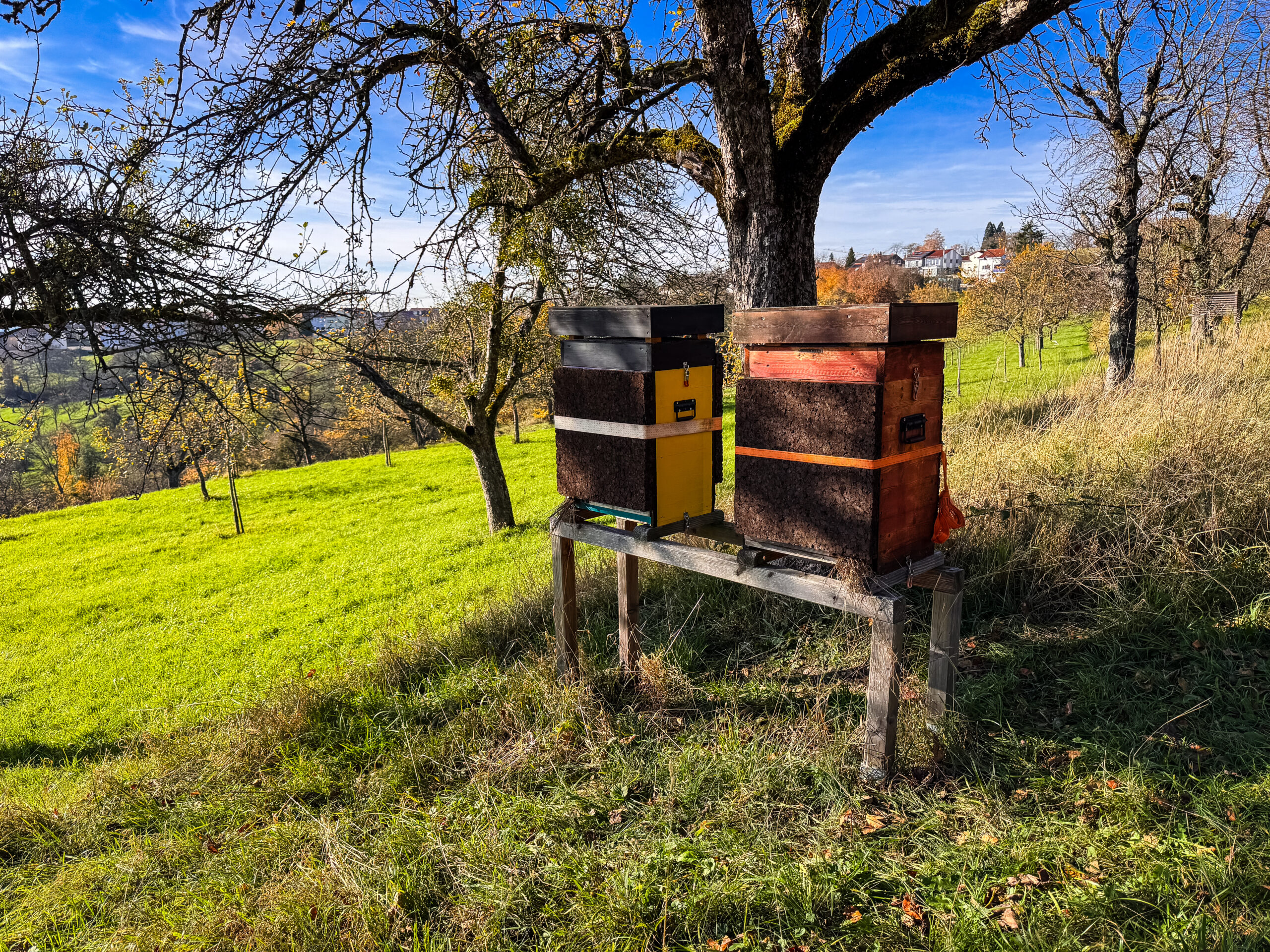
Two single-chamber hives insulated with 4 cm cork panels
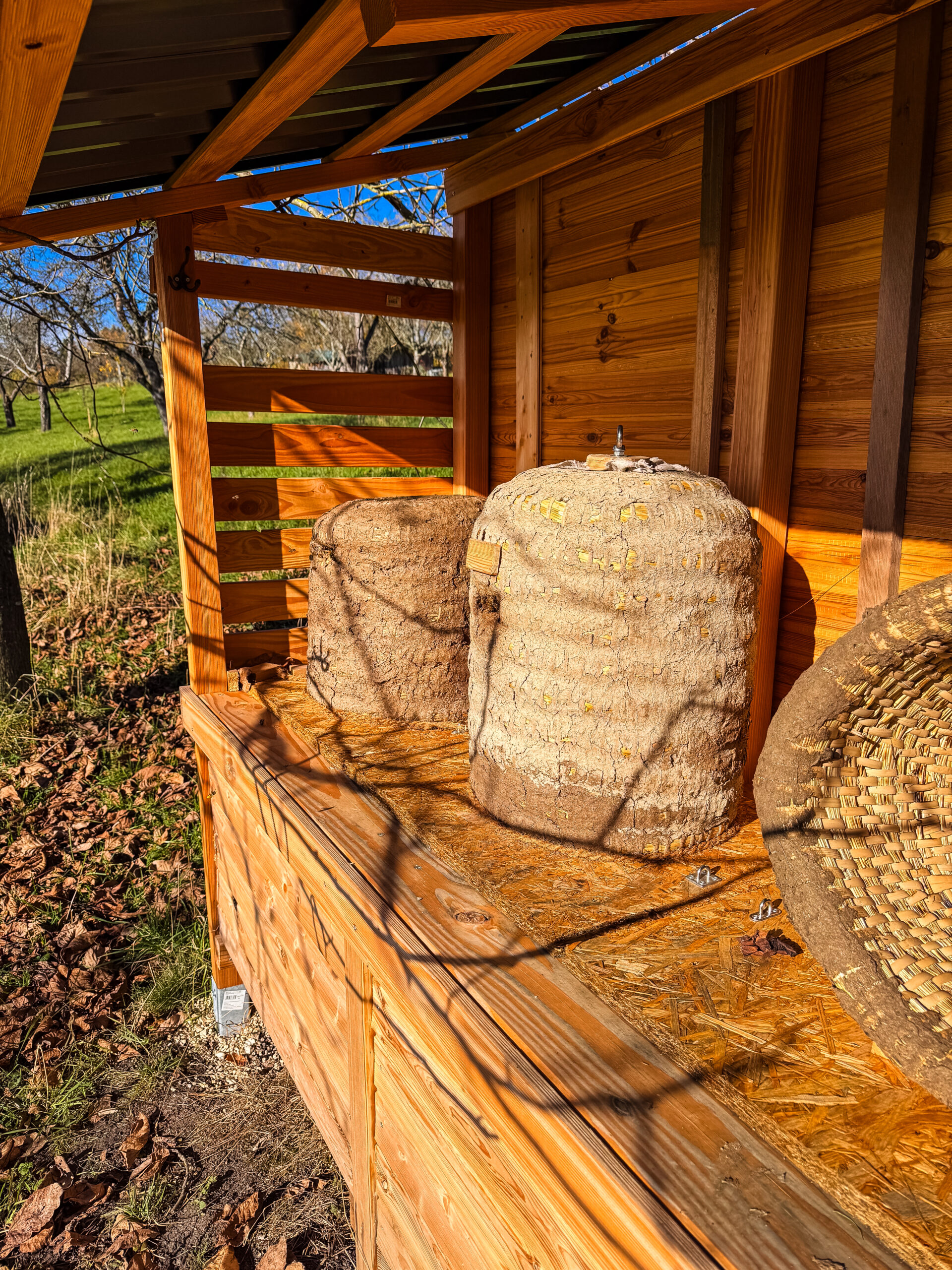
Lüneburg skeps do not need additional insulation, as their basket construction provides five times more insulation than modern wooden box hives
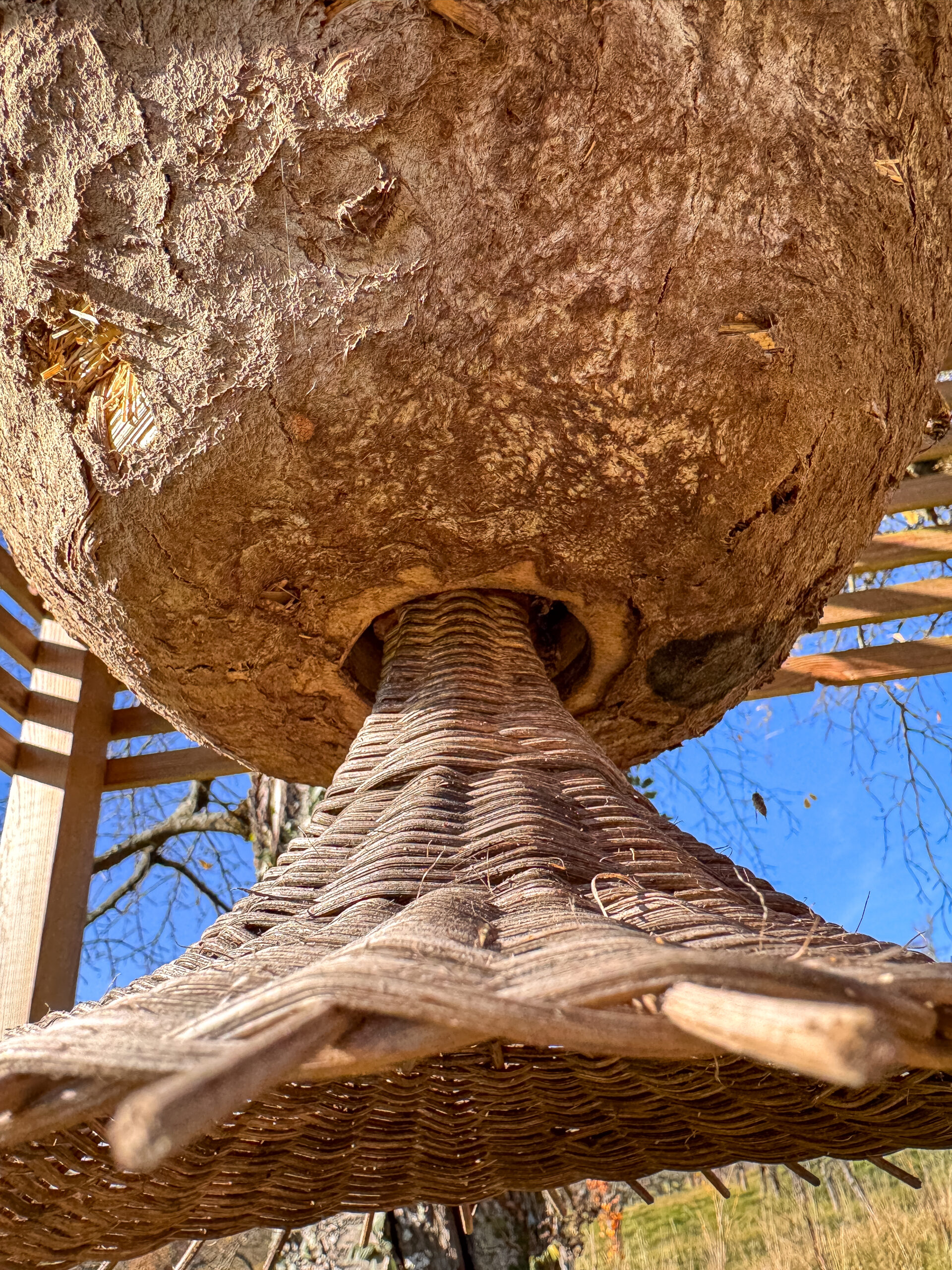
Weißenseifen hanging basket without additional insulation, because the straw already provides a high level of insulation
While my colonies prepare for winter, a question has been on my mind that I would not have dared to voice for a long time:
Why does a colony of 50,000 individuals with sesame-seed-sized brains make better decisions than most businesses?
I spent almost two decades in the corporate world. As an engineer, strategist, manager and speaker. I sat through countless meetings, witnessed dysfunctional processes, paralysing decision-making and destructive egotism. And no, it was not just my company. It was everywhere. Every person I spoke to had experienced it.
But the more I immersed myself in the way my bees work, the clearer it became to me: the parallels are astonishing – but the differences are illuminating.
Leadership without a boss
Most businesses try to control everything during a crisis. The pyramid gets steeper, control tighter and micromanagement more intense. The result? Paralysis. I saw it happen: teams suddenly no longer allowed to make decisions. Managers panicking. Innovations dying because everyone is waiting for the boss to say something.
A bee colony works in a completely different way. The queen makes no decisions. She manages no one. Her main job is to lay eggs. Leadership is distributed. And this is not just a nice idea – it is vital for survival.
Young bees start out as cleaners, become nurse bees, then builders, guards and finally foragers. The most dangerous job comes last. Roles are based on age, abilities and, above all, the needs of the colony. If half the foragers suddenly disappear, other bees step in immediately. Automatically. Without consulting the queen. Without a strategy meeting. Without an organisational chart update.
The colony responds to existential threats within minutes. Fortune 500 companies take an average of 18 months to make a pivot like that. Which is more likely to survive a sudden crisis?
Decisions that matter
What happens in most businesses? An idea goes into a meeting, then into the next meeting. Someone’s ego gets bruised, the legal department reviews it, and it languishes in someone’s inbox for three weeks. Months wasted. Millions burned. Endless discussions with no result – because everyone is afraid of making a mistake or upsetting someone.
Bees solved this 100 million years ago with the waggle dance. It does not matter who gave the initial signal. The option that receives the most dancing – the best option – wins. No PowerPoint presentation, no politics, no spin. The best option wins. Period.
When your colony is starving, you cannot afford to make a bad decision. That is why bees achieve 80 – 90% decision-making accuracy. And businesses? If they are lucky, they manage 50%.
Community over self-interest
What I saw most during my two decades in business was selfishness. Especially in a crisis. Everyone thinks of themselves. Everyone protects their own position. Departments fight each other. The best people leave. The ship sinks while everyone fights over the lifeboats.
Bees? The complete opposite. Every bee knows exactly why it exists and how it contributes – especially in a crisis. A forager is not simply doing “just” her job. She keeps 50,000 bees alive. A guard does not sting in order to die. She defends her colony. And when things get tough, the community grows stronger, not weaker.
And here is the part that moves me every time: when famine comes, when the end really is near, the whole colony dies at the same time. Because the last of the food is shared right to the bitter end. Every single bee gets its share. No leader helping themselves first. No privileges. No more important bees.
The colony survives together or dies together. And that is not romanticism. It is evolutionary mathematics. In the long term, only the community survives, not the lone fighter.
The timeline of humility
On a one-metre timeline, 100 million years of bee evolution are represented. Humanity as a whole appears only in the final three millimetres. And modern business management as we know it? Not even a speck of dust on it.
We are extremely new to what we do. Absolutely inexperienced. And yet we go around thinking we know it all. Perhaps, just perhaps, we should be humble enough to learn from those who came before us. From those who have been getting it right for 100 million years – however small and inconspicuous they may be.
For me, this November marks more than just the beginning of winter rest for the bees. It is also a moment for personal reflection.
The longer I work with bees, the more clearly I feel how much the corporate world has shaped me – its structures, its ways of thinking, its logic of efficiency. And I realise how much I want to break away from it. Not out of rejection, but from a deep desire to continue developing in an authentic way.
The bees have shown me that the best systems are the simplest. The most sustainable solutions are those that work in harmony with nature. The strongest communities are those in which everyone knows what they contribute – without paralysing hierarchies.
I want to increasingly orient my work in this direction. Less competitiveness, more mindfulness. Fewer directives, more clarity and trust in natural processes. More room for what really matters: genuine connections, meaningful activity, work that is true to our nature – with the bees and with people.
Winter is a time to pause. For the bees. And for me. I look forward to using these quiet weeks to gain clarity. To sense where the journey should lead. And to set the course for a new year that is even more in keeping with what matters to me.
YouTube video title image: Hierarchy kills businesses – bees have lived the alternative for millions of years
Until soon, in the quiet of winter
Ante
MARK.THIS.MOMENT
YouTube: https://www.youtube.com/@MARK.THIS.MOMENT
Instagram: https://www.instagram.com/markthismoment.co
TikTok: https://www.tiktok.com/@mark.this.moment
Website: https://antes-golden-girls.com
Subscribe to our newsletter here so you don’t miss any new blog posts.
Beekeeping Calendar 2025 – May: Spring Awakening in the Hive: Pollen, Brood and First Challenges
Beekeeping Calendar 2025 – April: First Inspection of the Bees
Beekeeping Calendar 2025 – March: Too Many Bees? Too Much Honey?
Beekeeping Calendar 2025 – January: The End and the Beginning
January – February: Looking Back and Planning the New Beekeeping Season
March: Preparing for the New Beekeeping Season and Ensuring Adequate Food Supplies
July: No Bee Treatment Without First Measuring the Level of Infestation
August: How Do Location and Conditions Affect the Health of Bee Colonies in Midsummer?

Text and photos by Ante Hamersmit Ante Hamersmit has a special way of keeping bees. A log hive resembles a tree trunk...
Text and photos by Ante HamersmitAnte Hamersmit has a distinctive way...
Text and photos by Ante HamersmitAnte Hamersmit has a distinctive app...
Important information
Important information: The original texts are published in German. The French, Italian and English versions are translated automatically and checked where possible. Please report any errors to bee@freethebees.ch.