By André Wermelinger, Managing Director of FreeTheBees

The fields and fruit trees are in full bloom or, depending on the region and seasonal variations, are already coming to the end of their flowering period. The sun has almost regained its full strength, and you can practically watch the plants grow from one day to the next.
My garden is largely ready, and after the Ice Saints I will also sow the seedlings and seeds that cannot withstand frost. The long-established residents here in Montévraz, a farming hamlet in the Sarine district of Fribourg at an altitude of 900 m, start planting as soon as the last patch of snow has disappeared from our local mountain, which usually coincides quite well with the Ice Saints. I like to follow such old, time-honoured wisdom; our ancestors were exceptionally good observers.
However, I have to admit honestly: the more I learn about ecological, biological and agricultural relationships, the less I can enjoy the initially impressive spring scenes in farming regions. The fantastic yellow rapeseed fields are nothing but monocultures, while the equally beautiful yellow dandelion fields are evidence of severe over-fertilisation and a lack of biodiversity. Even if the farmers did not mow the fields (up to seven cuts nowadays!), hardly any other plants would flower here besides dandelions. The farmers here “maintain” their pastures with incredible quantities of manure. Since this causes the pH value to drift, large quantities of lime are added. Plants such as docks, which indicate the poor condition of the soil, are controlled with synthetic pesticides (yes, unbelievably, pesticides are even used on green pastures!). Plant diversity is severely limited.
I have been working on my own wildflower meadow for around 15 years. My initial naivety has given way to reality, and I have learned a great deal: creating a beautifully flowering wildflower meadow is by no means easy. Even after well over 15 years without fertiliser, some parts of my land still seem to be too nutrient-rich. After all, rain continues to fertilise them with nitrogen, even when I do nothing. I have invested a great deal of effort and money in creating and maintaining what is now probably close to 1,500 m² of wildflower meadow. Some plots are developing quite nicely, while others have partly reverted to their original green state. But when I compare the biodiversity on my land with that of the surrounding fields, the difference is considerable and brings me joy. A farmer from the village recently remarked respectfully on the enormous diversity of species on my property, and one of my neighbours has noted that insect numbers have increased since I moved here. My efforts seem to be having an effect.
The bee colonies are in the midst of swarming season. Natural bee colonies without honey supers tend to swarm earlier, while conventionally managed colonies tend to swarm later. The colonies are strong, life is bustling, and the swarming fever is, for now, the high point of the beekeeping season, as shown by the busy activity and the explosion of energy when the bees swarm. One of my greatest pleasures is to breathe in the air by the hives and entrances in the evening, when the bees are drying their nectar and ventilating the hive. The smell of fresh bread is wonderfully comforting, and watching and listening to the bees ventilate the hive late into the night is incredibly calming, satisfying and soothing.
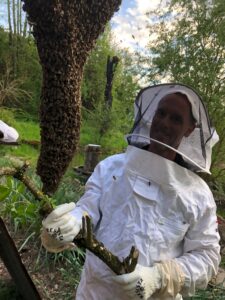
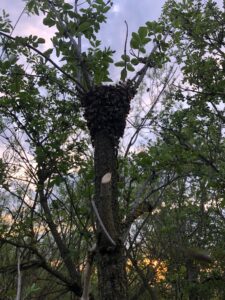
Seeing the first swarms leave after winter is a special experience. Even after many years, I still look forward to it and get as excited as a little child. Even more special is when swarms move into an empty hive. A huge cloud, buzzing and humming, disappears almost entirely through a small entrance in just a few minutes. In no time, the bees are cleaning, repairing and restoring the comb, and starting to brood again. And life goes on. The bees have chosen my location and the hive I have made available to them. Often, incidentally, not in the way my concept would predict.😉 Last year, for example, they ignored an empty hive standing in a tree and the colony moved into a Warré hive close to the ground, between two colonies that were already active. So much for bee density, and so much for bees living at height. There seem to be other criteria that I am not aware of.
In good years, I catch up to 10 swarms, which choose my two apiary locations and the hives and natural habitats I offer there. A few years ago, my “most productive” day saw four swarms. A tradesperson who was working on my driveway thanked me and went home, saying they would come back the next day, as they could not work under the circumstances.😊
I still like an idea I once learned from Bernhard Heuvel, an experienced German beekeeper: in spring, the bees outbreed the Varroa mites! Yes, that is exactly how I experience it: in spring, the colony comes alive and teems with energy; neither parasites nor bacteria nor viruses can pose a serious threat to it. In this respect, I hardly worry, and caring for my naturally managed bees involves very little effort. The effort involved with bees kept in a truly natural way is virtually zero anyway; I want to let nature take its course as much as possible.
Things are different with conventional hives. Swiss hives are opened regularly, and the honey super is built up step by step. With Dadant hives, you have to make sure the honey super does not overflow and add a second one if necessary. As I said, I am a poor conventional beekeeper. I do not have the time or the inclination to open the hives every few days and make sure the right number of empty honey supers are available. Instead, I rely on nature’s intelligence in my tree cavities: the bees should manage things themselves, as they can do this far better than I ever could.
Over the years, I have conducted many experiments with natural beekeeping. It seems to me that the best time for any honey harvest is immediately after the bees swarm. Harvesting twice, as is common in conventional beekeeping, is simply not possible.
As we know, the food supply for naturally managed bee colonies—those kept in a fixed-volume hive without adding a honey super—is generally precarious. Bee colonies often do not survive the following winter without support. The only time when significant quantities of honey are present in such a hive (for example, a Warré hive) is around the time of swarming, right in the middle of this wonderful month, during the main nectar flow. I do not want to interfere with the excitement before swarming or while the colony is raising new queens. Even if I were to open the hive, harvesting the honey would be unpleasant and difficult because it is almost overflowing with bees.
So I prefer to wait until the swarm has left. The colony has lost half its bees. It is calm, and the tension that had built up has subsided. There are substantial honey reserves in the colony (around 10 kg in a Warré hive without a honey super). This is higher-quality spring honey, particularly rich in nutrients. If I left the honey with the parent colony, the reserves would be consumed within about three weeks. As I have mentioned repeatedly, bee colonies nowadays usually swarm during what is known as the forage gap, and nature no longer supports the energy-intensive division of the colony. The colony therefore has to eat its spring reserves and still develops poorly unless nectar comes in from outside and stimulates brood rearing. I take advantage of precisely this moment: I harvest the spring honey and feed sugar during the forage gap.
A forage gap does not mean that no nectar is flowing at all. Fortunately, the bees leave the sugar syrup untouched when there is more valuable nectar available nearby. So the bees mix my sugar syrup with whatever nectar is available despite the forage gap. It is a compromise I am willing to make.
As described and illustrated last month, I press my honey. This is also part of my month of May, even if I will not go into further detail here.
Next month, things will get a little more interesting from a technical perspective, as I would like to discuss alternative methods for dealing with the Varroa mite.
Enjoy putting these ideas into practice. I look forward to sharing more insights into my work in June.
Subscribe to our newsletter here so you don’t miss any new blog posts.
January–February: Looking back and planning the new beekeeping season
March: Preparing for the new beekeeping season and ensuring an adequate food supply
July: Never treat bees without first measuring the level of infestation
August: How do location and conditions affect the health of bee colonies in midsummer?
In our conference series “Bees Without Borders”, renowned bee scientist and breeder Dr. Ralph Büchler showed on 28 Oc...
Martin Ott is convinced: We know enough to solve ecological crises. What is missing is a relationship with this knowl...
Important information
Important information: The original texts are published in German. The French, Italian and English versions are translated automatically and checked where possible. Please report any errors to bee@freethebees.ch.