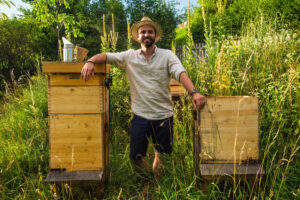
By André Wermelinger, Managing Director of FreeTheBees

It’s midsummer: we enjoy sunny days and like to cool off with a refreshing swim in the lake or at the public swimming pool. I also enjoy taking a dip in the fountain in front of my house, where I fit quite comfortably, like in a long bathtub.😊
In light of the current summer heat, I’d like to share some observations about my perceptions of beehive locations.
If you ask three beekeepers about the optimal placement of bee habitats, you’ll get at least five different answers. I can’t even say what has already been studied scientifically—a thought that just occurred to me as I was writing this, and which I’ll look into when I get the chance. I suspect, however, that there aren’t too many studies on the subject. Anyone who’d like to do the research on behalf of all of us and write a report about it is very welcome to do so! Especially if they can disprove the ideas I’ve put forward here.
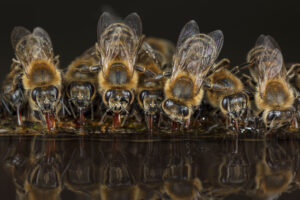
Just as we cool off in the water in midsummer, bees cool their hive through the evaporation of water (in accordance with the laws of thermodynamics). They carry water into the hive and allow it to evaporate by carefully regulating airflow, which cools the air inside. This is probably a crucial factor for survival, since a hive can become so warm in midsummer that the combs soften, melt, crack and fall down—which often means the death of the colony.
Cooling the hive requires a great deal of energy. That’s energy the colony lacks for other tasks, such as searching for and collecting food and other resources, many of which also serve as remedies. The same applies to cleaning, including grooming—the removal of parasites such as the Varroa mite from one another. In other words, something we actually want to prevent.
As someone who likes to follow principles, I’d like to highlight three that seem particularly important to me in the context of beekeeping:
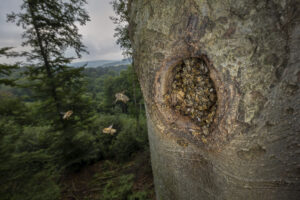
Let’s start by looking at nature: in our latitudes, bees have lived predominantly in tree cavities in the wild, and they still do today wherever they can find them. A tree cavity is very well insulated and can store a great deal of energy, absorbing and releasing it over time. The insulation protects against both cold and heat, while the wood’s capacity to store energy helps to even out fluctuations over time, such as changes between day and night, to a certain extent.
The tree provides other favourable conditions, too. In summer, the tree canopy usually protects bees in a tree cavity very well from direct sunlight and therefore from excessive heat. In forests, the surrounding trees often reduce wind flow, which helps the energy balance, particularly in winter and during the transitional seasons. In winter, when the trees have no leaves, the sun occasionally warms the tree cavity a little. But even in winter, thanks to its good insulation and ability to store energy, the cavity does not warm up quickly: while my bees in conventional hives already fly out on fine winter days, those in the tree cavity often remain still, benefiting from the warmth stored in the cavity through lower energy requirements overnight.
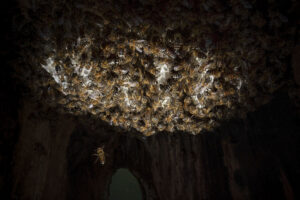
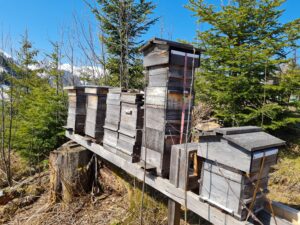
Since I generally don’t like to believe claims without doing my own research, I experiment with different hives, habitats and locations. Sometimes I even deliberately expose my bees to full sun in poorly insulated hives to test different conditions.
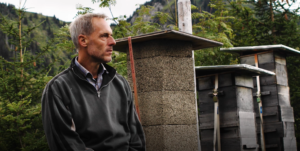
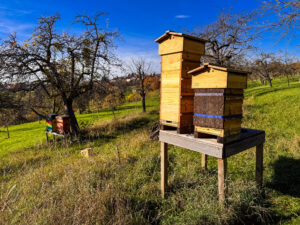
Now, on to the conclusions I’ve reached over the years. As mentioned, these are subjective impressions that I can’t substantiate with evidence, or can only do so in part. It seems to me that good insulation and the ability to store heat are important for bees. I try to protect my bees in particular from the cold Bise wind, which uses up a great deal of energy. I also like to protect the bees from the blazing summer sun. In winter, I’m happy for the sun to shine directly on the hive. When the hive is well protected from the sun, I tend to orient the entrance towards the south. When it is exposed to the blazing sun, I tend to orient the entrance towards the east, towards the morning sun. I try to avoid orienting it west because of the rain. A north-facing orientation doesn’t seem practical to me because of the Bise.
Incidentally, even in the midsummer heat, the bees are already preparing for winter. By August, they hardly find any surplus nectar and are barely able to store more honey than they need to maintain their own metabolism. The first winter bees are already being raised. The drone culling is usually behind us, and the colony keeps only a few drones for emergencies.
Otherwise, August is a fairly good month for me, with little work to do. The same goes for the bees and the garden. I also like to go swimming and fishing at the lake; usually, I haven’t had time for that before.
Have fun putting this into practice. I look forward to sharing more insights into my work in September.
Subscribe to our newsletter here so you don’t miss any new blog posts.
January–February: Looking back and planning for the new beekeeping season
March: Preparing for the new beekeeping season and ensuring an adequate food supply
July: No treatment of bees without first measuring infestation levels
August: How do location and conditions affect the health of honeybee colonies in midsummer?
Text and photos by Ante Hamersmit Ante Hamersmit has a special way of keeping bees. A log hive resembles a tree trunk...
Text and photos by Ante HamersmitAnte Hamersmit has a special way of ...
Text and photos by Ante HamersmitAnte Hamersmit has a distinctive way...
Important information
Important information: The original texts are published in German. The French, Italian and English versions are translated automatically and checked where possible. Please report any errors to bee@freethebees.ch.