Knowledge about bee health clearly shows that bees must be kept in a habitat that is as appropriate to their needs as possible; they need abundant food sources in the form of nectar and pollen; they must be kept away from environmental toxins; and interventions to increase yields and treat parasites and diseases sometimes have extremely serious side effects.
The fascinating workings of the immune system and defence strategies are demonstrated, for example, by Evans Jay D. and Spivak M. (2010) in “Socialized medicine: Individual and communal disease barriers in honey bees.” Journal of Invertebrate Pathology, Volume 103, Supplement, January 2010, Pages S62-S72. Each individual is protected by its own immune system (a). Through grooming, for example (similar to the delousing behaviour of monkeys), honey bees can remove parasites such as the notorious Varroa mite from one another in pairs (b). By differentiating tasks (young bees care for the highly sensitive young brood; older bees are exposed to toxins and pathogens in the wild, but do not go near the brood), they keep the highly sensitive brood free of pathogens (c). Old and sick bees leave the hive of their own accord and die outside, protecting the colony from pathogens (d). With highly active, antiviral, antibacterial and antifungal propolis, the colony creates a protective shield around itself in the tree cavity (e).
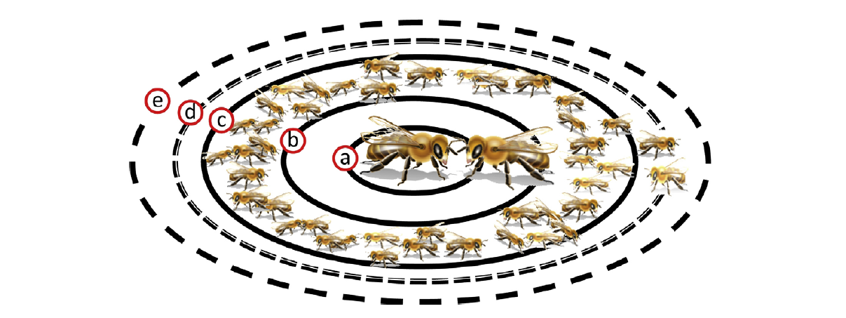
Defence levels in honey bee colonies: (a) individual defence, (b) pairwise defence, including grooming, (c) colony defence, such as task differentiation, (d) minimising the entry of infectious agents, and (e) using resins and other environmental substances to shield the colony.
The ability of honey bees to treat themselves is equally admirable. Ehrler S and Moritz RFA (2016) provide a scientific foundation in “Pharmacophagy and pharmacophory: mechanisms of self-medication and disease prevention in the honeybee colony (Apis mellifera).” Apidologie 47:389–411. DOI: 10.1007/s13592-015-0400-z.
Bees collect pharmacological substances from nature through nectar, pollen and propolis. They are able to store and further process them in the hive. Enriched with substances from their own glands, these substances are then fed to their brood, helping to keep it healthy.
The collected, processed and enriched substances have been studied extensively. The results clearly show that these substances are highly active, have antibiotic effects, and inhibit viruses, bacteria and fungi.
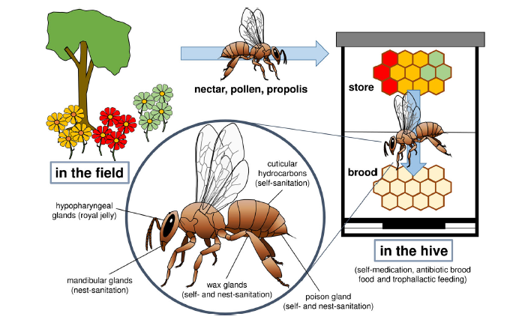
A repertoire of food and self-produced substances used by honey bees not only for personal and nest hygiene, but also to feed antibiotics to the brood and other nestmates. In the field: Secondary plant metabolites with antibiotic potential are inevitably fed along with pollen and nectar. Propolis, with highly antiviral and antibiotic compounds, is collected by specialised foragers to keep nesting cavities clean. In the hive: Stored honey and bee bread can be selectively used to feed sick and healthy larvae and other nest members. On the bee: Glandular secretions with antibiotic activity can be used to support the health of individuals and bee colonies.
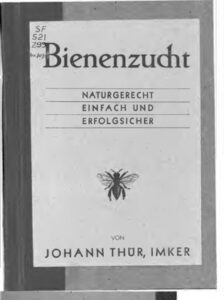 Highly relevant information does not always have to come from modern sources. As early as 1946, Johann Thür recognised and described many of the challenges facing beekeeping today. He emphasised the importance of natural comb and fixed comb construction, as well as the insulation of bee housing, both of which affect the health of bee colonies. His concept of the nest scent-and-heat bond is of great importance, although it has hardly been scientifically analysed to this day. The germ-free hive air around the sensitive brood is fascinating.
On 9 October, a class from Collège du Sud came on a school trip to our site in Vaulruz, right among the bees. The stu...
In our conference series “Bees Without Borders”, renowned bee scientist and breeder Dr. Ralph Büchler showed on 28 Oc...
“I observe how nature works” For over 15 years, Heinz Weder has been observing free-living honey bee colonies. He has...
Important information
Important information: The original texts are published in German. The French, Italian and English versions are translated automatically and checked where possible. Please report any errors to bee@freethebees.ch.