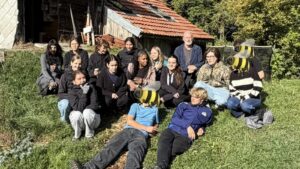
The Western honey bee (Apis mellifera) is mostly perceived as a livestock animal kept for beekeeping. Originally, however, it was a wild animal of European forests. For millions of years, honey bee colonies lived freely in tree cavities, rocks or niches in buildings and were part of natural ecosystems.
Even today, wild honey bee colonies still exist and survive without beekeeping care. In Switzerland, such colonies are legally considered native wild animals. But their situation is critical. Their protection status is unclear. Wild honey bee colonies are still actively destroyed instead of being protected and supported. While millions of honey bee colonies are kept in beekeeping, wild populations in Central Europe have almost disappeared.
In the past, honey bees existed as stable forest populations. Swarms established new colonies, some of which survived and went on to produce swarms of their own. This created a dynamic network of colonies across the landscape.
Today, researchers in Switzerland and Germany usually find only isolated individual colonies. These rarely form interconnected populations. Many disappear again after just a few years.
A study on the survival rate of wild honey bees shows dramatic differences between regions. The survival rates of free-living colonies in Switzerland and parts of Germany are significantly lower than in other European regions.
(Insert graphic here)
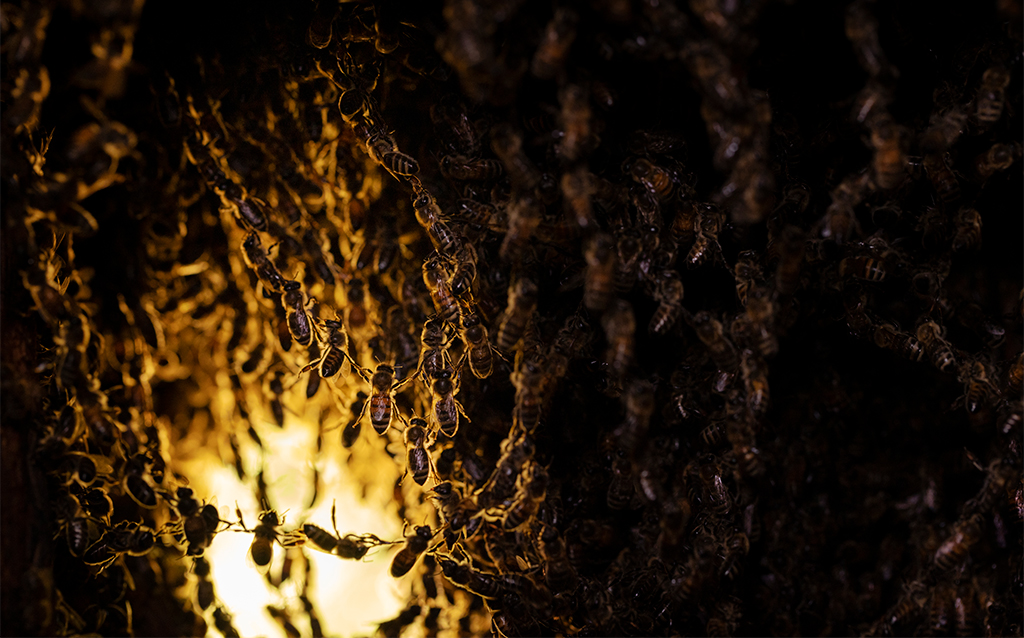
Wild-living honey bees in a tree cavity. Photo: Ingo Arndt
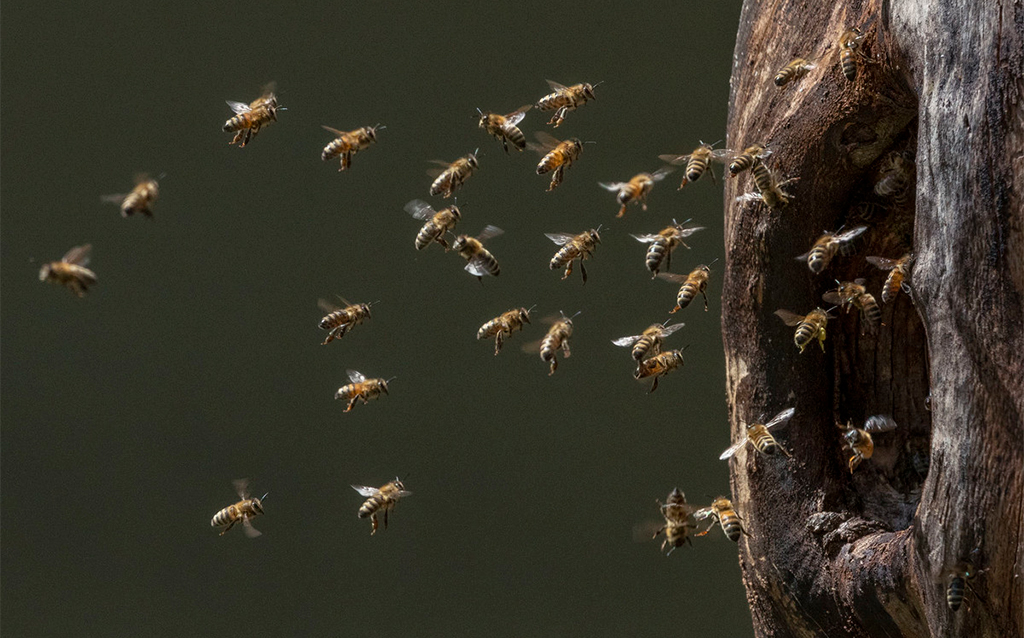
Honey bees approaching the entrance to their tree cavity. Photo: Ingo Arndt
The situation of the wild honey bee has now attracted international attention. Since the end of 2025, the wild form of the Western honey bee (Apis mellifera) has been listed as “Endangered” on the IUCN Red List in the European Union, as its natural populations have declined sharply.
Important: this refers to wild populations, not honey bee colonies managed by beekeepers.
In Switzerland, this classification has not yet been officially adopted. A national decision is still pending. However, the scientific assessment is clear: wild honey bees are among Europe’s threatened wild animal populations.
One particularly interesting observation is currently occupying us: why do wild honey bees survive significantly better in some regions of Europe than in Germany or Switzerland?
Viable wild populations have been found in several countries—for example, in parts of France, Eastern Europe and the USA. In Switzerland and Germany, by contrast, studies show significantly lower survival rates.
One possible explanation has been suggested, but is only beginning to be discussed: could the rigorous and intensive beekeeping inspections and treatments in Germany and Switzerland have serious side effects and significantly weaken natural defences, including the ability to adapt?
In intensively managed honey bee populations, the following are almost always the case:
As a result, an important mechanism is lost in the medium to long term: the honey bee’s natural adaptation to its environment.
This hypothesis has not yet been conclusively resolved scientifically—but it shows how complex the interplay between beekeeping, ecology and evolution is.
Wild honey bee colonies fulfil several vital functions:
Natural adaptability: Only in nature, without beekeeping interventions, can honey bees adapt to their environment and to ongoing environmental changes. Natural selection leads to natural evolution.
Genetic reservoir: Natural adaptability leads to genetic traits that benefit the entire bee population in the medium and long term.
Bioindicator of environmental quality: Wild honey bee colonies can be monitored very effectively for scientific purposes. They provide exceptionally valuable insights into the integrity of local ecosystems. Where a honey bee colony cannot survive, measures to improve the local natural environment are necessary.
Targeted measures are needed to preserve this original way of life for the honey bee:
Protection and support for wild honey bee colonies: Wild honey bee colonies must not be removed or destroyed.
More natural habitats: Old trees and large tree cavities are essential to their survival. During the transition period, artificial tree cavities must be created.
Improving floral diversity: A diverse landscape provides food throughout the bee season. A constant supply, especially of nectar but also of pollen, is essential for honey bees and many other insect species.
Research and monitoring: Fundamental data on the numbers, distribution and health of wild honey bees are still lacking. FreeTheBees has done unique groundwork in this area, which is continually being expanded.
FreeTheBees is working to ensure that wild honey bees have a future again.
Our projects include:
Our goal and vision is a landscape in which honey bees can once again survive independently in nature. Only there can their evolution, which began more than 30 million years ago, continue to unfold.
Yes. The Western honey bee (Apis mellifera) is a wild animal and has inhabited the forests of Europe as a distinct species for millions of years. In Switzerland, the Federal Office for the Environment (FOEN) officially recognised it again as a native wild animal species in 2020. Colonies kept in beehives are genetically the same species, but are under human care. FreeTheBees is committed to ensuring that the honey bee is kept more responsibly as livestock and, as a wild animal, is protected and supported.
Yes. The FreeTheBees Project Protection & Research has documented more than 400 sites of wild honey bee colonies in Switzerland so far (as of the end of 2025). This is the most comprehensive systematic dataset on wild honey bees in Europe. The findings contributed in 2025 to the reassessment of the honey bee as an “Endangered” species on the Red List of the EU-27. Anyone interested can report their own observations as Citizen Scientists.
Wild honey bees do not differ in appearance from bees kept by beekeepers, but they live without human care in natural cavities such as tree hollows, rock crevices or niches in walls and roofs. Typical signs include regular flight activity at a tree hole, traces of propolis at the entrance and recurring swarms in spring. If you discover a honey bee colony, you can report it to FreeTheBees and contribute to the largest European database of wild honey bees. Report a honey bee colony
Natural selection enables honey bee colonies to adapt to environmental changes, diseases and parasites such as the Varroa mite. Beekeeping interventions such as sugar feeding, artificial propagation or large-scale medication interrupt this evolutionary process. In wild populations, by contrast, greater resilience to disease demonstrably develops because resistant colonies survive and pass on their genes.
Wild honey bees in Switzerland die mainly because of monotonous landscapes, a lack of nesting sites, various environmental toxins and intensive beekeeping practices. For wild bees, the loss of species-rich meadows and specialised nesting resources is decisive: 90% of species-rich meadows have disappeared in Switzerland (Pro Natura). For wild-living honey bees, tree cavities are particularly scarce. The genetic pressure from breeding bees kept by beekeepers adds to the burden. FreeTheBees works on all three fronts at once: habitat, genetic diversity, training and awareness-raising.
On 9 October, a class from Collège du Sud came on a school trip to our site in Vaulruz, right among the bees. The stu...
In our conference series “Bees Without Borders”, renowned bee scientist and breeder Dr. Ralph Büchler showed on 28 Oc...
“I observe how nature works” For over 15 years, Heinz Weder has been observing free-living honey bee colonies. He has...
Important information
Important information: The original texts are published in German. The French, Italian and English versions are translated automatically and checked where possible. Please report any errors to bee@freethebees.ch.