In our conference series “Bees Without Borders”, renowned bee scientist and breeder Dr. Ralph Büchler showed on 28 October 2026 how honey bee colonies develop resistance to Varroa. Büchler headed the Kirchhain Bee Institute for 25 years and has been researching selection for Varroa resistance for decades. His thesis: beekeeping can do without medication if it once again allows natural selection to take place. He himself has not treated his colonies for ten years.
“I’ve never enjoyed beekeeping as much as I do today, now that I haven’t had to use medication on my colonies for 10 years.”
In Central Europe, Varroa treatment has followed the same routine for decades: formic acid in summer, oxalic acid in winter. Treatment reduces mite infestation, but according to Büchler it has two side effects. The highly concentrated acids impair the development and microbiome of the honey bee colony. And they keep colonies with weak defences alive, allowing them to pass on their susceptible genetics through their drones.
“Every new beekeeper learns how to use formic acid and oxalic acid today. But too few learn that simple biological and biotechnical measures can be used instead of poisons.”
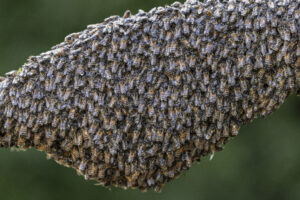
In nature, colonies take a brood break when they swarm in summer. During this time, the Varroa mite cannot reproduce. By deliberately replicating this brood break, it is possible to dispense with most treatments.
A European study conducted between 2009 and 2012 shows how important adaptation to the local environment is. At 21 test stations in 11 countries, 621 colonies were kept for three years without any disease treatment. By the end, 33 per cent of the native colonies were still alive, compared with only 17 per cent of colonies of foreign origin.
An example from Finland illustrates the difference. Greek honey bees (Apis mellifera macedonica) built up strong colonies there in autumn. But they did not stop brooding during the Nordic winter. They consumed an average of 18 kilograms of feed, compared with 13 kilograms for the native bees. By spring, they were depleted and produced very little honey.
Today, 31 subspecies of honey bee are recognised worldwide. Many of them, such as the Dark European honey bee, are threatened by imports and uncontrolled crossbreeding.
The honey bee’s ability to adapt is rooted in its mating biology. There are around 20,000 drones for every queen, but she mates with only 15 to 25 of them. At drone congregation areas, which can be 5 to 7 kilometres from the apiary, between 15,000 and 30,000 drones gather.
Drones carry only a single set of chromosomes from their mother. Genetic weaknesses therefore show up directly in them. Drones infested with Varroa fly less well, lose their sense of direction or have significantly fewer sperm. They are unlikely to mate. In this way, nature rigorously selects for vitality through the male line. Anyone who routinely treats every colony disables this filter.
Resistant colonies display three behaviours that can be deliberately encouraged:
With the “Varroa Resistance 2033” initiative, beekeeping associations aim to make it possible to keep bees across the board without medication within ten years. Büchler sees two pillars to this approach:
Only when many beekeepers work this way will resistant bees become widespread.
Instead of treating with acids every year, Büchler recommends a planned interruption of brood rearing in summer, at the end of June or in July. This replaces the brood break that colonies used to have when they swarmed. Three methods have proved effective:
The bees that develop after the brood break become long-lived winter bees. In a brood-free colony, mite infestation can be measured accurately in July, for example using a washed bee sample. In late summer and autumn, the threshold is no more than five mites per day on the bottom board insert. If the infestation is below this level, Büchler says winter treatment is not necessary.
According to Büchler, the problem is neither a lack of knowledge nor a lack of methods:
“It is by no means a question of biological possibilities or knowledge of suitable methods; all of these are already on the table. It is a question of willingness, sociology and psychology.”
Wild honey bee colonies still undergo this natural selection: they swarm, thereby taking a brood break, and are not treated.
You can watch the full talk, including the Q&A, on our YouTube channel.
It is part of our monthly conference series “Bees Without Borders”. You can find all previous recordings in our YouTube playlist.
Next conference: On 18 November, Günther W. Amann-Jennson will talk about bee sleep. Register now for free.
As of 15 September 2026 On 20 May 2026, the Swiss federal popular initiative “For the Safeguarding of Pollination of...
Martin Ott is convinced: We know enough to solve ecological crises. What is missing is a relationship with this knowl...
Important information
Important information: The original texts are published in German. The French, Italian and English versions are translated automatically and checked where possible. Please report any errors to bee@freethebees.ch.