By Ante Hamersmit
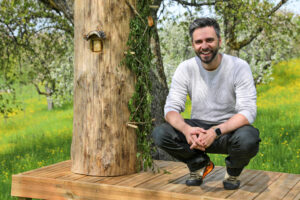
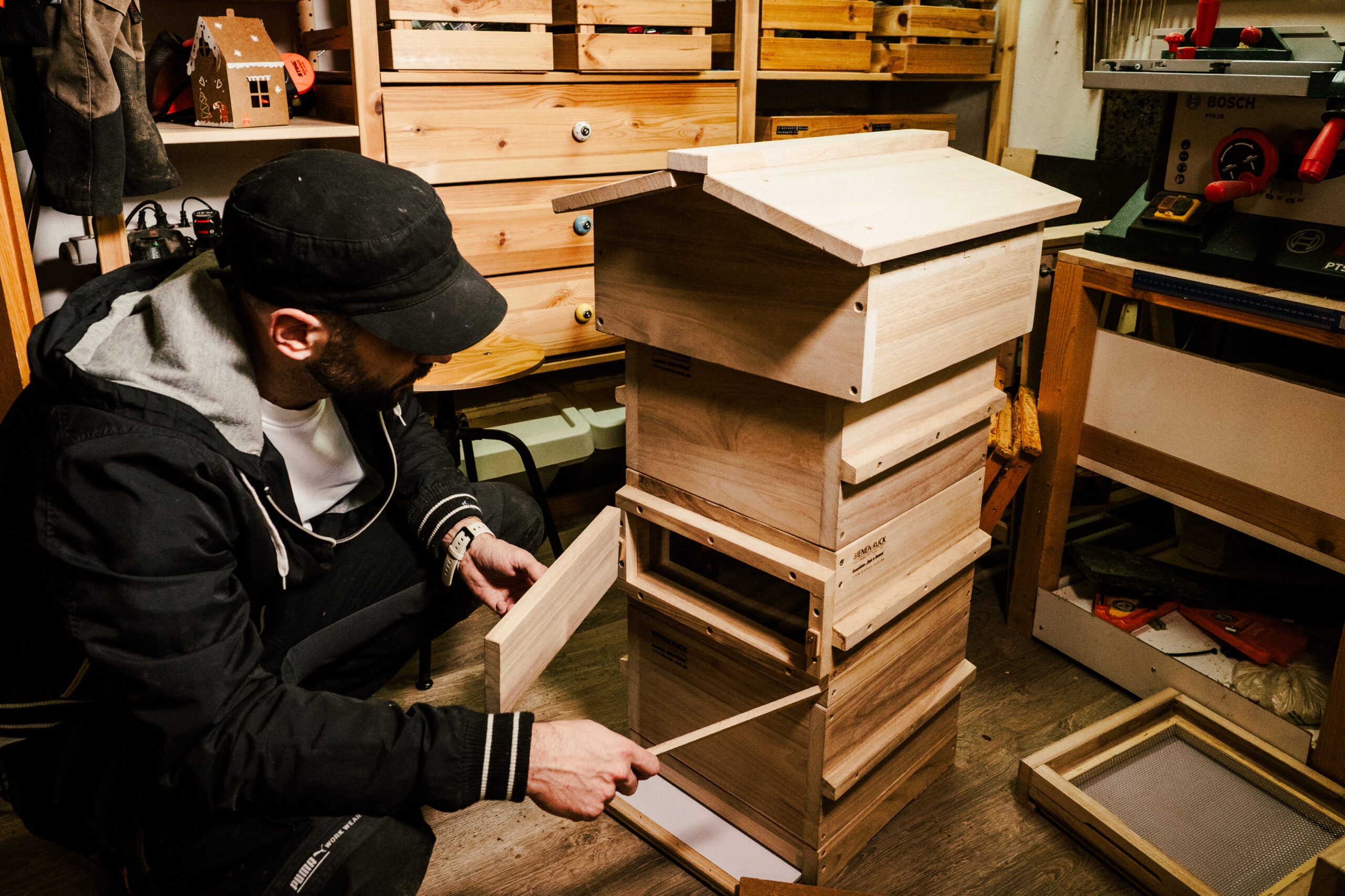
In my last post I announced that this season I wanted to Warré hives and gain experience with them. A beekeeping friend said in response that he was glad that I had now after all joined the magazine hive club. Well, yes and no. Warré hives clearly belong to the family of magazine hive systems. But even so, I would not describe myself as a conventional magazine hive beekeeper – at least not according to my understanding so far of a conventional beekeeper.
When I tell people that I keep bees, the first question is usually: “How much honey do you produce?” Well, quite apart from the fact that I don’t produce any honey at all, I don’t take from my ladies the quantities of honey that would make me a “good” beekeeper in the eyes of the people asking. That probably won’t change with magazine hives either. Today, I take only marginal amounts during the major nectar flows at the beginning of the beekeeping year. The bees can store late-season sources such as lime and forest honey for themselves for the winter. This quantitatively small honey harvest probably makes me the worst beekeeper in the world – or does it? After all, beekeeping has moved on! Am I still on the right track? Or should I harvest more too?
I wanted to look into this question objectively and came across bee-related statistics from the FAO1. It quickly became clear to me that the current peak in the number of colonies in the DACH region is not necessarily an all-time historical high. All three countries have had more or fewer bee colonies at different times.
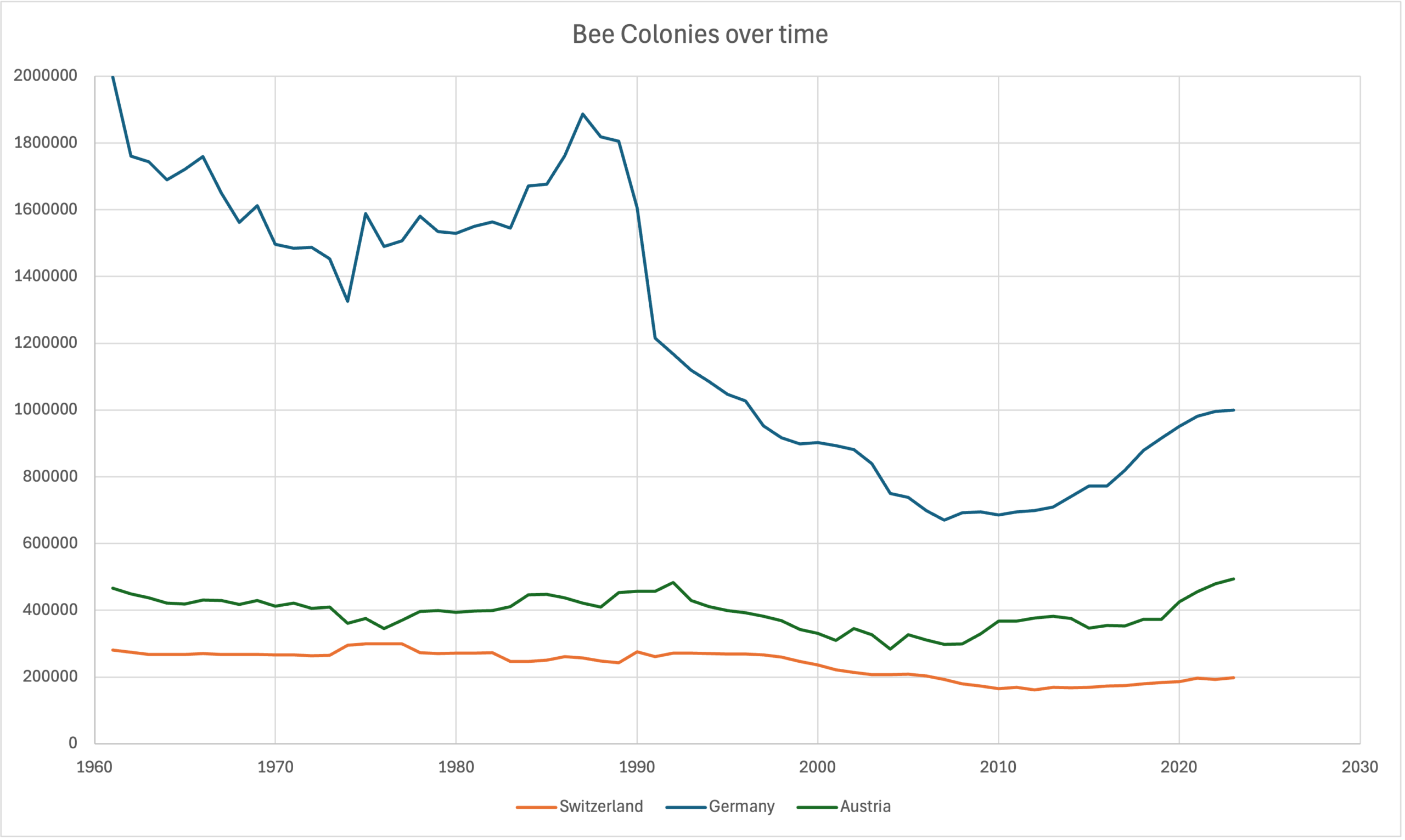
So I could in good conscience keep even more colonies, couldn’t I?! After all, there were almost 2 million bee colonies in Germany back in the 1960s.
I took a closer look at the qualitative trend, and the sharp decline in Germany at the beginning of the 1990s made me curious. As I discovered, the cause was not the Varroa mite, introduced in 1977, but politics. According to a study by the University of Halle2, subsidies for bee products in the GDR were discontinued around the time of reunification, and beekeeping was no longer as lucrative.
An interesting side story, but it didn’t really help me get any further with my question. However, if you consider the area of each country alongside its bee population, a more meaningful picture emerges.
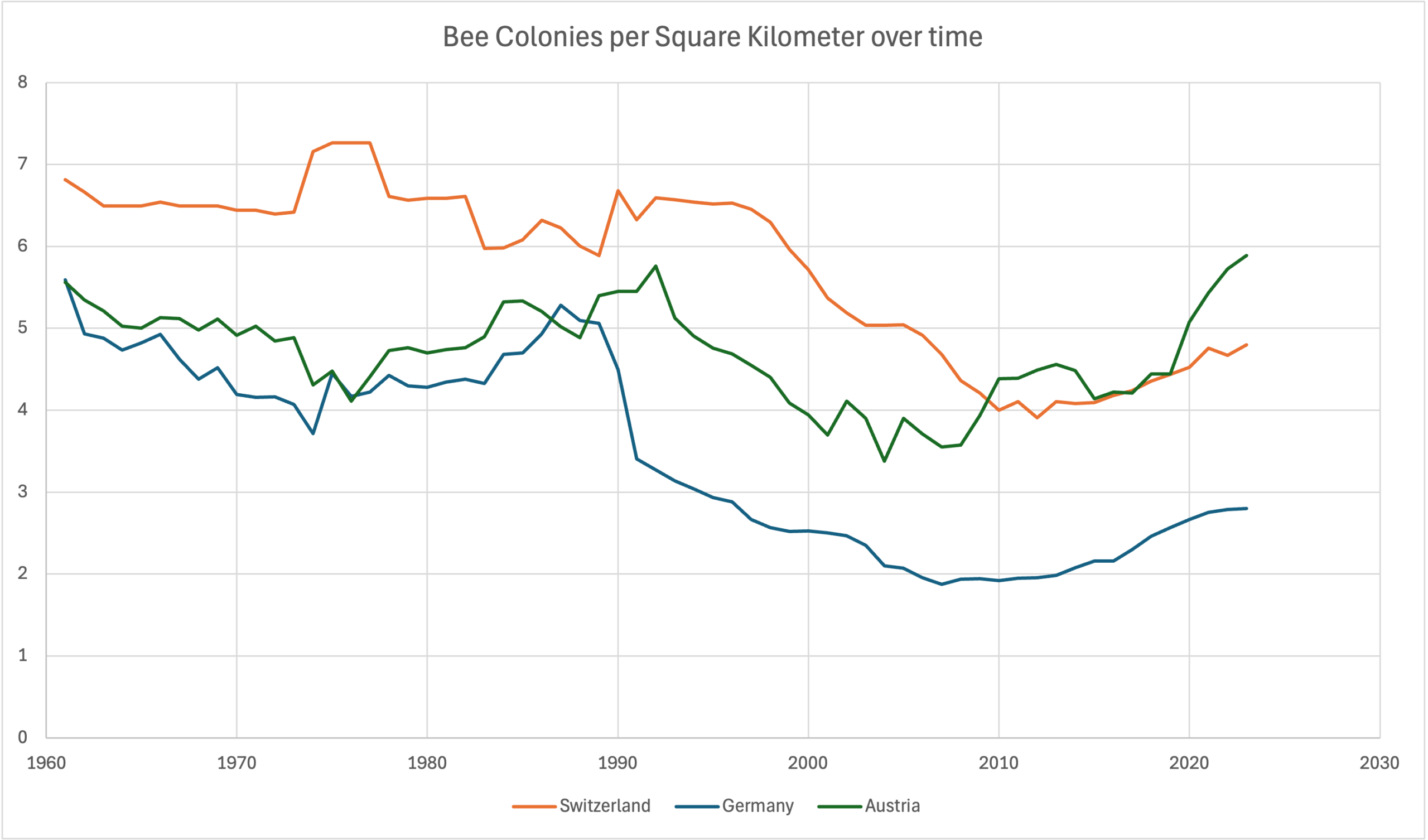
If Thomas Seeley’s estimate that only about 1 bee colony would establish itself per square kilometre in the wild is taken as a basis, there are too many bees in all three DACH countries. In Switzerland and Austria, this figure would be almost 5 and 6 times higher, respectively, than the value calculated by Thomas Seeley.
All right, now I know that these statistics could point to an overpopulation, but I still haven’t answered my question about honey. How much honey do we produce on average today? Calculating averages by decade gives the following picture:
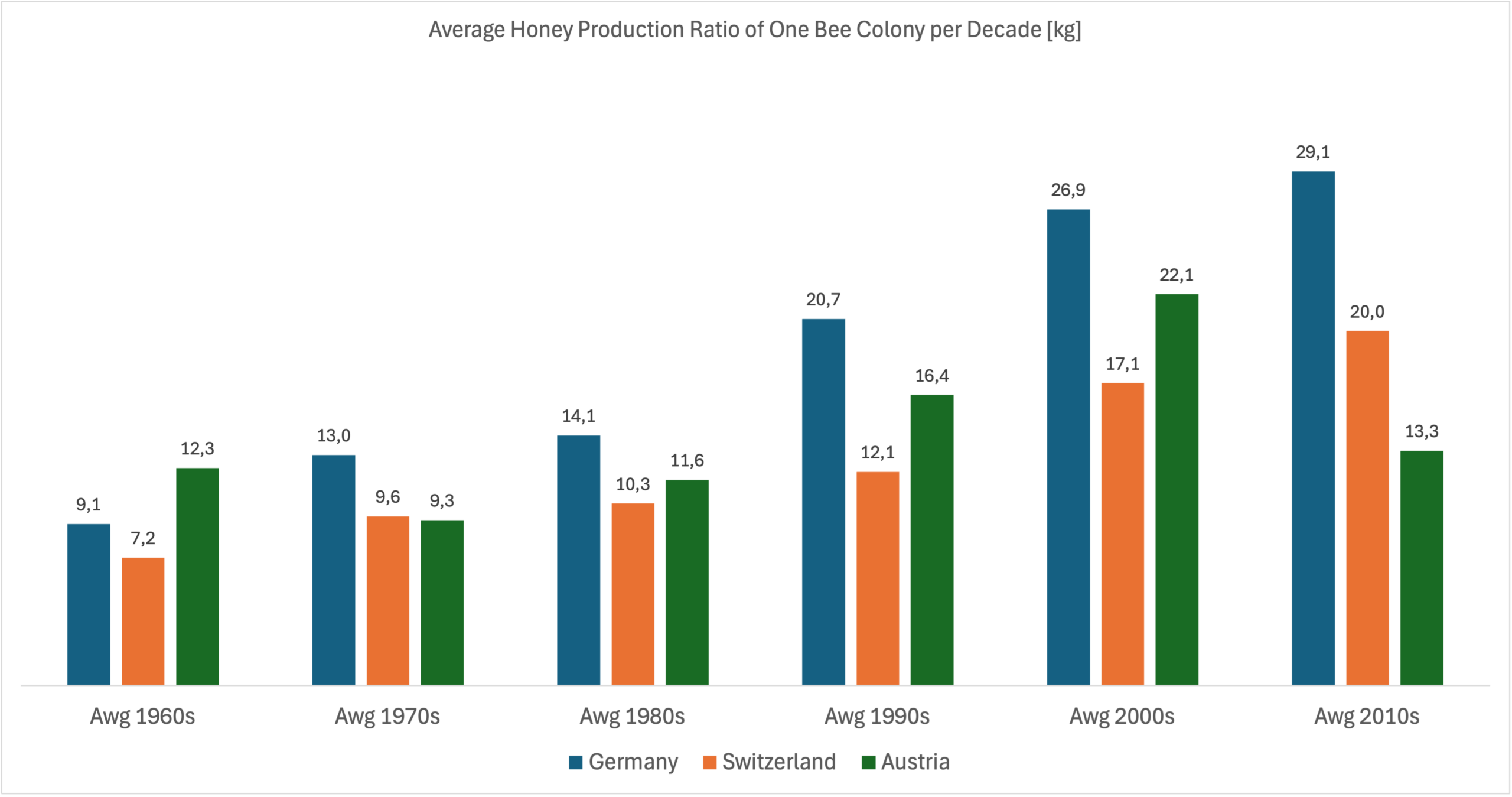
Broadly speaking, honey production per bee colony has steadily increased.
Today, we harvest around three times more honey per bee colony in Germany and Switzerland than we did 60 years ago.
The picture is somewhat different in Austria. Comparing only the 1960s with the 2010s, honey yield per bee colony is comparable. However, the increase between the 1970s and the 2000s still points to efforts to improve yields. I have not yet been able to determine the reason for the trend in Austria, and it will certainly require further research.
As I discovered, nature has also changed since 1960. Urban areas in Germany have grown significantly, while agricultural areas have decreased. The crops grown have also changed. For example, fewer nectar-producing crops are grown in Germany today – such as maize and grain.
For me, this leads to the following comparison with 1960 in Germany:
There is less forage available today. And although there are fewer colonies, honey bees harvest more blossoms today.
The full YouTube video: https://youtu.be/IXmjzE7FCnw?si=BF0NZCeLeV5hYfBF
The results strengthen my resolve to take only a little honey as medicine for myself and my family. Despite the possibilities offered by a magazine hive, I want to use it extensively as a way to explore biotechnical Varroa treatment. I personally will not sell any honey.
Dear reader, I have tried to present the figures as objectively as possible. If you can see my own assessment shining through, that was not my intention. Everyone should be able to form their own opinion based on the facts. I am happy to share my personal conclusion with you, but that does not mean it has to be the right approach for all of us.
Best wishes,
Ante
¹FAO – Food and Agriculture Organization of the United Nations https://www.fao.org/
² https://pressemitteilungen.pr.uni-halle.de/index.php?modus=pmanzeige&pm_id=2510
YouTube: https://www.youtube.com/@AntesGoldenGirls
Instagram: https://www.instagram.com/antes.golden.girls/
TikTok: https://www.tiktok.com/@antes.golden.girls
Website: https://antes-golden-girls.com
Subscribe to our newsletter here so you don’t miss a new blog post.
Beekeeping Calendar 2025 – January: The End and the Beginning
January – February: Looking Back and Planning for the New Beekeeping Season
March: Preparing for the New Beekeeping Season and Ensuring Adequate Food Supplies
July: Never Treat Bees Without First Measuring the Infestation
August: How Do Location and Conditions Affect the Health of Bee Colonies in Midsummer?
Text and photos by Ante Hamersmit Ante Hamersmit has a special way of keeping bees. A log hive resembles a tree trunk...
Text and photos by Ante HamersmitAnte Hamersmit has a special way of ...
Text and photos by Ante HamersmitAnte Hamersmit has a distinctive way...
Important information
Important information: The original texts are published in German. The French, Italian and English versions are translated automatically and checked where possible. Please report any errors to bee@freethebees.ch.