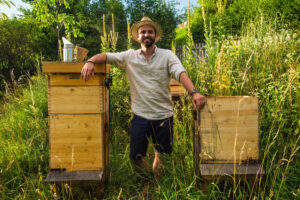
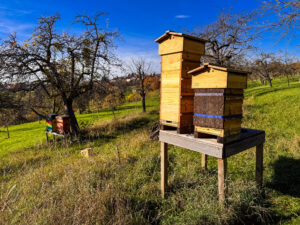
By André Wermelinger, Managing Director of FreeTheBees

I had only just started my beekeeping calendar, and autumn is already here again! I had a lot planned for 2024, and I have managed to put much of it into practice. But, as every year, the list is getting longer and the time remaining until the end of the year is getting shorter. I am practising focusing and setting priorities.
Late summer and early autumn are usually strongly shaped by my garden. As I have mentioned before, my garden is quite wild, but also a good size. Usually, the day comes in autumn when the first frost is forecast. After work, that sends me into the garden with a torch to search beneath the weeds for hidden vegetables. Once in the kitchen, I spend much of the night cooking, preserving and freezing. The effort is worth it: afterwards, I can usually live for months on my own fruit and vegetables from the freezer. My meals are prepared very quickly and could hardly be fresher. From the garden to the freezer and onto the plate.
With the cold nights, alternative treatments for our bees, for example with thymol, must also be completed. Liquid feeding is also hardly possible after around mid-September. The bees have long since switched to winter mode. They need to enter winter healthy, as free of parasites as possible, and with sufficient reserves. Since I have always refrained from any winter treatment, this also marks the end of my beekeeping season.
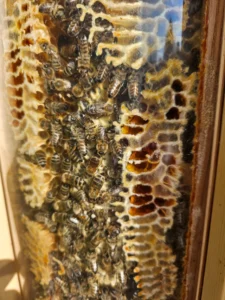
I am often asked how you can tell whether there is enough food in SwissTrees or in Warrés. In the March edition of the beekeeping calendar, I already referred to the relevant course materials, which explain how I can roughly estimate the honey reserves by weight using a hanging scale. However, if we have a window, it can also provide valuable information about the honey stores. For a long time, you cannot see anything at all through the window. Then suddenly the first nectar deposits appear in the cells along the edge. When the first comb cells at the top of the hive, in the upper third, are filled and capped, that is a sign to me that the reserves may gradually be becoming sufficient.
Another topic that comes up regularly and often is how many boxes I use to overwinter the bees in my Warré hives. As documented in various texts of mine and as can be seen in most of the photos, I almost always stack three Warré boxes on top of one another. Emile Warré removes the lowest, third box in autumn and lets the bees overwinter in two boxes. On the one hand, the space below seems to require little energy, so it does not bother me. On the other hand, I have tried several times to remove the bottom box from my bees in autumn and found that the colonies are strong and like to use the bottom box, even when there is no comb in it yet. I would have had to disturb and crowd them considerably.
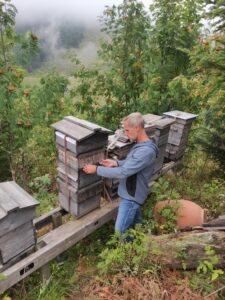
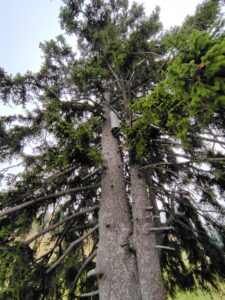
And then autumn arrives, the time when I like to retreat to my alpine hut for a while. The cows and alpine herders have gone back down. On less pleasant days, there are no tourists. I feel almost alone in the Fribourg Pre-Alps and enjoy the tranquillity of nature. Incidentally, since this spring, a wild bee colony has been living for the first time on my alpine pasture in the Gruyère region, in my own tree hive. Two SwissTrees were also spontaneously colonised. There are another four Warré hives at my apiary. I am continually amazed at how habitats and nesting sites are spontaneously colonised in large numbers, with a high success rate, even at an altitude of 1,400 m.
My beekeeping calendar began in January and February with a retrospective of the previous season and planning for the coming year. I would like to return to this once again. It is still too early (in September) to draw any real conclusions about the beekeeping season. In autumn, you can take a step back, observe nature and enjoy it. However, it seems important to me to bring all the results together in good time during winter and remind yourself once again what you originally wanted to achieve and what approach you had planned. Then you can take an honest look at how well you stuck to your plans and what the final results were.
And if a year turns out to be less successful, that is no reason at all to lose faith in what you do or how you do it. Nature works in abundance. Natural selection curbs this abundance. Some years are better and others more difficult, but these, too, are simply part of the selection criteria.
We live in a time when we strive for high, regular and consistent profits. This is a human aspiration that has absolutely nothing to do with the fundamental principles of nature. Decades of maximising yields and minimising losses do not leave our bees unaffected. If we want to restore the natural balance and enable bees to adapt to the natural conditions they face today, we must welcome losses or at least accept them. In my view, bee losses are not setbacks and have only a limited connection with our own beekeeping practices. Bee losses are progress along the timeline of evolution. And, as we already know: “Nothing in biology makes sense except in the light of evolution.”
With this in mind, I wish you a lovely autumn and a peaceful winter that inspires reflection. I hope you have enjoyed reading the beekeeping calendar and that it has given you an insight into my work.
Subscribe to our newsletter here so you don’t miss any new blog posts.
January – February: Retrospective and planning for the new beekeeping season
March: Preparing for the new beekeeping season and ensuring adequate food supplies
July: Never treat bees without first measuring the infestation
August: How do location and conditions affect the health of bee colonies in midsummer?
Text and photos by Ante Hamersmit Ante Hamersmit has a special way of keeping bees. A log hive resembles a tree trunk...
Text and photos by Ante HamersmitAnte Hamersmit has a special way of ...
Text and photos by Ante HamersmitAnte Hamersmit has a distinctive way...
Important information
Important information: The original texts are published in German. The French, Italian and English versions are translated automatically and checked where possible. Please report any errors to bee@freethebees.ch.