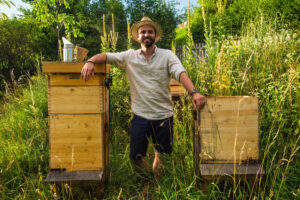
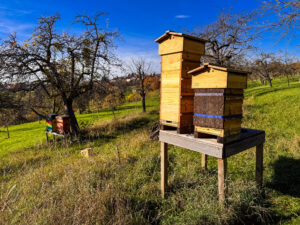
By André Wermelinger, Managing Director of FreeTheBees

We are in the middle of summer. This year (2024), after a rather unusual spring that was very rainy and unsettled. By the time I wrote this article at the end of June, there had still been little sign of summer. The garden has suffered, and gardening has not been much fun. It was also impossible to mow the flowering meadow properly. According to experts, this meadow should be mowed between 5 and 20 June, but there were no three consecutive dry, stable days when it would have felt right to mow.
Our bees are in what is known as the summer dearth, when only scanty forage is available. In addition, all bee colonies that have not been «well» managed by a beekeeper have swarmed and have not yet fully recovered from swarming. And how could they, after having had to get through the energy-intensive period of colony reproduction during the forage gap and switch to emergency mode?
If I harvest any honey at all, I do so right after swarming, as I described in the May article. Since I am a poor conventional beekeeper, practically all my colonies swarm with a fairly high degree of reliability.
Given the swarming and the fact that I do not manage honey supers, a summer harvest is hardly an option. But I don’t mind. If, on average, I have ten colonies and every other year two of them give me good honey in May, that is enough for me and a few friends and family members. And I like spring honey much more than summer honey.
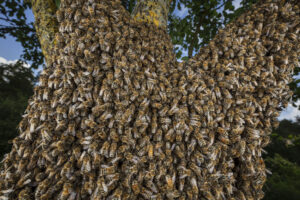
Anyone who reads FreeTheBees’ wide range of articles and concepts or attends its courses and lectures will know that I look forward to regular swarming. Not because I have to run after the bees. Swarming is a powerful natural cleansing function. It reduces not only the viral and bacterial load, but also the parasite load. The swarming impulse is therefore an important and integral part of Varroa control.
Of course, the swarming impulse is no guarantee that bee colonies will make it through the next winter unscathed. At least not here in Switzerland. In other regions, for example Wales, countless beekeepers have long since proved that their bees have adapted to Varroa mites. Some beekeepers never started treating after Varroa mites appeared in the 1980s. Others quickly recognised the strategic dead end and stopped treating. Today, they have reached a point where their statistics and the accompanying scientific studies clearly show that bees can be kept without any treatment at all. What’s more, survival rates among non-treating beekeepers are significantly higher than among those who treat!
But for now, let’s stay in Switzerland, where unfortunately the results are not so easy to achieve. I am, and will probably always be, a strategist who is much more drawn to long-term and therefore sustainable thinking than to supposed short-term success, or worse still, short-term profit maximisation. That is why FreeTheBees has developed various alternatives and compromises for dealing with the Varroa problem, at least temporarily.
In July, the mite infestation level must now be measured in order to determine the right treatment strategy. In my opinion, it is not acceptable to treat a bee colony without first assessing its infestation status. After all, no one would think of administering chemotherapy as a precaution without diagnosing cancer.
How to measure mite infestation is explained in detail in our course materials. The advantages and disadvantages of the different measurement methods are also discussed in detail.
One of my lecturers at the technical college in Winterthur used to say, “If you measure, you measure rubbish.” The same applies when measuring mite infestation. You need to be aware of exactly what you are measuring and what conclusions can be drawn from it.
Measuring natural mite fall, widely practised by conventional beekeepers, is easy to do in practice and can be used by all beekeepers. But with all due respect, it provides only very limited information. Unfortunately (or fortunately…!), mites do not die only of «natural» causes, as proponents of this method assume. They also die because they are attacked by predators and defend themselves against them. These include the mite Scimitus (Stratiolaelaps scimitus), the book scorpion (Chelifer cancroides) and even our western honey bee (Apis mellifera), which can groom mites off other bees. The technical term is grooming, a kind of delousing, as seen in monkeys.
Anyone who wants to measure accurately must either use the CO2 or powdered sugar method to wash mites off nurse bees, or examine every fallen mite under a magnifying glass (7–10x). Ron Hoskins in England took this to the extreme: for years he kept statistics and bred only from colonies in which he found particularly large numbers of damaged mites (that is, mites that had not died on their own). His success with treatment-free beekeeping proves him right.
Those who are unwilling to go to the trouble will still measure mite fall, knowing that under certain circumstances they may unnecessarily treat the best bee colony—the one that could keep the mites in check itself—and thereby cause unwanted side effects and weaken the colony.
First, let us consider a bee colony kept in a natural way (terminology as defined in the well-known FreeTheBees beekeeping methodology). Whether it has swarmed or not is of little significance here, as is whether it is a newly settled swarm or a parent colony.
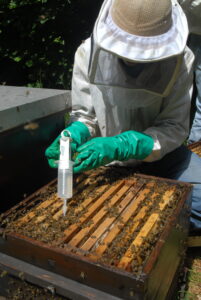
If the mite infestation level is too high in July, it may make sense to treat the bee colony with thymol. Details of how to do this can be found in the FreeTheBees concept for alternative Varroa treatment.
Since thymol cannot work inside brood cells, it needs to act over more than one brood cycle. It is also crucial to maintain a stable thymol concentration in the hive air. From mid-September onwards, nights can become cooler again, which greatly reduces the effectiveness of thymol, so two brood cycles must be covered before the first cold nights. This means that treatment must begin at the end of July if it is to be successful.
I have described in detail in the linked concept how I have been doing this successfully for six years, with below-average loss rates.
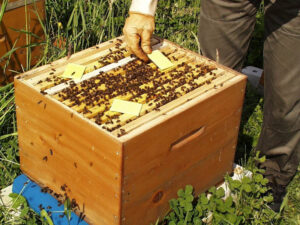
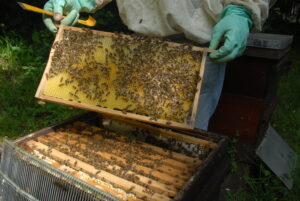
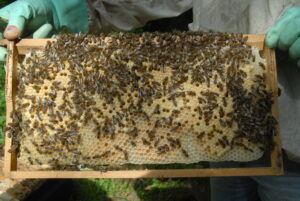
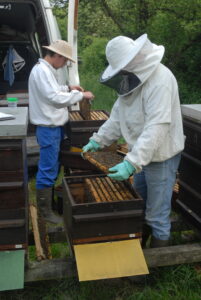
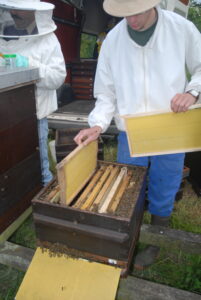
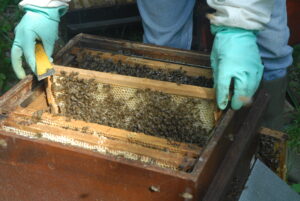
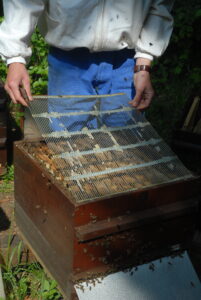
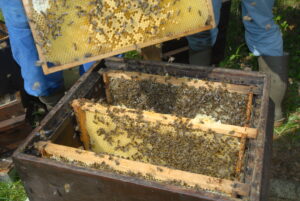
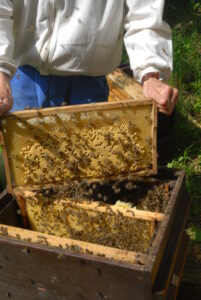
As I have mentioned several times, I consider complete brood removal as developed by Dr Büchler—or, more recently and even better, his trapping-comb method—to be an excellent alternative for Varroa treatment. Thanks to these two methods, it is possible to produce just as much honey as conventional beekeepers, entirely without chemicals.
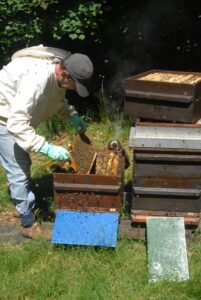
The complete brood removal method is described and illustrated in detail. However, it requires a minimum level of experience with bees, as well as the use of movable frames. The intervention takes a little longer in a Swiss hive than in a Dadant or a Warré hive with frames.
The more modern and optimised trapping-comb method is not yet available on the FreeTheBees website, but can be found on the website of the Landesbetrieb Landwirtschaft Hessen.
Büchler conducted extensive studies. In his region, mid-July proved to be the best time for complete brood removal. It should not be left too late: the bee colonies need to rebuild some comb and replace the removed generation of brood. Büchler shows that they go into winter just as strong in numbers as conventionally treated colonies, but with stronger defences. As with the swarming impulse, complete brood removal and the trapping-comb method also serve as a «natural» cleansing function.
Have fun putting this into practice. I look forward to sharing more insights into my work in August.
Subscribe to our newsletter here so you don’t miss any new blog posts.
January–February: Looking back and planning for the new beekeeping season
March: Preparing for the new beekeeping season and ensuring food supplies
July: No treatment of honey bee colonies without prior assessment of infestation
August: How do location and conditions affect the health of bee colonies in high summer?
Text and photos by Ante Hamersmit Ante Hamersmit has a special way of keeping bees. A log hive resembles a tree trunk...
Text and photos by Ante HamersmitAnte Hamersmit has a special way of ...
Text and photos by Ante HamersmitAnte Hamersmit has a distinctive way...
Important information
Important information: The original texts are published in German. The French, Italian and English versions are translated automatically and checked where possible. Please report any errors to bee@freethebees.ch.