The new European Red List of wild bees assesses 2,138 species. Denis Michez of the University of Mons, one of the authors, presented the findings in our “Bees Without Borders” conference series. There is one piece of good news: not a single bee species has gone extinct in Europe so far.
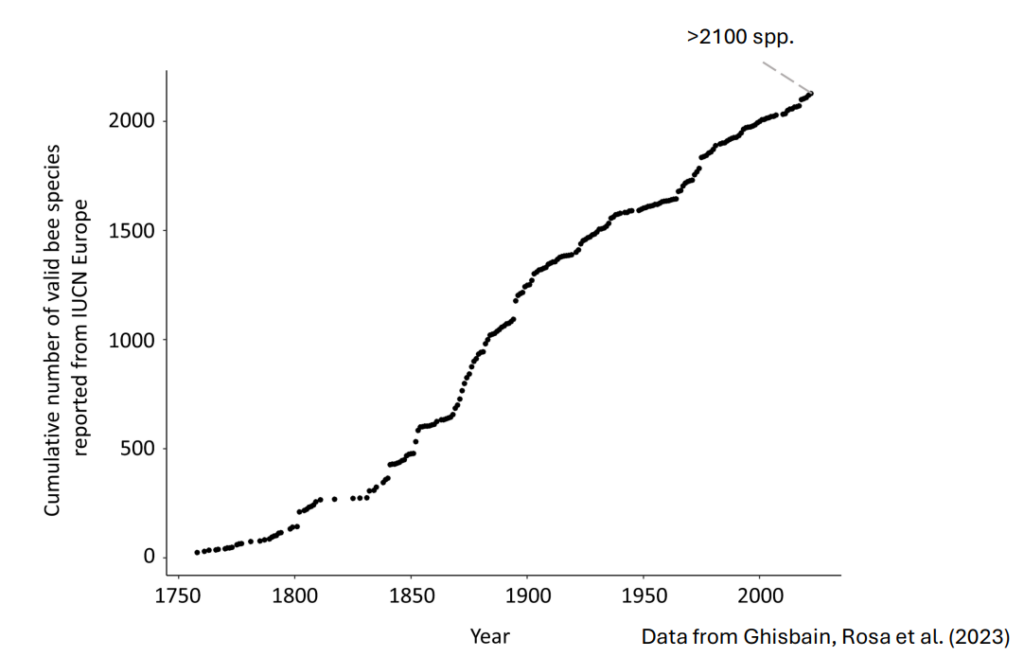
Europe is home to far more bee species than most people think. The curve showing the number of described species has risen almost continuously since 1750 and has now passed the 2,100 mark. New species are added every year, partly through genuine discoveries and partly because genetic methods reveal that what was thought to be a single species is in fact several.
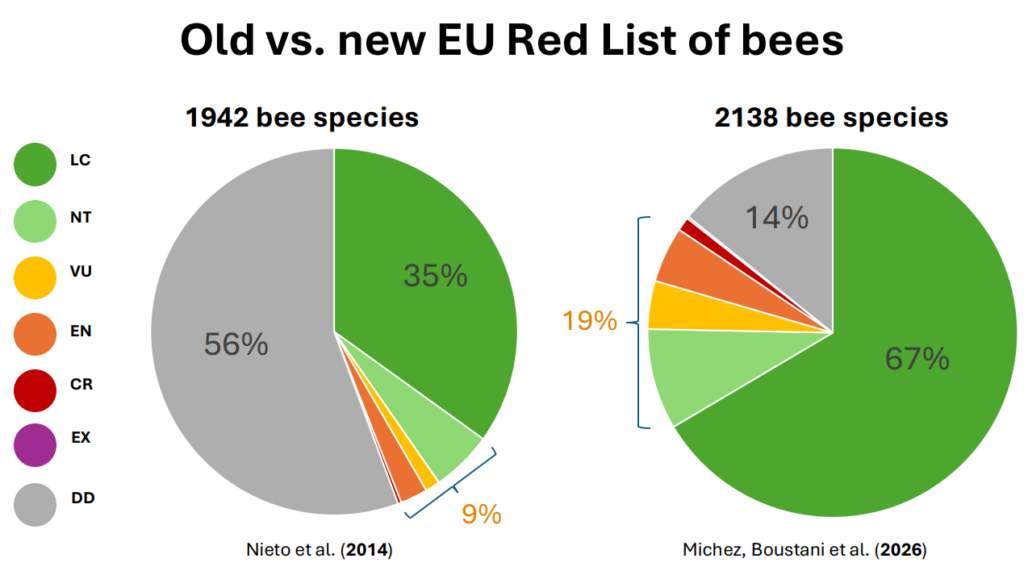
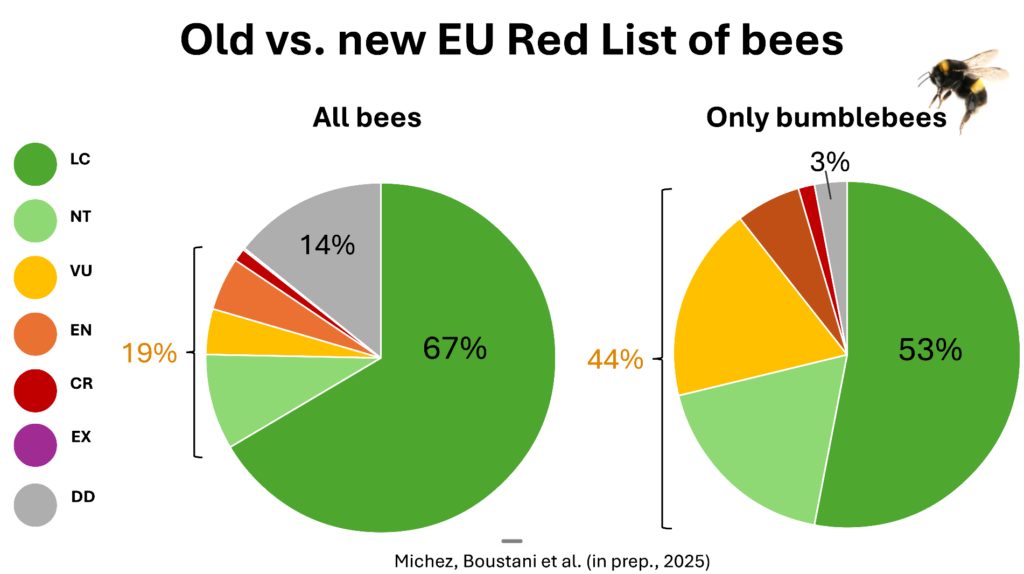
In the first European Red List, published in 2014, 56 percent of the 1,942 species assessed at the time could not be assigned to a threat category. The data simply did not exist. This category is called “Data Deficient” and for years was the biggest obstacle to effective protection.
In the new assessment, this proportion is 14 percent. This reflects years of work on collections, museum holdings, national data centres and the digitisation of old records.
Today, 67 percent of species are considered not threatened. The situation is precarious for 19 percent: they are threatened or close to becoming so. Almost 200 species are new to the list.
The picture changes when we look only at bumblebees. Here, 44 percent of species are threatened or potentially at risk, compared with 19 percent of all bees combined. Only 53 percent are considered not threatened.
The reason lies in their biology. Bumblebees are adapted to cool conditions, have dense hair and are sensitive to heat. During heatwaves, they move to higher elevations and further north. At some point, there is nowhere left for them to go.
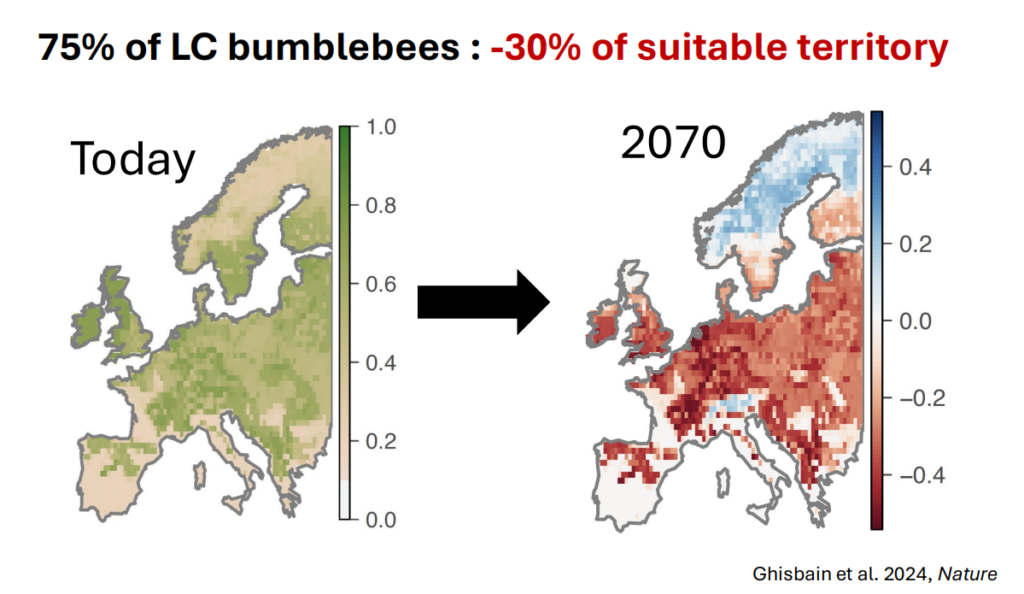
The outlook is particularly striking. Even for three quarters of bumblebee species currently considered not threatened, climatically suitable habitat will shrink by around 30 percent by 2070. For the alpine bumblebee Bombus alpinus, habitat loss will be as high as 92 percent, and for Bombus pyrrhopygus, as high as 96 percent.
This means that today’s threat status does not reflect what will happen in the coming decades.
The ranking of the causes is clear. “Agriculture & aquaculture” affects by far the most species, followed by pollution from agriculture and forestry, changes to natural systems, residential development and climate change.
But the second chart on the same slide is more revealing than any alarm bell: population trends are unknown for the majority of species. We now know how threatened a species is. For most species, we do not know whether their populations are currently increasing or declining.
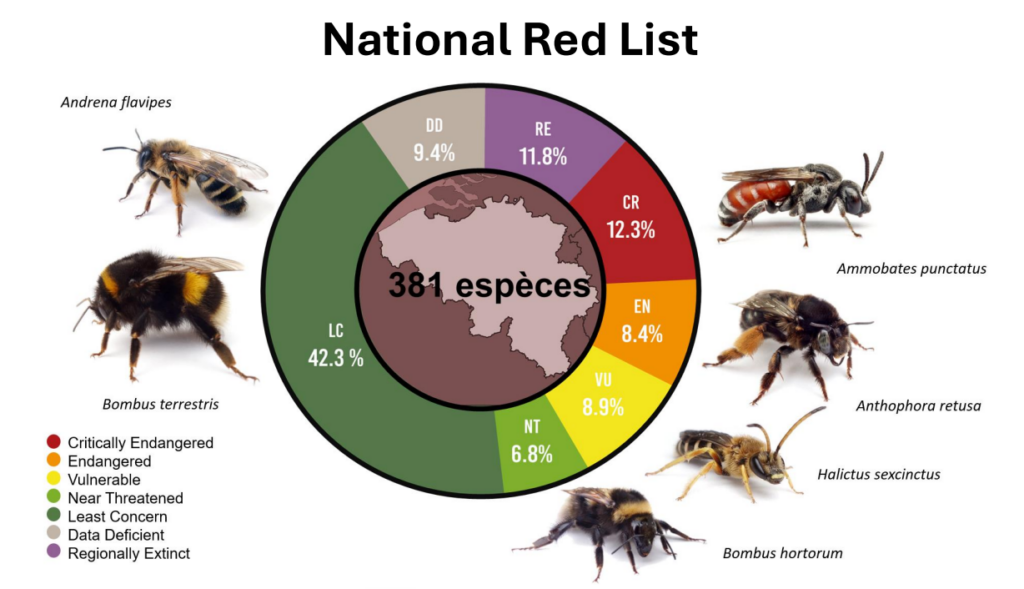
At the European level, the situation appears less dramatic than it is regionally. Belgium’s national Red List assesses 381 species. There, 11.8 percent are already regionally extinct, and 12.3 percent are threatened with extinction. Only 42.3 percent are considered not threatened.
A species can be stable across Europe and still disappear from a particular country. That is exactly why national surveys are needed in addition to the European list.
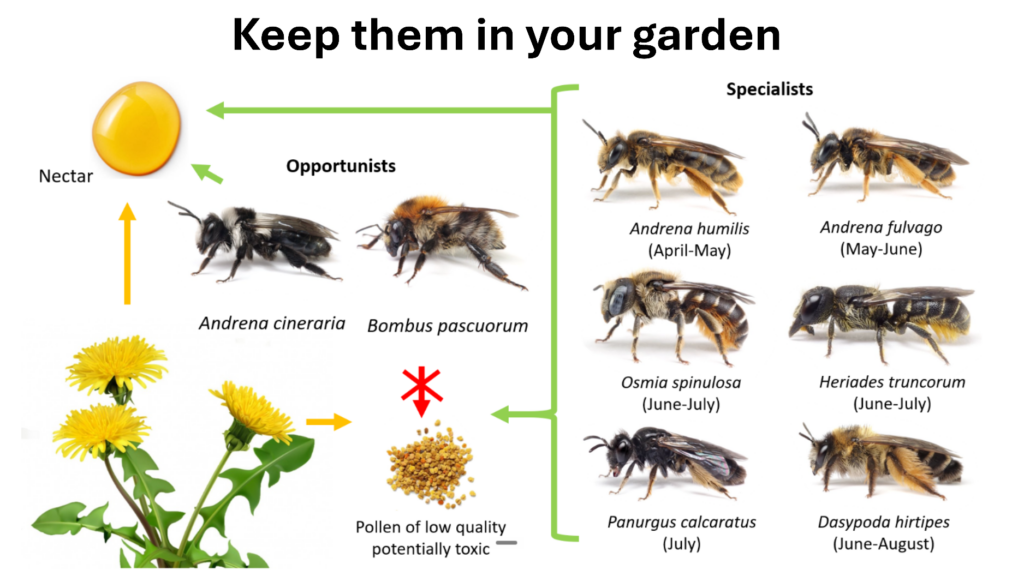
Michez gets very specific at one point. Many specialist wild bees depend on plants in the daisy family, such as dandelions, cat’s-ear and hawkbits. These plants are considered weeds in gardens and are mown down.
One distinction is important: dandelion nectar is valuable to opportunistic species, while its pollen is of low quality and potentially toxic. Even so, it is indispensable for specialist species that depend in turn on different plants in the daisy family from April to August.
The same applies to thistles in the landscape. Michez names spear thistle, curly thistle, nodding thistle and knapweeds as valuable plants.
One finding relevant to our own work concerns nesting sites. Ground-nesting species fare worse in the assessment than cavity-nesting species. More ground-nesting species are regionally extinct or threatened with extinction.
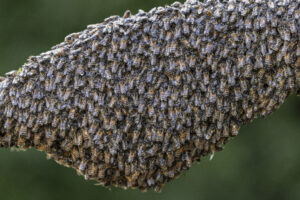
For species that nest in cavities, including wild honey bee colonies in tree hollows, the availability of suitable structures is the limiting factor. This is exactly where our work with tree hollows comes in.
The EU launched its Pollinators Initiative in 2018. This led to a Europe-wide monitoring system, identification courses and research programmes. Article 10 of the European Nature Restoration Regulation requires Member States to reverse the decline of pollinators by 2030 at the latest and to achieve an upward trend thereafter. The survey methodology became binding in September 2025.
Michez is also a co-author of an article in Science warning that the EU’s Omnibus proposal would increase pesticide risks again.
Switzerland is not part of this EU programme. This makes our own surveys and volunteers all the more important here. Around 180 volunteers document the sites of wild honey bee colonies for us three times a year. Without data like this, we would remain in the same situation that the European Red List has just overcome: a lack of knowledge.
👉Denis Michez’s full presentation, with all the charts and the discussion that followed, is available on our YouTube channel.

Denis Michez
All charts: ©️ Michez, Boustani et al. (2026), University of Mons / IUCN. Reproduced with kind permission.
In our conference series “Bees Without Borders”, renowned bee scientist and breeder Dr. Ralph Büchler showed on 28 Oc...
As of 15 September 2026 On 20 May 2026, the Swiss federal popular initiative “For the Safeguarding of Pollination of...
Important information
Important information: The original texts are published in German. The French, Italian and English versions are translated automatically and checked where possible. Please report any errors to bee@freethebees.ch.