Honey is one of humanity’s oldest foods. Long before sugar cane or sugar beet was cultivated, honey was Europe’s most important natural sweetener.
A colony of bees gathers nectar and honeydew from its surroundings, processes these substances with enzymes produced by its own body and stores them as provisions for the winter. The result is an exceptionally complex natural product.
The so-called honey composition diagram vividly shows just how diverse the composition of honey really is.
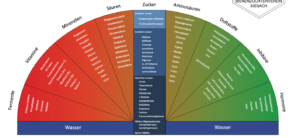
{%CAPTION%}
In addition to water and various types of sugar, honey contains, among other things:
Depending on its origin, several hundred different constituents can be detected.
The term “liquid gold” is therefore more than just a poetic expression.
Modern nutritional science views honey primarily as a food.
At the same time, honey has also been used as a remedy for thousands of years. Many cultures used honey to treat wounds and colds, or as a general tonic.
Today, various health-promoting properties have been scientifically documented. In particular, the antibacterial effect of certain types of honey continues to be used in medicine.
Nevertheless, honey should not be romanticised.
It consists mainly of sugar and is correspondingly high in energy. Anyone who consumes honey is also consuming sugar.
From FreeTheBees’ perspective, neither demonising nor glorifying honey makes sense. As with many foods, quality and moderation are key.
Today, most people know only extracted honey.
This method of obtaining honey is relatively recent and became possible only with modern beekeeping.
For thousands of years, by contrast, honey was pressed or squeezed out. This brought not only the honey stores but also components of:
into the final product.
Historical pressed honey therefore often had a much more complex composition than modern extracted honey.
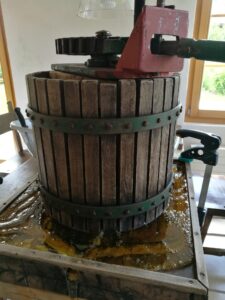
Many connoisseurs also consider pressed honey to have a much more intense aroma and a richer flavour. This, however, is a matter of personal preference.
Every jar of honey tells the story of a landscape.
The composition of honey is shaped by:
Honey is thus, in a sense, a biological fingerprint of its origin.
Analysing honey can provide insights into the environmental conditions at a particular location.
For thousands of years, honey was a precious commodity.
Before cane sugar and, later, beet sugar became widespread, honey was one of Europe’s most valuable foods. It served not only as a sweetener but also as a preservative, a means of payment and a trade commodity.
Forest beekeeping arose from this special significance.
Forest beekeepers managed natural or artificially created tree cavities in forests and harvested honey from wild bee colonies. In large parts of Central Europe, this developed into a distinct profession with special rights and privileges.
One of the best-known centres of forest beekeeping was around Nuremberg. For centuries, honey there formed the basis for making the famous Nuremberg gingerbread.
Honey thus shaped not only people’s diets but also the economy, culture and society.
Yes, it is!
FreeTheBees does not call for people to give up honey or to adopt a vegan lifestyle.
We eat honey ourselves, value it as an exceptional natural product and recognise its cultural, historical and culinary significance, as well as its health benefits in some cases.
At the same time, we do not view honey in isolation, but in the context of how it is produced. Without honey, beekeepers would currently have no incentive to keep bees. That would be dangerous, because an important part of pollination would be at risk, putting not only biodiversity but also the human food chain at risk.
The key question for us is therefore not:
“Is it okay to eat honey?”
But rather:
“How was this honey produced, and what impact does its production have on bees, biodiversity and the environment?”
There can be considerable differences between a beekeeper who works in a nature-oriented way, a forest beekeeper, a small-scale part-time beekeeper and a large-scale beekeeper focused strongly on production.
That is why we support conscious consumption, not uncritical consumption.
Anyone who buys honey also supports a production system. This system should be as responsible, transparent and sustainable in the long term as possible.
For FreeTheBees, the central question today is less whether honey should be consumed.
What matters instead is the conditions under which honey is produced.
The honey bee is both a wild animal and a farmed animal. This dual role creates conflicts of interest between honey production, animal welfare, biodiversity and nature conservation.
That is why we are interested not only in the quality of the honey, but also in the quality of the production systems.
Today’s honey production is often strongly focused on maximising yields.
At the same time, there is a growing desire for forms of production that take greater account of the long-term health of honey bees and their habitats.
The ApiVita project grew out of this idea.
The basic idea is simple:
Not every beekeeping operation has to produce honey exclusively. Mixed operations can combine honey production, biodiversity promotion and nature-oriented beekeeping.
Perhaps the honey of the future will be judged not only by its taste or origin, but also by the contribution its production makes to bees, biodiversity and society.
On 9 October, a class from Collège du Sud came on a school trip to our site in Vaulruz, right among the bees. The stu...
In our conference series “Bees Without Borders”, renowned bee scientist and breeder Dr. Ralph Büchler showed on 28 Oc...
“I observe how nature works” For over 15 years, Heinz Weder has been observing free-living honey bee colonies. He has...
Important information
Important information: The original texts are published in German. The French, Italian and English versions are translated automatically and checked where possible. Please report any errors to bee@freethebees.ch.