By André Wermelinger, Managing Director of FreeTheBees

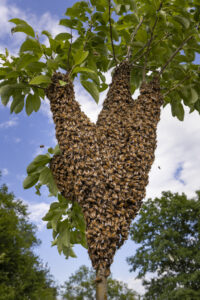
It is June. Most bee colonies under natural conditions have already swarmed. Conventionally managed bee colonies swarm less often and/or later. Swarms are still possible until mid-June.
The later a swarm emerges and the smaller it is, the lower its chances of survival in nature generally are. While a beekeeper can still establish a colony from a nucleus in June, swarms emerging from mid-June onwards are almost certain to die in nature.
Parts of June are often still marked by a forage dearth; the summer nectar flow only begins in the second half of the month. And the swarms that emerge fall right into this forage dearth. A colony ready to swarm may even interrupt its swarming impulse because of the forage dearth and switch to a kind of emergency mode, with minimal resource consumption.
In conventional beekeeping, the beekeeper tries to suppress the swarming impulse as much as possible. Since an excessively strong colony that does not swarm would consume a great deal of resources and decline, the beekeeper resorts to a workaround by artificially creating nucleus colonies. In effect, the beekeeper reduces the size of excessively strong colonies, creates nuclei and feeds and stimulates both the parent colony and the nuclei so that they continue to develop steadily.
What seems sensible from the perspective of a beekeeper focused on yield has undesirable side effects. Without swarming and with feeding, there is no brood break; the parent colony and, depending on how the nucleus was created, the nucleus as well, continue to raise brood without interruption. Bee colonies may thrive as a result, but so can parasites such as the Varroa mite, which depend on bee brood. The unwanted populations of disease-causing bacteria, fungi and viruses also increase along with the parasites.
Chemical treatments are generally avoided during this period, probably above all because they may affect honey quality. The official treatment guidelines of the umbrella organisation recommend drone brood removal. It is easy to understand, and often pointed out, that the Varroa population grows exponentially in these circumstances. Drone brood removal can only counteract this to a limited extent and in turn has undesirable side effects.
In near-natural beekeeping (see FreeTheBees beekeeping methods), we benefit from swarming and the brood break that follows. The new queen in the parent colony only starts laying eggs again once the last brood cell laid by the old queen has hatched. The swarm that has left is broodless in any case.
The broodless period prevents the spread of Varroa mites, bacteria, fungi and viruses, and thus serves as an automatic cleansing function of nature.
The broodless period can also be put to use, for example by treating with thymol. Thymol works well against mites that are freely accessible, but not against those in brood cells. This is why it is particularly effective when there is no brood.
During my first six years as a beekeeper, I worked under near-natural conditions and used thymol during the brood break. The results were very good: my loss rates were lower than those of conventional beekeepers.
If you would like to learn more about the alternative Varroa treatment with thymol, I recommend our detailed plan: Alternative Varroa Control Plan
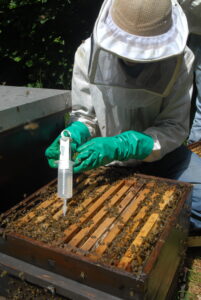
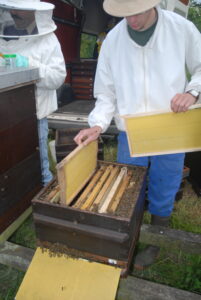
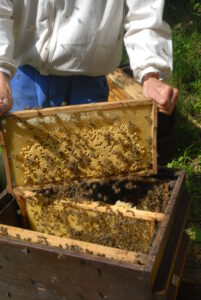
The approach of complete brood removal developed by Dr Büchler is very interesting. Although it is only carried out in mid-July, it makes sense to mention it now.
The plan could hardly be more appealing: the same honey yield as in conventional beekeeping, while avoiding chemicals altogether! We have always dreamed of this. Nor is the plan diminished by the fact that perhaps 10–15 minutes of work per colony are required, which seems perfectly acceptable to me.
Next month, in July, I will take a closer look at complete brood removal and Dr Büchler’s new trapping-comb method. If you can’t wait, you can read more here now, or listen to Dr Büchler’s presentation.
Enjoy putting this into practice. I look forward to sharing more insights into my work in July.
Subscribe to our newsletter here so you don’t miss any new blog posts.
Photos: Ralph Büchler
January–February: Looking back and planning for the new beekeeping season
March: Preparing for the new beekeeping season and ensuring adequate food supplies
July: Never treat bees without first measuring infestation levels
August: How do location and conditions affect the health of bee colonies in midsummer?
In our conference series “Bees Without Borders”, renowned bee scientist and breeder Dr. Ralph Büchler showed on 28 Oc...
Martin Ott is convinced: We know enough to solve ecological crises. What is missing is a relationship with this knowl...
Important information
Important information: The original texts are published in German. The French, Italian and English versions are translated automatically and checked where possible. Please report any errors to bee@freethebees.ch.