By André Wermelinger, Managing Director of FreeTheBees
After January and February were devoted to reviewing the past year and planning the new bee season, March is primarily a time for me to make concrete preparations for the new bee season.
In March, the sun grows stronger again, and the first pleasantly warm days arrive. The life energy in plants, animals and us humans increases from week to week. There are still very cold nights at times, often well below freezing, and regular generous falls of snow. But the willows, hazelnuts, snowdrops and crocuses are already in bloom. As soon as temperatures rise above 10 degrees, the bees fly out again and diligently collect pollen to feed their brood.
Since the bees are already raising brood again, and the bees are known to keep the brood at 35–36 degrees, it is easy to imagine how energy-intensive this season is for them. Even when it is -10 degrees outside, the brood is kept at 35 degrees, a difference of more than 40 degrees. The energy needed for this comes from the stored honey. The honey reserves stored by the bees last year decrease only slowly from October to January, but can then dwindle very rapidly in March. Many a colony has starved to death at this point, just before the finish line for the start of the new bee season. The first priority is to check the food reserves and secure them if necessary. The bees cannot provide for themselves from nature again until around mid-April.
I check the food reserves simply by lifting my beehives (the ones I can lift, of course, not the 250 kg log hives.. 😉); I have developed a feel for whether there is still a supply of honey in the hive or not. If you want a more precise measurement, you can weigh your empty beehive beforehand and now use a spring scale to determine the honey supply (see Introduction Course, page 83).
If the honey supply is insufficient and the colony is at risk, fondant can help at this point. Castaflor, available from specialist suppliers, is ideal: a honey-and-sugar mixture with an optimal consistency, tested to ensure it is free of disease spores. For more on feeding, I recommend my online presentation as part of Bees Without Borders.
If you no longer remember what I said in the Beekeeper’s Calendar for January and February, you should revisit it. After considering our goals for the coming bee season over the winter and, ideally, writing them down, it is now time to prepare and put them into practice. Our methodological foundation was the FTB Beekeeping Methodology.
I am always surprised by how often even the simplest mistakes are made, including here. Just because my friend, beekeeping godfather or grandfather keeps bees in a Swiss hive, that does not mean I need a Swiss hive to achieve my goals. Instead, I start with the goals I have set and want to achieve. From these, the necessary beekeeping methods follow in accordance with the FTB Beekeeping Methodology. Only then do I decide which beehive or bee habitat is best suited to achieving my goals. See also the Introduction Course from page 32 onwards. As the explanations so far have shown, there is no longer just one “right” method, let alone the “good beekeeping practice” advocated by conventional beekeepers. The challenges of our time call for at least two, if not three, different methods, which need to be combined and cannot take place in the same habitat.
Once all this has been clarified, the materials can be purchased or made yourself.
One of the main problems for honey bees is the so-called nectar dearth: a period of the year when particularly little nectar is available. As we know, in addition to temperature, the bees’ comb-building and brood-rearing activity depends particularly on the incoming flow of nectar. If there is not enough nectar in nature, the colony switches to emergency mode, reduces brood rearing and stops building comb. It is difficult for the colony to make up for this developmental setback during the same bee season.
Conventional beekeeping manages the colony so that it can cope with the nectar dearth. Spring honey is normally harvested in mid-May, and the colony is fed sugar through the nectar dearth. Since the swarming impulse is negatively affected by adding a honey super and, in some cases, by considerably harsher interventions such as removing queen cells, colonies become excessively strong—something that would not happen in nature. Once again, the beekeeper benefits unnaturally from the situation by artificially increasing the number of bees at precisely this point. So the beekeeper has harvested the honey, feeds the bees through the nectar dearth and splits the excessively strong colony to make nucleus colonies.
None of this happens in nature. In a tree cavity with a fixed volume, a wild bee colony can store a maximum of around 10 kg of honey over the spring and the lovely month of May, which usually begins in mid-April. The colony swarms when resources are abundant and overflowing. The parent colony loses the swarming bees and has to raise replacements. The swarm moves into a new habitat and has to build everything from scratch. The most energy-intensive time of year is accompanied by a nectar dearth and a lack of nectar in an agricultural landscape—conditions that would never occur in a biodiverse natural environment.
As also described in our course materials (Introduction Course, page 23 onwards), although a wild bee colony can survive this nectar dearth, in most regions of Switzerland it develops rather poorly and then starves miserably over the winter, either because it is too small or because it lacks the food reserves needed for winter.
Note that: While in a tree cavity in the agriculturally dominated Swiss Plateau, our wild-living bees often starve to death, Bashkirian tree beekeepers in the Urals, Russia, harvest 20 kg of honey from the tree hive, and the bees also overwinter on their own honey!
The conclusion to draw from these lines can only be this: plant as much as you possibly can and bring biodiversity into the plant world. And, of course, we do not need another dandelion, which blooms in the lovely month of May anyway, nor necessarily another apple tree. We need to prioritise plants that provide nectar early in the season, during the nectar dearth between mid-May and mid- to late June, and throughout the summer and autumn. To do this, you can consult forage plant calendars to help you choose which plants to prioritise.
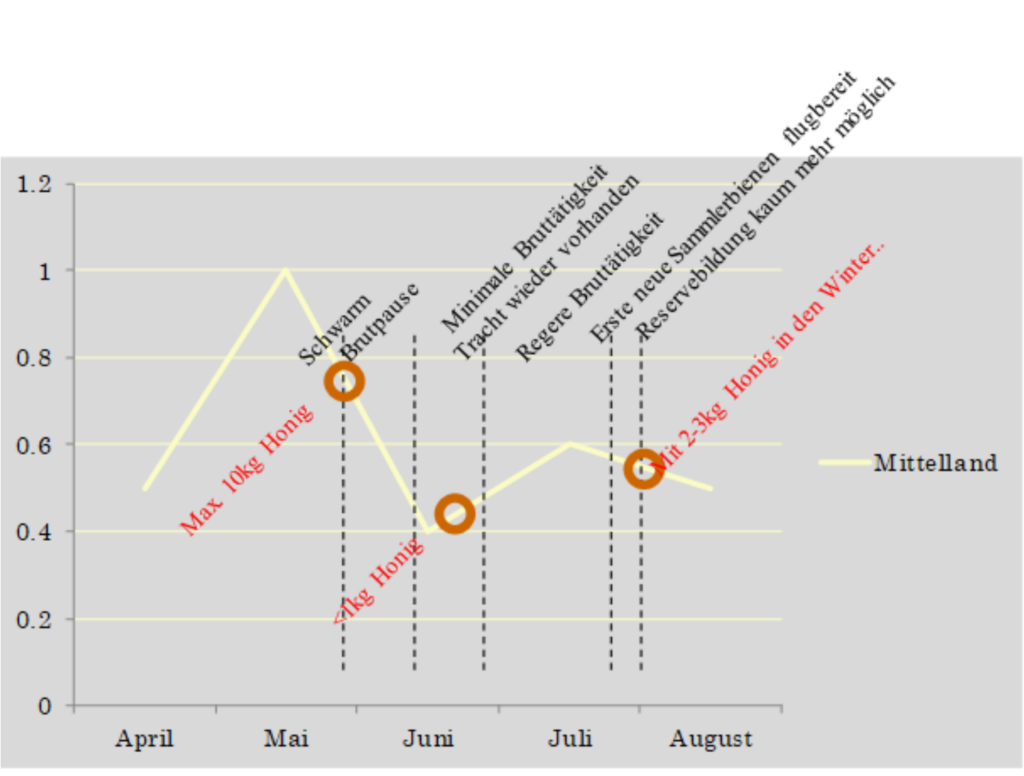
Figure 1: Nectar dearth in the Swiss Plateau (yellow curve), a real challenge for wild-living honey bee colonies.
I am always astonished by the photos I receive as early as February from beekeepers proudly showing off their full brood frames, even outside, exposed to the still rather low temperatures. Brood diseases such as American and European foulbrood are associated with cold affecting the highly sensitive bee brood, and we know that opening beehives significantly disrupts the microclimate and therefore also the bees’ immune systems. In my view, this is something to avoid, especially in early spring, when the colony is still weak.
Why should I open the hive at all? If the queen is missing, I can tell from the bees’ behaviour on the landing board or at the entrance. A debris sample gives me a great deal of information about what is going on inside. In cold, rainy weather, I can see what the bees are cleaning out and bringing as far as the entrance or landing board, including diseased brood. I can rule out brood diseases to a large extent by smelling at the hive entrance. Heinrich Storch describes this very well in his little book “At the Hive Entrance”.
I also do not equalise colonies by strength. I believe this intervention can encourage the transmission of diseases and parasites and override my selection process. If a colony is currently weak, that does not mean it will remain weak throughout the season or in the following year. Weakness is temporary and can change quickly.
March is also the time to get fully prepared for swarm season. A new beekeeper needs bees; an established beekeeper does not want to lose the swarms that leave the hive, even if they are sitting in the office working on the perfect swarming day in May.
I usually advise new beekeepers to start by building as many connections as possible in their local area and asking several beekeepers whether they can supply bees. Swarms are the first choice, but nucleus colonies are also an option; the main thing is to get started and gain practical experience. Building a network takes time, but it is helpful. March is an ideal time for this, as many beekeepers are also working at their apiaries and can regularly be found there.
A much simpler option is to put old wax in the new beehive. Bees are known to have an excellent sense of smell, and research has shown that they seek out habitats that smell of wax and propolis—in other words, places where a bee colony must have nested before. You can take advantage of this by hanging an old comb or pieces of comb in the new dwelling and simply waiting to see whether a swarm settles there spontaneously between mid-April and mid-June. In my best spring, I managed to attract 10 swarms this way, four of them one after another on the same day.
Swarms that leave a hive at your own apiary rarely stay there. At least, I have never observed this myself in all my years as a beekeeper. From the perspective of population dynamics, it would make little sense: swarms leaving the hive want to spread out, so they leave rather than moving back into a hive at the same apiary. But this, too, can be put to good use. Studies show that you need to place a hive at least 50 m from your own apiary, preferably a little farther away—75 or 100 m. If you put habitats, beehives, swarm traps and so on there, you have a good chance of catching your own swarms. At my alpine apiary, for example, where I am rarely there at the right time, two of the three tree cavities I put up—at distances of between 50 and 150 m—are usually occupied after swarm season.
Coming soon
Enjoy putting these ideas into practice. I look forward to sharing more insights into my work in April.
Subscribe to our newsletter here so you don’t miss any new blog posts.
March: Preparing for the New Bee Season and Ensuring an Adequate Food Supply
July: Never treat bees without first measuring infestation levels
August: How do location and conditions affect the health of bee colonies in midsummer?
In our conference series “Bees Without Borders”, renowned bee scientist and breeder Dr. Ralph Büchler showed on 28 Oc...
Martin Ott is convinced: We know enough to solve ecological crises. What is missing is a relationship with this knowl...
Important information
Important information: The original texts are published in German. The French, Italian and English versions are translated automatically and checked where possible. Please report any errors to bee@freethebees.ch.