By André Wermelinger, Founder and Managing Director of FreeTheBees
Michelle Knecht’s article “The forgotten wild honey bees” in the Swiss Bee Journal (11/2026) highlights a key finding of the study by Patrick Kohl and Benjamin Rutschmann: in the Swiss study areas north of the Alps, only just under 10 percent of free-living honey bee colonies survived each year. The figure was around 11 to 13 percent in the German study areas, compared with 37 percent in southeast England. These differences are alarming—and have not yet been adequately explained.
The researchers model an average population decline of 56 percent over ten years in Europe, assuming no influx of swarms from beekeeping. This is a projection based on survival rates in recent years, not a decline that has already been measured. Among other things, it is based on the assumption of an average of two swarms per colony per year; the actual reproduction rate of free-living colonies is difficult to measure. This is precisely why more research into their natural swarming behaviour is needed.
A passage on page 25 of Knecht’s article merits clarification. It gives the impression that a subpopulation can be considered “wild” only if it survives for ten years, or three generations, without an influx from human-managed colonies. This wording refers to the IUCN’s official definition; this is therefore not a criticism of the journalist, nor an attempt to deny the existence of wild-living honey bees to Kohl and Rutschmann, the study’s authors.
Rather, the IUCN guidelines address a specific question in assessing extinction risk: subpopulations that would die out within ten years without intensive human intervention—such as regular artificial restocking—are not classified as wild for the purposes of this assessment. The often-cited three generations are part of the timeframes used in the extinction-risk criteria; they are not a waiting period after which a free-living colony only then becomes wildlife.
Kohl and Rutschmann themselves explicitly distinguish between the way an individual colony lives and the demographic independence of a population. They define wild-living colonies by their unmanaged life in natural nests of their own choosing. Treating the natural departure of swarms from beekeeping as “restocking” is a defensible modelling choice—but it is not a natural-law distinction between wildlife and livestock.
A swarm from an apiary that settles in a tree cavity without human care lives in the wild. Whether enough such colonies survive and produce successful offspring of their own to maintain a population without a continuous influx is a separate question. Low capacity for self-sustenance is no argument against protection: it is precisely a warning sign.
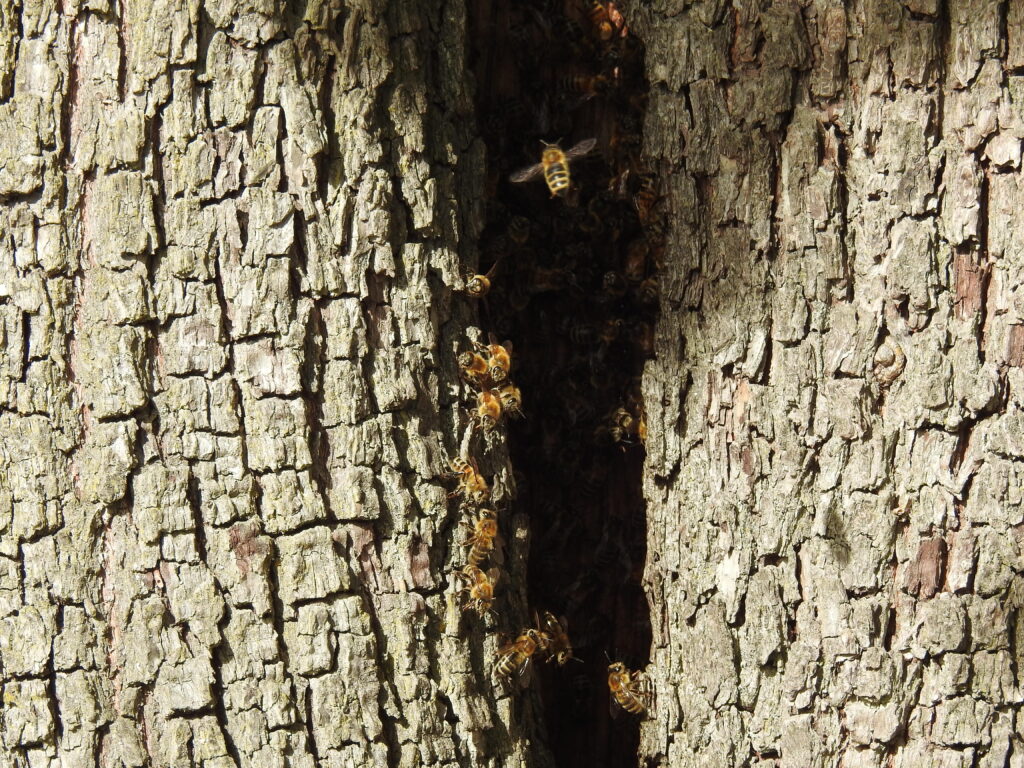
Wild-living honey bees in a tree-cavity niche, photographed by Erich Lang, FreeTheBees volunteer
The honey bee remains the same biological species, whether we keep it as livestock in beekeeping or it lives freely. There is genetic exchange between the two groups; no reliable genetic boundary exists. The reverse can also happen in principle—a swarm from the wild enters beekeeping—but this is likely rare in western Europe today.
This makes it all the more important to look at the phenotype: how does a colony actually develop, how does it withstand parasites, how often does it swarm, and how many of those swarms survive as new colonies? Epigenetic effects may also play a role. They must not be overlooked.
For generations, beekeeping has deliberately selected for honey yield, gentleness and a low tendency to swarm, and has profoundly changed the conditions of selection through feeding, Varroa treatments, large-volume hives, honey supers and swarm prevention. Yet swarming is the natural reproduction of a honey bee colony, not an operational failure. Under the conditions of modern beekeeping, it is difficult to assess how a colony would reproduce most successfully in a natural cavity.
There is no question that management changes swarming and the conditions of selection. Whether, and to what extent, these changes explain the particularly low survival rates in Switzerland and Germany remains unknown. This hypothesis must be rigorously and comparatively examined alongside Varroa and viruses, bee density, food availability, pesticides and the lack of old cavity-bearing trees.
FreeTheBees now monitors around 400 nesting sites used by wild-living honey bees, many of them systematically for years. Another scientific publication based on this monitoring is planned for 2026. A nesting site being occupied again does not necessarily mean that the same colony survived; distinguishing between overwintering and recolonisation over the long term is crucial.
The European Red List published in 2026 classifies wild-living honey bees as Endangered in the EU27; the broader pan-European assessment remains “Data Deficient” because of regional data gaps. These gaps concern other regions of Europe. For Switzerland, the FreeTheBees monitoring provides multi-year data, which were included in the study mentioned above.
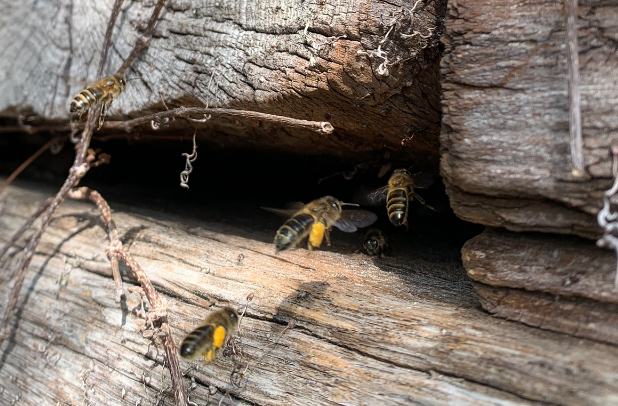
Wild-living honey bees, photographed by Corinna Sidselrud, FreeTheBees volunteer
By contrast, the honey bee remained “Not Evaluated” (NE) in Switzerland’s 2024 Red List: free-living populations were considered to be more strongly influenced by managed honey bee colonies than by environmental factors. This blanket comparison in particular needs to be reviewed today. Beekeeping influences may themselves be a cause of endangerment—and do not make nature conservation redundant.
FreeTheBees is therefore calling for a timely, transparent reassessment of Switzerland’s conservation status, taking the new data into account, and for concrete protection measures for free-living colonies and their habitats. A Red List classification does not replace legal protection instruments, but it can provide the scientific and political basis for them.
It isnot the question of whether honey bees are “wild enough” that should guide us. Rather, we should ask why they survive so poorly in Switzerland’s natural environment—and what conditions we need to change so that resilient, self-renewing populations can once again emerge.
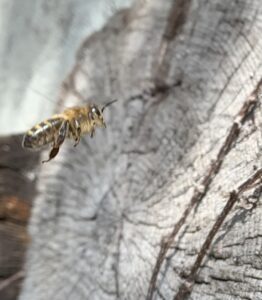
Wild honey bee, photographed by Corinna Sidselrud
Sources: M. Knecht, “The forgotten wild honey bees”, and “Questions for Benjamin Rutschmann”, Swiss Bee Journal 11/2026, pp. 24–30; Kohl & Rutschmann (2026), Conservation Science and Practice 8, e70345, doi:10.1111/csp2.70345; IUCN Red List Guidelines, V16 (2024), § 2.1.4; European Red List of Bees (2026), p. 45; FOEN/info fauna, Red List of Bees (2024), p. 10.
The featured image at the top is by Ingo Arndt
Every month, we introduce one of the volunteers in the “Wildlife Honey Bee” project. This time: Angelika. Her photo w...
Bees sleep, and the first studies on this subject date back more than 40 years. On 18 November 2026, sleep researcher...
In our conference series “Bees Without Borders”, renowned bee scientist and breeder Dr. Ralph Büchler showed on 28 Oc...
Important information
Important information: The original texts are published in German. The French, Italian and English versions are translated automatically and checked where possible. Please report any errors to bee@freethebees.ch.