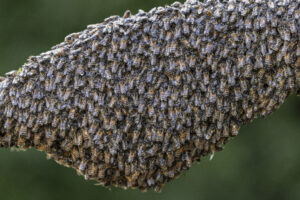
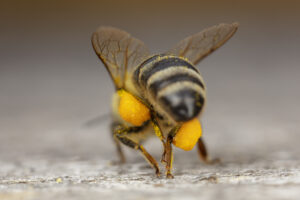
At the 50th edition of our «Bees Without Borders» conference series, André Wermelinger, founder of FreeTheBees, called for a radical rethink of beekeeping. His central message: the Varroa mite is not the cause of bee deaths, but a symptom of a diseased system. We need to move away from «monoculture beekeeping» towards a diversified portfolio that gives nature room to adapt again.
For years, the Varroa mite has been regarded as beekeeping’s greatest enemy. But André Wermelinger challenges this view. Drawing on hundreds of scientific studies, including those by renowned researchers such as Tom Seeley and Peter Neumann, it becomes clear that nature has no problem with the mite.
«Varroa is not a problem for nature. It can be a problem for beekeeping.»
One key fact from the conference is often overlooked: the greatest risk to wild honey bees in Switzerland is not the parasite, but simply hunger. In intensively farmed agricultural landscapes, there is a lack of floral diversity and forage. Based on observations across many regions of Switzerland, corroborated by many beekeepers in Germany, André Wermelinger reports that without human feeding, 80% to 90% of wild colonies starve. If food is provided but the bees are not treated for mites, losses already fall to 50% to 70%. The mite only becomes a problem when the immune system of the «superorganism» has already been weakened by other stressors such as hunger, inappropriate breeding goals, intensive honey production, environmental toxins, etc.
The fact that bees can survive without chemical intervention is not just a theory. In Wales (UK), beekeepers such as Jonathan Powell, David Heaf, Clive & Shan Hudson and many others show that stable colonies are possible in the wild and in beekeeping, entirely without treatment, with winter losses of just 13%—something Swiss beekeepers can often only dream of.
One of the key factors is natural selection. In undisturbed tree cavities, bees develop defence mechanisms such as «grooming» (cleaning one another), or live in symbiosis with helpers such as the book scorpion or the predatory mite Stratiolaelaps scimitus (Skimitus), which eat Varroa mites. Beekeepers can influence their bees’ ability to adapt to a certain extent and help them become better suited to nature again.
André Wermelinger issues a strong warning against the routine use of formic or oxalic acid. He compares this practice to chemotherapy:
«When you fight one of these attackers, it is practically impossible not to harm the bee as well.»
These acids severely damage the bees’ delicate immune system and prevent colonies from ever adapting to the parasites. This creates a vicious cycle of dependence.
FreeTheBees is not calling for an end to beekeeping, but for diversification. Instead of «monoculture beekeeping», a mixed portfolio is proposed:
There is evidence that, for example, the Dark Bee (Apis mellifera mellifera) uses its stores more sparingly. However, local adaptation and selection are much more important than breed. Colonies that have learned to get by with little are more likely to survive.
Nature does not only lose; it is also constantly creating new things, for example through mutations. FreeTheBees focuses on protecting the species (Apis mellifera) as a whole. Genetic diversity within the species is actually greater today than ever before, thanks to the mixing of bee breeds.
The sealed brood, where the mites are concentrated, can be destroyed (for example, by feeding it to chickens) or used to create new colonies. In the latter case, however, the new colony must be treated specifically, as the mite load there is extremely high. The resulting brood break does, however, make it possible to consider gentler treatment measures such as essential oils.
A study by Agroscope (Liebefeld) confirmed that thymol is the most effective essential oil against Varroa, provided the concentration in the hive air is kept at the correct level. Essential oils work very well as part of the FreeTheBees Methodology for nature-oriented beekeeping. They are less suitable for intensive honey production.
Watch the full 50th conference here and find out how we can work together to solve the Varroa problem over the next 10 years.
In our conference series “Bees Without Borders”, renowned bee scientist and breeder Dr. Ralph Büchler showed on 28 Oc...
As of 15 September 2026 On 20 May 2026, the Swiss federal popular initiative “For the Safeguarding of Pollination of...
Important information
Important information: The original texts are published in German. The French, Italian and English versions are translated automatically and checked where possible. Please report any errors to bee@freethebees.ch.