Text and photos by Patricia Maillard
For many years, FreeTheBees has received valuable support and guidance from Patricia Maillard. Her knowledge of bees enriches the team’s expertise. We also owe Patricia our excellent and precise translations of the bulletin from German into French. FreeTheBees and Patricia Maillard are inseparable. Today we present the second part of her article, in which she introduces her terracotta beehives. You can find the first part of the article here.

We have an exclusive offer for our loyal readers: Get a terracotta beehive at a special price while stocks last! Instead of CHF 550, you pay only CHF 300 per hive. Transport costs extra. If you are interested, please contact André Wermelinger at andre.wermelinger@freethebees.ch.
The bee’s task is to ensure its own survival, and as a side effect, its pollination also contributes to our survival. We should therefore approach this collaboration with the utmost respect and make life easier for the bees.
One of the aims of this beehive is therefore to help restore the autonomy of the colony that inhabits it. To achieve this, it seems essential first to give the hive a shape and structure that respects the bees’ way of life and habits.
We often forget that the bee’s own body provides the building material for the structure. Its form is the result of physical stress caused by the strength of the wax and other natural constraints, together with the constraints of a biological and social structure.
The beehives used in conventional beekeeping have seriously disrupted the biological and social structure of bee colonies: the bees were prevented from using all their abilities to solve the problems posed by life in nature. They thus became hostages to the convenience of beekeeping, which only increased their difficulties. To restore their autonomy and enable them to use their genetic, mechanical, physical, chemical and biological strategies as efficiently as possible, we must once again become aware of their true needs.
We all know that the bee is a wild animal, and it would be wrong to think that it can be domesticated in the way we imagine: total control, obedience, loyalty and a sedentary lifestyle.
Today’s problems extend far beyond honey production and confront us with the consequences for pollination and the disappearance of a wild species—in other words, the consequences of our harmful attitude towards nature. Without yet speaking of reintroducing the honey bee, since many wild colonies still exist, the aim of these beehives is to release colonies into the wild through natural selection, colonies that are a little more resilient. We must therefore give colonies living in an artificial habitat the opportunity to adapt their physical, biological and social structure as closely as possible to natural conditions.
This terracotta beehive is nevertheless the creation of a person trying to think like a bee (a bold challenge) and asking:
I must emphasise that my claims are never absolute. What I consider probably correct is merely a proposal open to discussion, and I always welcome controversial debate and the opportunity to adapt my views.
At the very least, in its shape, volume, structure and fittings, this beehive should correspond to the kind of cavity bees seek in nature. It should meet the requirements for optimal energy management and a specific way of life.
To achieve these aims, the beehive should:
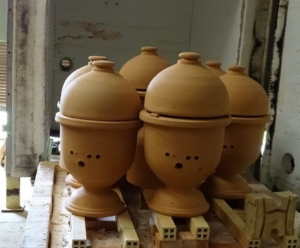
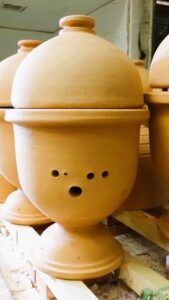
The egg shape seemed to me to meet almost all the requirements and offer the colony an ergonomic optimum. The egg-shaped hive is not an invention, but simply the result of observing nature. A bee colony’s structure meets the requirements of energy conservation, strength, space, thermodynamics, biological function and structure, as well as social function and structure.
This structure must therefore ensure the social life of the hive, hygiene, food supply throughout the year, protection of reproduction and continuation of the species under conditions that meet their needs. All they need is a suitable protective shell; then the bees take care of everything in nature, and clay provides them with optimal protection.
We must accept that beehives, regardless of the material used, have always been sheltered, regardless of civilisation or latitude. They are completely protected from the wind, an extremely energy-intensive factor, as well as unpredictable weather fluctuations.
Although terracotta hives have a shape that offers little resistance to the wind and are considerably heavy due to their thickness, they are not exempt from this constraint.
The beehive should also never be placed too close to the ground, because of rising morning damp and the fact that it would be too accessible. A good compromise for the bees and the beekeeper’s back is to place it on a surface that does not retain water, under a roof and between three walls, about 50 cm above the ground.
Terracotta has many qualities:
We chose chestnut wood to make the perforated discs. This choice was no accident, as chestnut wood comes from our temperate regions.
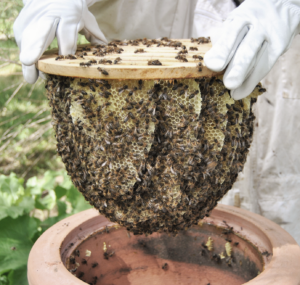
The most common natural form of Apis mellifera comb is based on a chain structure. The complete beehive is egg-shaped, a form that solves many problems.
Despite its unusual appearance, the “Golden Ratio” beehive is therefore not new. Its egg-shaped design provides an ergonomic optimum for the colony. It does away with movable frames or bars, while giving the swarm the option to increase the volume, which may be necessary for its development in spring. This expansion makes it possible to obtain a small honey surplus at the end of the nectar flow without disturbing the bees.
The hive supports the life of naturally sized bee swarms, which is preferred for honey bees (Apis mellifera, mellifera). It has been shown that even small swarms can survive the winter more easily.
The oval shape can be compared to joining two arches to create one of the most stable structures. This meets the requirements for protecting the brood from possible external attacks.
The shape of the hive body allows the bees to build their combs in a natural comb shape. The principle is simple: a freely hanging chain forms a catenary curve. This shape ensures that the sum of the horizontal forces along the chain is zero at all times, thanks to uniform tension. This allows bees to store the maximum amount of supplies using the minimum amount of wax. Even the most ingenious scientists could not design a more efficient structure, as the balance between saving wax and the strength needed to support the weight of the stored material is often underestimated. The bees have solved this problem masterfully. Why should we compromise their ingenious work with unnatural frame shapes?
In aerodynamics, the ideal shape is called “ovoid”. This shape performs better in bad weather and strong winds because it offers less resistance and allows water to run off.
However, if we look at the history of beehives, we see that for most of the time they were protected from the wind and weather, and in some regions they still are. Then came the age of constant increases in production and profit. I would say that the coming together of the Adam/Dadant duo focused on methods of “exploitation” and unlimited increases in production using artificial forms, without regard for the consequences, and without realising that bees already do everything in nature to survive and produce as much honey as possible. Each had their own ideas about size, proportions, structure and methods for driving colonies to burnout. In 2005, people were still willing to admit that more than 50,000 beehives, mostly Dadant type with 3, 4 or 5 honey supers, often grouped four to a pallet and exposed to all weather, were brought to the Valensole plateau, which covers about 9,000 hectares, to harvest tonnes of lavender honey.
The need to build a shelter for this beehive therefore arises not from its material or shape, but from general considerations of respect for what bees seek: protection from wind, direct sunlight and heavy rain. As already mentioned, wind is the most energy-intensive factor. It not only increases the range and extent of temperature fluctuations, but also makes it harder for bees to return to the hive. It is therefore a real adversary of bee activity and the bee system.
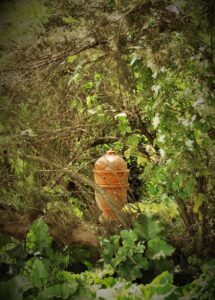
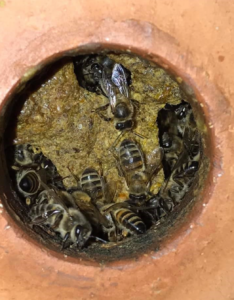 Photo: Marc Boukri, bees reduce the size of the entrance
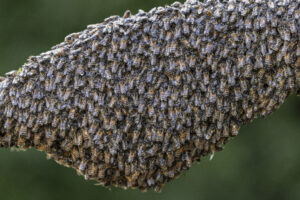
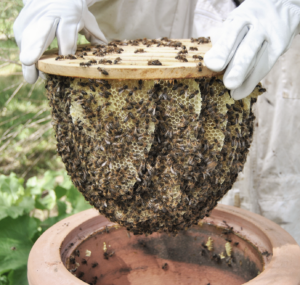
The brood and the honeycomb plates structure the interior of the hive—the former covers the area of narrower combs in the bee cluster, while the latter is used for the wider storage combs. This arrangement allows the bees to anchor their combs firmly and build their structures as close as possible to their natural form.
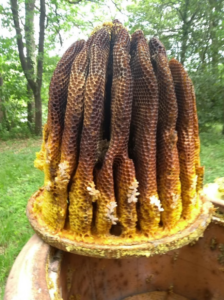
The bees do not seem very interested in attaching their combs to the walls. This only happens occasionally.
The brood plate prevents the queen from laying brood in the lid. The round holes are very rarely used for the beekeeper’s fingers; they prevent the queen from passing through. They are plugged with corks after checking that the swarm has settled in, about ten days after its arrival. . In his experiments on the bees’ tendency to orient themselves according to the Hartmann grid, A. Champendale had left the finger holes open. Unfortunately, the bees and the queen, who fled into the lid, did not survive the winter. One finding could nevertheless be made: as long as the wind does not force the bees to orient their combs differently, they seem to prefer the orientation of the Hartmann grid in the domed structure. (Géobiologie et Apiculture 2018- S. Cardinaux – Génie du lieu & A. Champendal – GEOBIO-Habitat)
Under the honeycomb plate, the bees apparently orient themselves according to the slots provided by the beekeeper. Under the lid, the climate is stable and undisturbed by the wind. Once the combs have been fully installed in the hive and under the lid, it is possible to observe whether there are differences in orientation between the combs under the lid and those under the plates. The orientation of the combs under the lid reflects the orientation preferred by the bees. But be careful: conditions are different inside the bee cluster, where the entrance—and therefore an air inlet—is located, and these may force the bees to make adjustments.
Natural construction without frames that unnecessarily restrict the bees allows them to:
When managing these beehives, the number of handling operations and openings is reduced to an absolute minimum (twice a year, three times at most), reducing the time spent on physical exertion in favour of careful observation at the entrance. This method will provide crucial information about the bees’ health. However, this observation must be excellent, as it is limited exclusively to the entrance, with no possibility of looking through a rear window or beneath the frames—at least initially—to assess the situation accurately. This is based on H. Storch’s short book, with a few necessary adjustments.
The compact hive body is never uncovered, preserving the hive’s fragrant warmth and ensuring good hygiene around the brood.
Honey is easy to harvest from the hive. The honeycomb is put in or taken out at the right time without disturbing the brood. The combs are cut flush with the honeycomb plate, and the honey can be extracted by pressing without expensive equipment (a purée press or a wooden press, depending on the volume to be pressed). Depending on the filtering method, it meets the required purity standards without being excessively denatured by centrifugation. It can also easily be used in honeycomb pieces.
Adding extra honey supers encourages honey production. The bees are encouraged to store more nectar, pollen and honey. This can change their activity priorities.
Too much space can dilute pheromones and disrupt colony cohesion, potentially affecting grooming behaviour.
Overcrowding caused by the rapid multiplication of bees can influence behaviour. An overcrowded hive can lead to stressful living conditions, and the bees may be less inclined to devote themselves fully to brood care.
For these reasons, there is usually only one honey super. But what is suitable for Apis mellifica mellifica could be restrictive for Apis mellifera carnica or Apis mellifera ligustica and might require a second super. As for Buckfast, it is completely unsuitable for this hive.
The terracotta beehive is therefore not a production hive in the classical sense. However, it is possible to remove the honey super early if it fills quickly and the prospects for further nectar flow are good. Only half of the honeycombs are removed, and the honey super is then put back in place. This creates enough space for new stores while also ensuring that the bees have reserves for exploration or a shortage of nectar. A completely full honey super can hold 8 to 10 kg of honey.
The honey in the lid of the hive, which covers the hive body, is not affected by moisture and retains its quality for both the bees and our consumption. It can also be removed at the end of winter, but not in the first year. This allows the bees to renew the combs. All this depends on conditions being favourable and benefiting the colony.
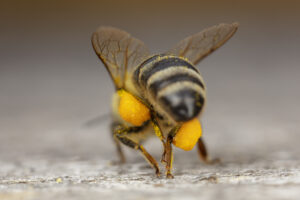
There is no landing board. This is intentional. Observing nature shows us that wild colonies do not need a meeting place outside the hive. Common sense tells us that these queues of bees are an invitation to predators, and that pollen—even on the bees’ legs—ends up where it should not. Pollen belongs on the flower, on the bee’s leg or in the comb… every forced stop on a dirty board is bad for both the pollen and the bee. The entrance must therefore have features that allow bees to come and go without obstacles, even at the height of the nectar flow and activity.
The landing board is the place where bees enter and leave the hive. It serves as the main entrance for bees going out to forage, collect water or return to the hive after foraging.
So let’s watch a few videos of bees entering and leaving conventional beehives. We will understand the stress imposed on them, the time they spend waiting and then twisting and turning so as not to lose their precious pollen—especially when there are also entrance reducers. What a waste of energy! Not to mention that walking around on the floor of the hive can hardly be very hygienic.
The landing board also helps regulate ventilation inside the hive. In summer, bees can ventilate the hive by flying near the entrance to regulate the temperature.
If a landing board is needed to regulate ventilation, there is a design flaw in the living space.
In nature, bees have various ways of regulating the temperature inside the cavity.
The design of conventional beehives does not allow bees to use these natural strategies. They are therefore forced to waste valuable energy unnecessarily to compensate for design flaws.
Bees often clean the hive by pushing waste, dead insects or other unwanted material outside. These are deposited on the landing board.
Yes, and that is exactly where they land carrying pollen, nectar or water. It is as if, to get home with our shopping basket, we first had to walk through the rubbish room and the toilets.
But we admire them because they know how to clean it… what a waste of time and energy!
Bees use the landing board as a landmark to identify their hive among other hives or surrounding structures.
Should we really ignore the bees’ olfactory markings, spatial memory, sensitivity to vibrations and the specific sounds of their hive, and visual memory for recognising the shape and colour of their home? It is as if our doormat were the landmark we used to identify our house.
The landing board gives the beekeeper a convenient place to observe bee activity. This allows them to monitor bees coming and going, identify potential health problems in the colony and assess the hive’s behaviour.
Careful observation of bee traffic and flight behaviour at the entrance, observation of the ground around the hive, using the sense of smell, putting an ear to the hive… also produce good results, but seem to be regarded as a tiresome waste of time.
Some parasites, such as the Varroa mite, can be detected on the landing board.
Wouldn’t a varroa tray under the hive and a good magnifying glass be more precise?
Not to mention that, while the landing board is unnecessary for bees to identify their hive and only causes them difficulties, it also makes it easier for predators to spot a potential food source. It serves as an effective springboard for attacks on the hive to capture bees, pollen or other resources.
That is why the terracotta beehive has no landing board.
The bees take care of everything under the beekeeper’s watchful eye; with their hands behind their back, they intervene only when a problem has been confirmed.
However, the process of introducing the swarm is fairly precise.
To populate the hive, the swarm is traditionally introduced through the entrance, using a board or a white sheet. At this point, the hive consists of the hive body, the lid and the brood plate. A few wax strips are placed in the lid and under the brood plate. Starter strips should be avoided, as the bees will remove them and replace them with their own wax; however, a few clean wax strips and a small spray of propolis might create a sense of déjà vu or “already inhabited”, although I am not sure whether that is too “motherly” an idea.
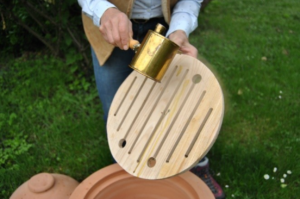
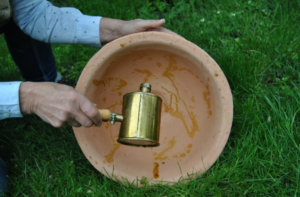
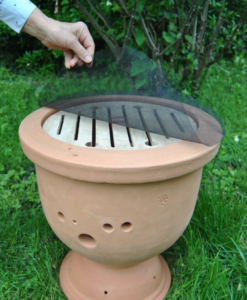
Between the hive body and the lid, on the brood plate, it is important to place cotton gauze or a piece of jute fabric so that the bees do not start building in the lid. Building must start in the hive body. About ten days after the swarm has moved in, when the comb covers the entire surface of the plate, we should remove the separating fabric, perform our only voyeuristic act to inspect the work and the colony, assess it, and put the plate back on the hive body, plugging the finger holes with cork discs before putting the lid back on.
The honey super is not added until the hive body and the lid are full, preferably after the first swarm of the year, so as not to disrupt the colony’s life cycle.
Treatments against the Varroa mite have proved unnecessary. The incoming swarm benefits from the queen’s pause in laying; the Varroa mite does not particularly favour chestnut wood, but more importantly, the temperature maintained by the bees in the combs is always a little above the temperature that favours the development of the Varroa mite. After that, the bees know very well what to do.
I am aware that our efforts for the bees will bear fruit only if environmental conditions are right. Even the best-designed beehive will fail if we do not restore biodiversity. We must stop releasing poisons and waste into nature. We must also limit genetic manipulation, especially when we do not yet fully understand its long-term effects.
Our attitude towards life must change. We must not assume that our cognitive abilities give us the right to dominate and exploit nature.
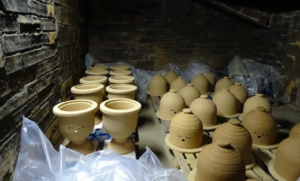
But as the wheel turns and the clay rises in the potter’s wheel cup, I conscientiously smooth the inside of the hive. As I do so, I think that I must make an effort so that the little ones will accept my contribution.
In our conference series “Bees Without Borders”, renowned bee scientist and breeder Dr. Ralph Büchler showed on 28 Oc...
As of 15 September 2026 On 20 May 2026, the Swiss federal popular initiative “For the Safeguarding of Pollination of...
Important information
Important information: The original texts are published in German. The French, Italian and English versions are translated automatically and checked where possible. Please report any errors to bee@freethebees.ch.