Dear readers,
As part of our commitment to the highest standards of quality and accuracy in our publications, we would like to inform you of a necessary correction to our latest bulletin.
We have discovered that the cover image accompanying the article about the Asian hornet mistakenly showed a Vespa mandarinia japonica rather than the intended Vespa velutina nigrithorax. In addition, after careful review, we decided to remove the article because of factual inaccuracies and a one-sided presentation.
To address this topic appropriately and in a balanced way, we have invited two experts in the field to contribute:
We will present their well-founded findings in a new, comprehensive article that offers a balanced and scientifically accurate perspective on the topic.
We sincerely regret this error and would like to apologise for any confusion. Our commitment to accuracy and integrity in our reporting remains unwavering, and we appreciate your understanding and continued support.
Please do not hesitate to contact us if you have any questions or would like further information.
The FreeTheBees team
Article by Charly Giesen and Andi Roost
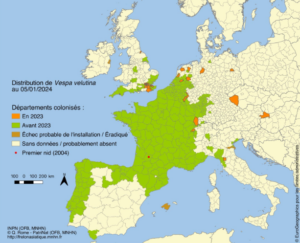
The Asian hornet has been a regular “guest” in Europe since 2004. Having spread from Bordeaux, it is now spreading across Central Europe. In Germany, its current (still) main areas are the warmer regions of Rhineland-Palatinate and Baden-Württemberg in Germany, and Geneva, Jura and Vaud in Switzerland. However, this is likely to change in the coming years. The natural spread rate is estimated at approx. 70 km per year and has slowed in a north-easterly direction. Due to human activity (transport through logistics), it can spread much faster as well (there are already occurrences in Schleswig-Holstein, originating from an island population in Hamburg in 2020).
To analyse the potential risks of Vespa velutina in greater detail, I will first discuss the key differences between Vespa velutina and Vespa crapro.
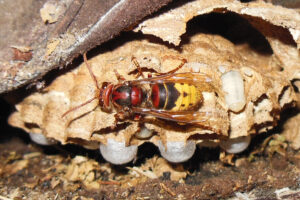
In appearance, Vv is slightly smaller than Vc. Its thorax and abdomen are darker (black), with a few yellow-orange bands. Its legs are yellow in the front third, dark-coloured elsewhere and not reddish-brown as in Vc.
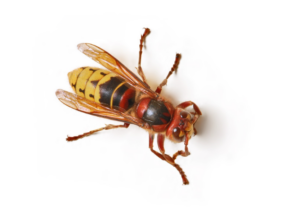
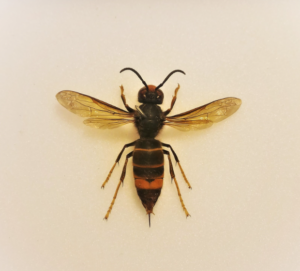
Vv is very alert near its nest (as is Vc), but will only attack if it feels directly threatened. I have not observed any differences in their readiness to defend themselves over the past few years. Even large secondary nests with >1,000 hornets remained completely calm when approached slowly to within 1 m.
Another difference from Vc is that it builds a primary nest (often close to people: under the eaves, in an open conservatory, in an empty birdhouse, etc.), hanging freely or in an open location (such as a birdhouse). Vc does this out of sight, nesting in cavities or niches. Around mid-to-late July, Vv workers build a secondary nest, usually very well hidden high in the trees and often not discovered until late autumn. In Europe, secondary nests can contain up to around 2,000 hornets, far more than Vc nests. Vc only builds secondary nests when its nesting space becomes too cramped and there is no way to expand it.
In favourable conditions, Vv produces many hundreds or even more than a thousand young queens.
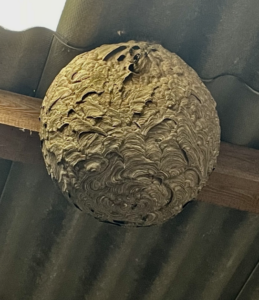
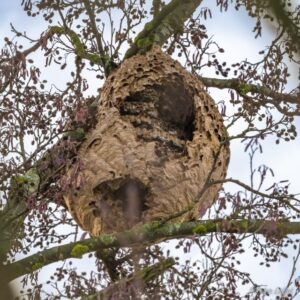
The diets of the two hornet species are broadly similar. They need animal protein to feed their larvae. Sources include numerous species of flies, horseflies, grasshoppers, Vespula species and honey bees. Because Vv colonies are generally larger, Vv needs more food. Some sources estimate this at around 10 kg of insects per year for each secondary nest.
No direct encounters between Vv and Vc have been documented so far. Vc queens regularly fight one another during the nest-founding period in spring; whether this also happens with Vv is not yet known in detail!
Vv is no more aggressive than Vc (both defend their nests only when they are threatened nearby). However, because there can be a much larger number of hornets per nest, the risk of an attack if a Vv nest is disturbed may be greater. But disturbing a Vc nest is also very dangerous without protective clothing.
The venom of both hornet species has a similar effect: in my painful experience, the sting is somewhat more painful than that of honey bees or wasps, but the venom is less toxic than wasp or honey bee venom. In rare cases, someone may have a true wasp venom allergy even if they are not allergic to honey bee stings (and vice versa). I have not met anyone who has been stung by Vv (apart from a hornet consultant).
Both Vv and Vc prey on honey bees. This fact has enabled French beekeepers and beekeeping associations to get Vv classified as an invasive species to be controlled in the EU! This raises the question: “Is Vv really an existential threat to European honey bees, as many beekeepers claim?” French beekeepers have cited the decline in honey production per hive as “proof” of this hypothesis.
For most of the year, Vespa velutina (Vv) poses no greater threat to honey bees than the native Vc. However, one significant difference is Vv’s greater cold tolerance. While this has little impact in spring, the situation is different in autumn: Vv remains active in temperatures down to around freezing point, when other hymenopterans are already inactive. At this time, honey bees still fly out on fine days. Weak or weakened colonies are therefore more at risk than strong, healthy ones. From a beekeeping perspective, this is a loss; from an evolutionary biology perspective, it is natural selection. This dynamic is particularly evident in regions such as the Southern Palatinate, where both hornet species become active at about the same time, in mid-to-late April.
I have never seen Vv “wipe out entire bee colonies”! Nor does Vv attack hives “in swarms”, as is known to happen with Vespa mandarinia and is repeatedly confused with it (Vespa mandarinia is considerably larger (30–50 mm) than Vv and Vc. It is always a single Vv, or a few of them, that try to catch honey bees in flight as they approach the hive. They are quite successful at this, since they are better “fliers” than Vc. I have never seen a Vv inside a hive, because it would be caught and cooked there too. Beekeepers can also protect their bees with a mouse guard (mesh with a mesh size of approx. 6–7 mm) or a porch. Many alternatives to prevent or reduce predation by Vv are published online (additional mesh in front of the hive, narrowing the entrance flight path with partitions, etc.). Many of these methods are ineffective, often non-selective and therefore prohibited (especially killing hornets with bait traps, which always cause considerable collateral damage!).
Given the differences between Vv and Vc outlined above, and the potential risks that follow from them, it should be clear that the issue of Vv is not so clear-cut as some beekeepers, beekeeping associations and media outlets make it seem.
One thing is clear to me, however (to quote a report by the Süddeutsche Zeitung):
“Here to stay.”
All measures to “remove” Vv are Sisyphean tasks. Only nature can set the limits here. Humans may have created the problem, but they can no longer solve it (as has also happened with other invasive species). Ultimately, nature will set the limits and establish a new ecological balance. The process and outcome of this natural adjustment are uncertain. The only certainty is that a new balance will emerge – the timeframe and the precise mechanisms, however, remain a matter of speculation.
Important legal notice: In Germany, the removal of insects is subject to strict nature conservation regulations. Any removal requires authorisation from the competent nature conservation authority. Trapping methods that result in high bycatch are particularly problematic, as they could also put protected species at risk. Such practices are prohibited without the appropriate permit and may have legal consequences.
In our conference series “Bees Without Borders”, renowned bee scientist and breeder Dr. Ralph Büchler showed on 28 Oc...
Martin Ott is convinced: We know enough to solve ecological crises. What is missing is a relationship with this knowl...
Important information
Important information: The original texts are published in German. The French, Italian and English versions are translated automatically and checked where possible. Please report any errors to bee@freethebees.ch.