FREETHEBEES is regularly approached by friends and supporters about “foundations” or, more specifically, “foundation purposes.” Together with our partner Nachlasstreuhand.ch GmbH, we would like to cover topics related to estate planning regularly in our blog and bulletin in a simple and accessible way. Our members are also eligible for reduced rates on advice from Nachlasstreuhand GmbH.
At the end of 2020, 13,375 charitable foundations were registered in Switzerland. As in previous years, the canton of Geneva recorded the highest growth, with 46 new foundations. Across Switzerland, one third of the net growth (25 foundations) was attributable to Geneva. The cantons of Zurich (2,211 foundations), Bern (1,378), Vaud (1,375), Geneva (1,275) and Basel-Stadt (888) continue to occupy the top places in the ranking of leading foundation locations.
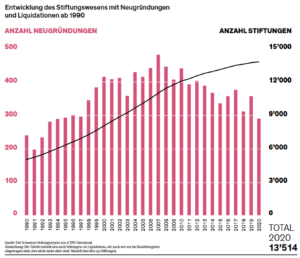
The dynamism of Switzerland’s foundation sector is demonstrated by the fact that over 60% of all charitable foundations in Switzerland were established in the past 30 years, and that with 15.6 foundations per 10,000 inhabitants, Switzerland has six times more foundations per capita than the USA or Germany.
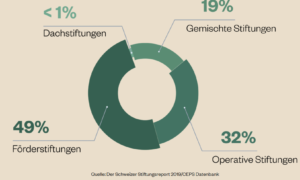
With their financial resources and expertise, charitable grant-making foundations are an independent force that contributes to identifying and solving social problems alongside the state and the economy. Grant-making foundations see themselves as social investors and focus on relevance, impact and professionalism. They are open and visible, and act reliably and in partnership. In return, they enjoy a liberal regulatory framework and public recognition. (1)
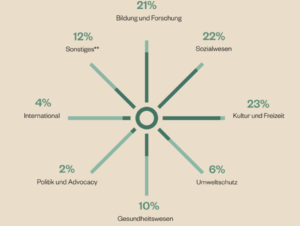
Source: Swiss Foundation Report 2019/CEPS database
Interview with Nachlasstreuhand.ch GmbH
In our last blog post, “Plan your inheritance early and stay flexible,” Beat Schellenberg of Nachlasstreuhand.ch GmbH outlined the important and critical points to consider when drawing up a will, particularly the statutory rules of inheritance. In this new blog post on the subject of “estate planning,” Thomas Fabian, Head of Philanthropy at FREETHEBEES, discusses the establishment of foundations with Beat Schellenberg. We are grateful to Beat for making himself available for another interview.
TF: Dear Beat, we regularly receive enquiries about establishing foundations. Could you tell our friends at FREETHEBEES how to set up a charitable foundation?
BS: Switzerland has a long tradition of foundations and a very liberal foundation law. With more than 13,000 charitable foundations and total foundation assets of around CHF 100 billion, Switzerland has six times more charitable foundations per capita than the USA or Germany. Accordingly, it is relatively easy to establish a charitable foundation in Switzerland. There are only a few restrictions on the establishment, purpose and organisation of a foundation. For this very reason, careful planning is essential.
The following parties are involved in establishing a foundation, and the following steps should be followed:
A foundation can be established during the founder’s lifetime or upon their death through a will or an inheritance agreement. Many founders prefer a combination of the two: they establish their foundation during their lifetime and endow it with the minimum contribution of CHF 50,000 to keep certification and notarial costs low. This allows them to shape their foundation sustainably while ensuring that everything is implemented according to their wishes.
They increase the foundation’s capital year by year. They can deduct contributions as donations on their tax returns—at federal level and in most cantons, up to 20 percent of net income. In their will, founders provide for further assets from their estate to be transferred to the foundation.
Transferring assets to a foundation cannot be reversed, and withdrawals for personal use are not permitted. If you would like to give away some of your assets during your lifetime, you should therefore plan your finances carefully and for the long term, so that you do not later find yourself in financial difficulty or unable to make ends meet.
TF: What should be considered when defining the foundation’s purpose?
BS: The foundation’s purpose is the most important guiding principle for your foundation. It should therefore be worded carefully and thoughtfully. The Board of Trustees has the entrepreneurial responsibility of specifying the foundation’s purpose within the framework of its strategy and putting it into practice. It therefore makes sense for the founder to issue a mission statement and organisational regulations to serve as strategic guidance for the Board of Trustees. Once the foundation has been established, its purpose generally cannot be changed unless the founder has included a “reservation of the right to amend the purpose” in the deed—a provision now recommended by most foundation experts.
TF: How much does it cost to establish a foundation?
BS: A distinction must be made between one-off and recurring costs.
The costs of establishing an independent foundation include:
• Lawyers’ fees and any other advisory fees
• Fees for entry in the commercial register
• Notarial costs (notarisation of the foundation’s establishment)
• Fee for placing the foundation under supervision
Establishing an independent foundation is likely to cost at least CHF 10,000 to 15,000, or more depending on the complexity of the foundation.
Various factors affect recurring costs, such as the size of the foundation, the scope of its grant-making activities, and whether a professional office is to be set up or the Board of Trustees will run the foundation itself on a voluntary basis. The costs of auditing and foundation supervision must also be taken into account.
TF: How much capital is needed for an independent foundation?
BS: In practice, most supervisory authorities require initial capital of CHF 50,000. In addition to cash, assets in kind (e.g. income-generating properties) can also be contributed to the foundation. For cost and tax reasons, it may be worthwhile to endow the foundation with the minimum capital and provide it with ongoing contributions.
In an article in Schweizer Monat in 2010, founder Dr Peter Spinnler argues—and demonstrates this with his own example—that a foundation needs assets of at least CHF 10 million to establish a charitable grant-making foundation intended to exist in perpetuity. (2) Personally, however, I would set the lower limit at around CHF 5 million.
What matters, however, is not the initial capital, but that the future value of the assets is proportionate to the foundation’s purpose. Many foundations, particularly those with no time limit, suffer from having too little capital. If the foundation deed requires the capital to be preserved and imposes restrictive investment rules, foundations may be unable to provide grants during periods of negative interest rates. In addition, the smaller the assets, the greater the relative share of administrative costs in total expenditure. (3)
TF: Who can help me establish a foundation?
BS: I would be happy to support prospective founders in an initial meeting; Nachlasstreuhand.ch GmbH has helped establish foundations and has practical experience in both establishing and running them. To avoid unnecessary mistakes, simplify the actual establishment process and save costs, legal professionals with in-depth knowledge of foundation law should be involved in drafting the statutes and submitting them to the authorities for preliminary review. In addition to covering other important aspects of estate planning (wills, division of estates, inheritance taxes, real estate and provision for the future), Nachlasstreuhand.ch GmbH supports foundations throughout the entire process, from establishment to long-term support.
As of 15 September 2026 On 20 May 2026, the Swiss federal popular initiative “For the Safeguarding of Pollination of...
On 30 July 2026, 44 donors accepted our invitation to Estavayer-le-Lac—the highest attendance ever at a FreeTheBees d...
Around 30 members and the board met on 25 July for the annual members’ gathering at Park Seleger Moor in the canton o...
Important information
Important information: The original texts are published in German. The French, Italian and English versions are translated automatically and checked where possible. Please report any errors to bee@freethebees.ch.