Summary of findings from the conference with Dr. Stefan Hügel on 8 April 2026
In FreeTheBees’ monthly “Bees Without Borders” conference series, a central loop was recently closed: the path from soil health through plant and animal health to human health. Dr. Stefan Hügel, a bioprocess engineer and trace element expert, vividly illustrated in his presentation that the fate of our honey bees is inextricably linked to the mineral composition of our soils.
From the Ground Up: Why Bee Conservation Begins in the Soil
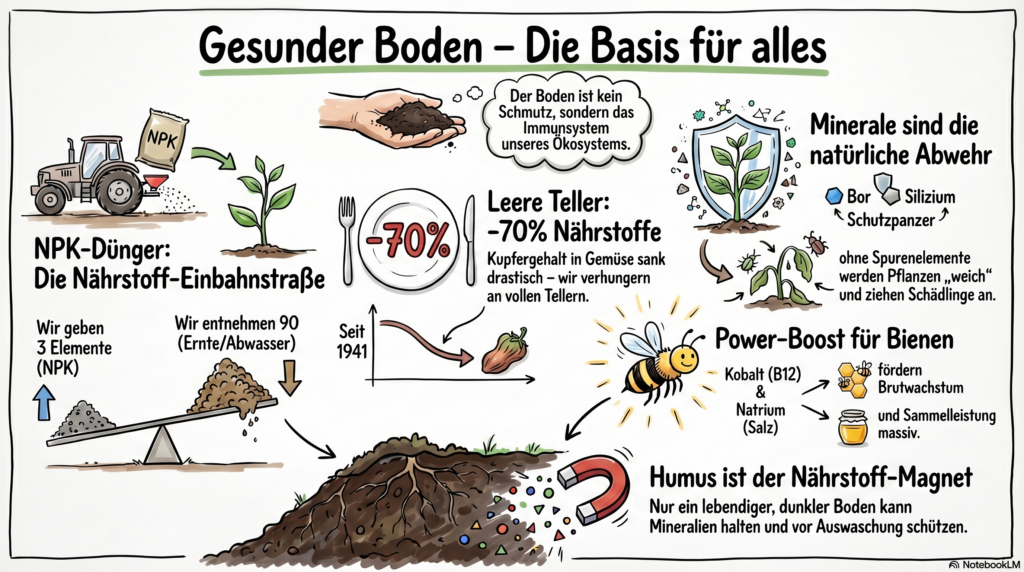
In the past, agriculture was a cycle. Today, Dr. Hügel says, we live in a “nutrient one-way street”. Whereas manure and slurry used to nourish the soil, modern agriculture now relies almost exclusively on water-soluble NPK fertiliser (nitrogen, phosphorus, potassium). The problem: while NPK supplies three important elements for yields, it completely neglects the supply of dozens of essential trace elements.
Because human waste is discharged into the oceans via sewage treatment plants instead of being returned to fields as nutrients, no recycling takes place. The result is dramatic depletion: studies show, for example, that the copper content of vegetables fell by more than 70% between 1941 and 1990. Dr. Hügel summed it up aptly: “We are starving at tables laden with food” — we may produce plenty, but it lacks the life-sustaining quality of micronutrients.
This one-sided fertilisation system produces weak plants. Nitrogen and phosphorus massively stimulate primary metabolism (growth), but this comes at the expense of secondary metabolism. Through this individual metabolism, plants produce secondary plant compounds and defences against stress. Without them, the plant becomes “soft” and attracts pests.
Dr. Hügel describes these pests as “nature’s garbage collectors”, which remove sick and nutrient-poor plants. To stop infestations, crop protection products are used, which often makes the situation worse: fungicides, for example, block the bees’ detoxification system, which can make insecticides 2 to 10 times more toxic.
Research shows that bees have an instinctive hunger for minerals that conventional sugar feeding cannot satisfy.
For Dr. Stefan Hügel, the solution lies in a step-by-step strategy developed by the Almaterra association: in the short term, nutrient deficiencies must be addressed directly; in the medium term, plants must be strengthened through targeted mineralisation; and in the long term, the global nutrient cycle must be closed again.
In our conference series “Bees Without Borders”, renowned bee scientist and breeder Dr. Ralph Büchler showed on 28 Oc...
As of 15 September 2026 On 20 May 2026, the Swiss federal popular initiative “For the Safeguarding of Pollination of...
Important information
Important information: The original texts are published in German. The French, Italian and English versions are translated automatically and checked where possible. Please report any errors to bee@freethebees.ch.