FOCUS: Fewer interventions, greater resilience: Lessons from low-intervention beekeeping
Summary of the Bees Without Borders conference with Paul Honigmann
Less is more. Three words that contradict a society that constantly calls for «more»: more treatments, more control, more interventions. Yet the honey bee survived for millions of years without us—and for the last 200 years, not because of us, but in spite of us. At our «Bees Without Borders» conference, Paul Honigmann made this strikingly clear: when we impose less on bees, we get more resilient colonies. Resilience comes from trusting what evolution has created.
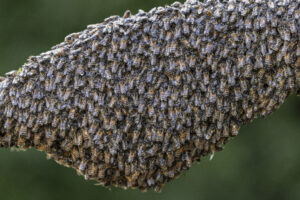
This insight runs through this issue. Benedikt Arnold reports on his forest beekeeping trip to Poland—where centuries-old knowledge is still alive. 188 volunteers are documenting through Swiss BeeMapping how wild colonies survive without beekeeper intervention. We have built what is probably the largest scientific dataset on wild honey bees in Europe. Survival rates here in Switzerland are alarmingly low compared with other countries such as France and England—but they show us the way.
With the merger of Swiss BeeMapping and the Tree Cavity Project, we are opening a new chapter. Monitoring and active protection—two sides of the same coin. Behind every data point is a person. A volunteer who makes the journey to «her» tree three times a year. An arborist who carries SwissTrees up a steep slope. People who do not call for recognition, but simply get things done. They are the heart of this movement.
Spring teaches us that a new beginning does not mean throwing everything overboard. It means preserving what has stood the test of time—and having the courage to let go of what is outdated. That is exactly what FreeTheBees stands for.
Enjoy reading this spring edition!
Warm regards,
André Wermelinger
In our conference series “Bees Without Borders”, renowned bee scientist and breeder Dr. Ralph Büchler showed on 28 Oc...
As of 15 September 2026 On 20 May 2026, the Swiss federal popular initiative “For the Safeguarding of Pollination of...
Important information
Important information: The original texts are published in German. The French, Italian and English versions are translated automatically and checked where possible. Please report any errors to bee@freethebees.ch.