The way we keep bees determines their well-being, their ability to adapt and, ultimately, their survival.
Yet for a long time, there was no clear system for comparing or classifying different beekeeping methods. Terms such as nature-oriented, true to the nature of the bee or species-appropriate were understood in different ways – there was no common technical basis.
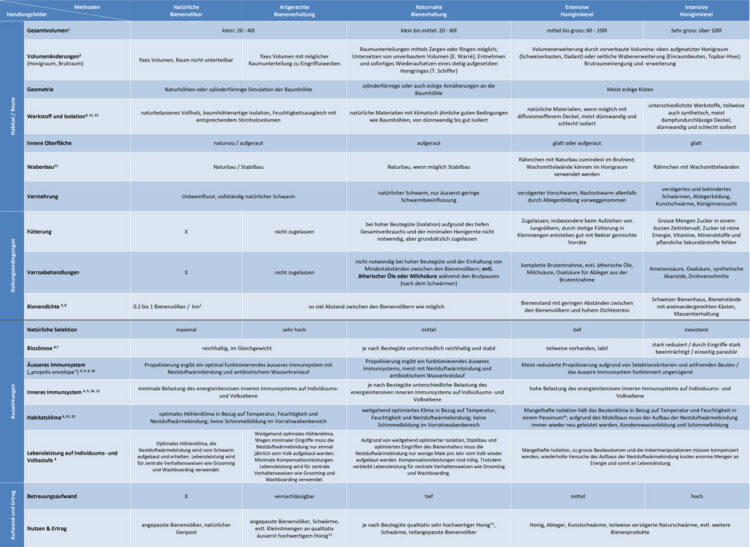
FreeTheBees has developed a beekeeping methodology for this purpose: a structured classification that shows for the first time
Reference: Wermelinger, A., & Hörler, E. (2026). The FreeTheBees Beekeeping Methodology (Version 2020_06_03_de). FreeTheBees. https://doi.org/10.5281/zenodo.19019478
Download table: Beekeeping Methodology, Including References
Our aim is not to define the “best” or “right” method. There is no single optimal beekeeping method. Every form of beekeeping has advantages, but also limitations – depending on the location, climate, the beekeeper’s experience and objectives.
The beekeeping methodology helps you
We call this the “both-and principle”: mixed beekeeping.
FreeTheBees developed the beekeeping methodology to provide beekeeping with a clear technical basis. Until then, the field lacked a consistent definition of what determines the intensity of beekeeping.
Our classification is based on scientific findings, practical experience and observations from Switzerland and many neighbouring countries. It draws on honeybee biology, natural principles, evolutionary theory and the work of leading experts such as Prof. Thomas D. Seeley, Prof. Jürgen Tautz and many other highly regarded scientists and practitioners.
The methodology is continuously developed and refined with the aim of
The future of the honeybee does not depend on either-or, but on both-and. Integration and interdisciplinary collaboration are needed, not division and narrow self-interest.
Anyone who harvests honey from bees also has a responsibility towards nature. Diverse, differentiated beekeeping creates healthy colonies, supports stable ecosystems and leads to a more sustainable balance between humans and bees.
FreeTheBees invites all beekeepers to reflect on their approach and calls on them to think and act independently – and to contribute, step by step, to beekeeping that is more in tune with nature.
On 9 October, a class from Collège du Sud came on a school trip to our site in Vaulruz, right among the bees. The stu...
In our conference series “Bees Without Borders”, renowned bee scientist and breeder Dr. Ralph Büchler showed on 28 Oc...
“I observe how nature works” For over 15 years, Heinz Weder has been observing free-living honey bee colonies. He has...
Important information
Important information: The original texts are published in German. The French, Italian and English versions are translated automatically and checked where possible. Please report any errors to bee@freethebees.ch.