At its meeting on 19 May 2021, the Federal Council decided that the revised inheritance law would enter into force on 1 January 2023. Under the new law, testators will be able to freely dispose of a larger portion of their estate. Wills already drawn up may then no longer reflect their final wishes. It is therefore advisable to review them now.
The revised inheritance law is more flexible than before. Testators will be able to freely dispose of a larger portion of their estate. Today, children are entitled to three quarters of their statutory share as a reserved share. In future, this will be reduced to half. The reserved share for parents will be abolished entirely under the revision. The reserved share for a spouse or registered partner, on the other hand, will remain unchanged. Anyone who wishes to distribute their estate according to their wishes by means of a will will therefore be less restricted by reserved shares in future. They will be able to dispose of their assets more freely and, for example, provide more generously for a cohabiting partner. The Federal Council has decided that the revision will enter into force on 1 January 2023. (Link)
In our last two blog posts, «How to establish a charitable, tax-exempt foundation» and «Plan your inheritance early and remain flexible», Beat Schellenberg of Nachlasstreuhand.ch GmbH highlighted the important and critical points involved in these common questions raised by our supporters. In the new blog post on the topic of «Revised Inheritance Law», Thomas Fabian, Head of Philanthropy at FREETHEBEES, discusses with Beat Schellenberg the reasons for the new inheritance law and the specific changes it introduces. We are delighted that Beat is once again available for an interview.
Thomas Fabian: In December 2020, Parliament reformed Swiss inheritance law. Just a few months later, the Federal Council decided that the revision would enter into force on 1 January 2023. Why?
BS: The current inheritance law came into force in 1912 and has only been revised in specific areas since then. It is based on the traditional family model: married couples with biological children. Over the past hundred years, however, ways of living together, as well as family and demographic structures, have changed considerably. Today, there are many other forms of living together—unmarried partners with or without children, as well as, for example, blended families. The planned changes to inheritance law are intended to take these circumstances into account.
TF: What will change under the new inheritance law?
BS: In future, testators will be able to dispose of their assets more freely and provide for their loved ones. Anyone who wants to provide for their cohabiting partner, for example, will have more flexibility. The same applies to providing for stepchildren.
TF: But these people still have no statutory right to inherit?
BS: That is right. Unlike statutory heirs—such as spouses, children and parents—the testator must appoint them as heirs in a will. However, a larger portion of their assets will now be available for this purpose; that was, after all, the main aim of the legislative revision.
TF: How was this aim achieved?
BS: By reducing the reserved shares. These are minimum portions of an estate to which descendants, spouses, registered partners and parents are entitled. Today, three quarters of the statutory inheritance entitlement of descendants is protected as a reserved share. In future, it will be only half. The reserved share for parents will be abolished entirely. The reserved share for a spouse or registered partner will remain unchanged at half of their statutory inheritance entitlement. Anyone who wishes to distribute their estate according to their wishes by means of a will will therefore be less restricted by reserved shares in future.
TF: What happens if I do not make a will?
The law then determines who inherits what. Statutory shares of an estate are not affected by the revision and will remain unchanged. If the testator has not stipulated their succession in a will or an inheritance contract, statutory succession applies, in accordance with Articles 457 to 466 of the Swiss Civil Code.
TF: When does the new inheritance law come into force?
It comes into force on 1 January 2023. Anyone who has already made testamentary provisions for their estate has until then to have their will reviewed by a specialist.
TF: Why is it advisable to review existing arrangements in light of the legislative revision?
Where existing estate-planning arrangements were drawn up before the new inheritance law comes into force, difficulties of interpretation may generally arise if the testator dies after 1 January 2023.
For example, a person may have limited their own biological children to their reserved shares so that their stepchildren can benefit. It must then be checked whether, under the current interpretation of the wording chosen at the time and the new inheritance law applicable from 1 January 2023, the children or stepchildren concerned will receive enough, too much or too little. It is also possible that the wording used at the time may suddenly become unclear or ambiguous under the revised inheritance law.
In that case, the shares of the estate may need to be adjusted and worded more clearly in a new estate-planning arrangement. It is best to discuss these questions with an inheritance law expert (lawyer, attorney or notary) or make an appointment with my company, Nachlasstreuhand.ch GmbH.
It is also advisable to take the new provisions into account when planning your estate today, so that no changes are needed once the new law comes into force.
Regardless, you should review your estate-planning arrangements every few years, as your family and financial circumstances, as well as your own wishes, may change over time.
TF: What does the inheritance law revision mean for the freely disposable portion?
BS: The assets in an estate remaining after all reserved shares have been deducted make up the freely disposable portion, which can be distributed as one wishes. Anyone who leaves no heirs entitled to reserved shares can even distribute their entire estate completely freely—for example, by appointing charitable organisations such as FREETHEBEES as an heir or legatee. Anyone who wishes to dispose of the freely disposable portion must draw up a will or enter into an inheritance contract. They can then use this freely disposable portion to benefit any natural person or legal entity, provided that the document is worded correctly from a legal standpoint.
TF: Who can help me draw up a will that complies with the law?
BS: I am happy to offer members and supporters of FREETHEBEES a free one-hour initial consultation. In addition to the important aspects of estate planning (wills, division of an estate, inheritance taxes, real estate and financial planning), Nachlasstreuhand.ch GmbH also supports foundations throughout their lifecycle, from establishment to providing ongoing support. Establishing a foundation during one’s lifetime or through a will is a special form of estate planning.
…Many thanks, Beat, for your valuable time! We will be back in a follow-up blog post to discuss with you the important, though for the vast majority of people «unpleasant», topic of the execution of wills…
The following graphic was prepared by our CFO, Thomas Fabian, together with lawyers who are friends of FREETHEBEES:
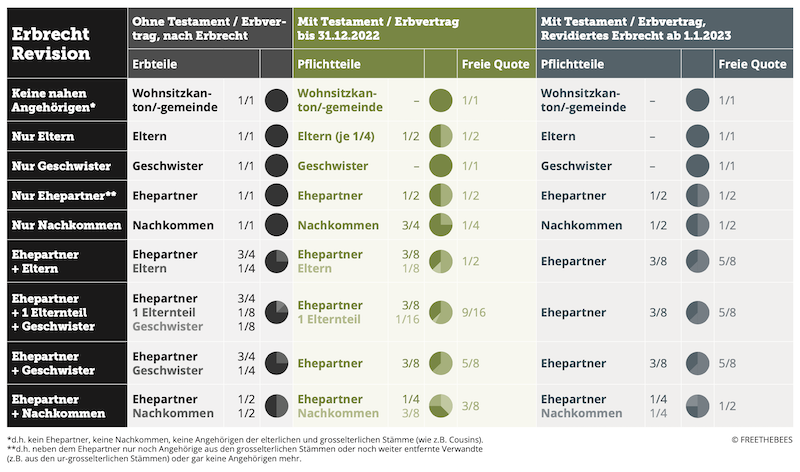
FREETHEBEES recommends that its supporters, members and sympathisers have the current status of their estate-planning arrangements reviewed from an inheritance law perspective, or consult an inheritance law expert when drawing them up for the first time.
As of 15 September 2026 On 20 May 2026, the Swiss federal popular initiative “For the Safeguarding of Pollination of...
On 30 July 2026, 44 donors accepted our invitation to Estavayer-le-Lac—the highest attendance ever at a FreeTheBees d...
Around 30 members and the board met on 25 July for the annual members’ gathering at Park Seleger Moor in the canton o...
Important information
Important information: The original texts are published in German. The French, Italian and English versions are translated automatically and checked where possible. Please report any errors to bee@freethebees.ch.