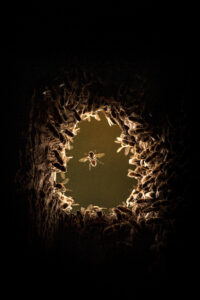
Every month, we introduce one of the volunteers in the “Wildlife Honey Bee” project. This time: Angelika. Her photo was chosen as the winning image of the autumn observation period, and she answers the question Heinz Weder asked all the observers in his last portrait.
Angelika spent her entire working life sharing her enthusiasm for nature—as a biology teacher, nature educator and wilderness educator. Now retired, she has time for something that has been close to her heart for a long time: observing wild honey bees. To do so, she and her husband Wolfgang travel from southern Germany to the Canton of Basel-Stadt.
My name is Angelika and I live in southern Germany. I have always been fascinated by nature, so I studied biology and became a teacher. As a biology teacher, nature educator and wilderness educator, I tried to share my enthusiasm and knowledge.
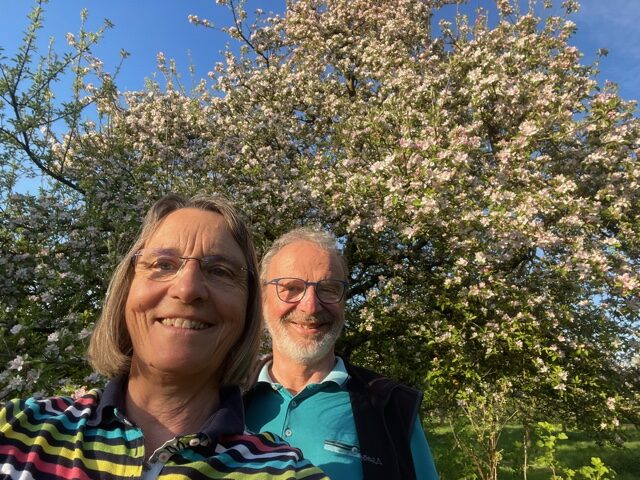
Angelika and Wolfgang among the blossoming fruit trees. At this time of year, they especially enjoy observing insects and are glad there are enough blossoms for honey bees, wild bees and butterflies.
I kept bees for many years. At some point, I started looking for ways to do more justice to the bees. During a tree-beekeeping course in Germany, I built a log hive and came across FreeTheBees online. I have been involved since 2026.
Angelika and her family made a bee video from their own footage, which also shows the log hive.
So far, one colony in the Canton of Basel-Stadt. The journey is a little long, but now that I am retired, I really do have the time, and my husband Wolfgang comes along.
In early October, during the autumn observation, we could immediately tell from the intense flight activity that the colony had survived until then. We were especially pleased because the tree cavity is in the middle of a residential area. The bees fly in and out through a low opening in the trunk, right next to a footpath. It is wonderful that people here are so tolerant!
During the autumn observation, Asian hornets hovered in the air like little helicopters in front of the entrance slit. The honey bees used very different parts of the slit to fly in and out. This meant the hornets were unable to catch any prey while we were observing. I hope the bees will continue to cope with this threat.
I am glad these observations can show that honey bees still have the potential to survive as wild animals without human intervention. The project takes a different approach from most initiatives involving honey bees. It is not about our benefit or the easiest way to manage them for our own purposes, but about how honey bees can lead independent lives as wild animals.
I hope we will recognise the intrinsic value of nature more. Albert Schweitzer put it this way around a hundred years ago: “I am life that wills to live, in the midst of life that wills to live.”
It is very rewarding to see honey bees from a different perspective and experience for yourself that they do not need people to look after them in order to live. Nature is strong! We just have to let go. That gives us hope. So, do get involved!
In his last portrait, Heinz Weder asked all the volunteers what role a bee colony plays in the ecosystem. Angelika replied:
“To me, honey bees are excellent networkers. Through pollination, they provide food for many animals and people: berries, apples, plums … For wild plants, pollination and the subsequent formation of fruit ensure their reproduction.
The cavities where wild honey bees live also provide space for other creatures, such as pseudoscorpions, which help the bees fight Varroa mites. Great tits are happy to eat dead bees. Living honey bees are also food for animals such as bee-eaters and hornets. And the wax moths still feed on the combs in abandoned nests.
Honey bees also connect people and landscapes: honey is a landscape you can taste.
It is astonishing how much life the little honey bees make possible together as a superorganism—the ‘bee’!”
Like Heinz, Angelika is passing a question on to the other volunteers:
Can any of you think of a specific example where we managed to put our human interests aside in favour of other living beings? How were people motivated to do so?
Send us your answer at marie.hallmann@freethebees.ch. We will publish a selection in the next portrait.
In the “Wildlife Honey Bee” project, around 180 volunteers document more than 400 nesting sites of wild honey bees in Switzerland. You do not need any prior knowledge, just curiosity and a little time. Become a volunteer now.
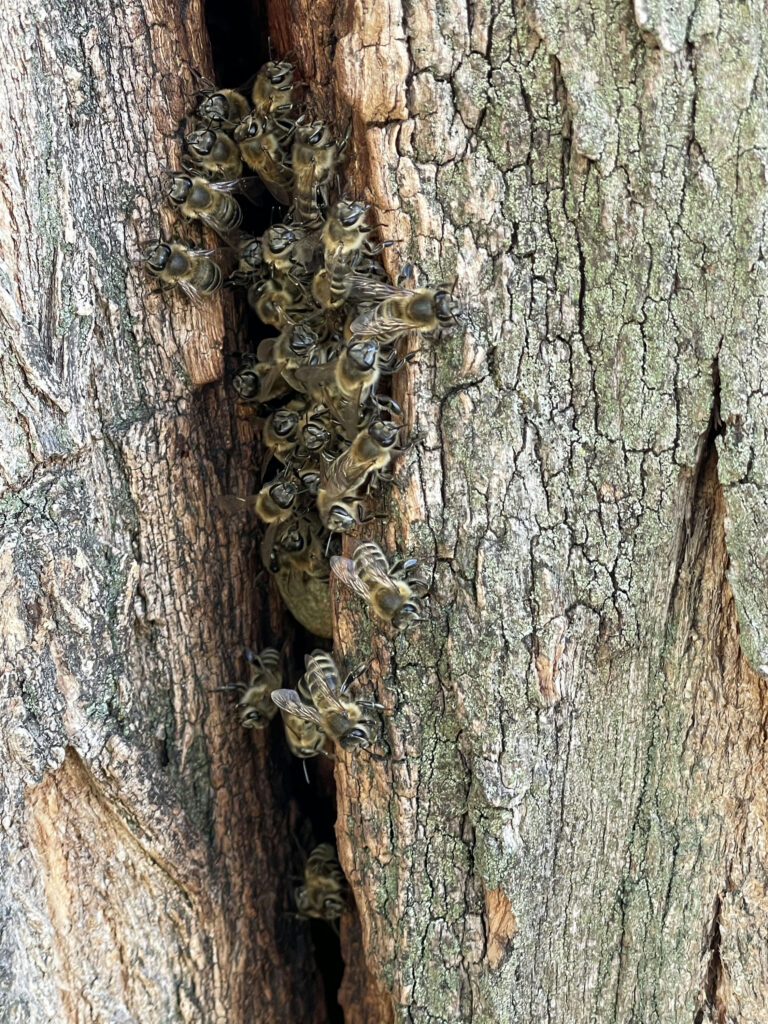
Angelika’s winning photo from the 2026 autumn observation. As her prize, she chose a voucher from Delinat. Congratulations!
What Michelle Knecht’s report gets right, where the IUCN definition is imprecise—and why Switzerland should act now. ...
Bees sleep, and the first studies on this subject date back more than 40 years. On 18 November 2026, sleep researcher...
In our conference series “Bees Without Borders”, renowned bee scientist and breeder Dr. Ralph Büchler showed on 28 Oc...
Important information
Important information: The original texts are published in German. The French, Italian and English versions are translated automatically and checked where possible. Please report any errors to bee@freethebees.ch.