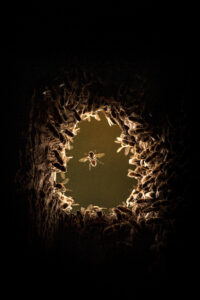
Bees sleep, and the first studies on this subject date back more than 40 years. On 18 November 2026, sleep researcher Günther W. Amann-Jennson presented at “Bees Without Borders” what is known about bee sleep and which environmental factors he believes could disrupt it. Here are the key findings and quotations from the talk.
Amann-Jennson, from Frastanz (Austria), has been studying human sleep health for more than 40 years. For the conference, he familiarised himself with bee sleep and brought together findings from bee research with his experience in human sleep research. Where direct scientific evidence is lacking, he says so himself. This is noted at the relevant points.
According to Amann-Jennson, research into bee sleep began more than 40 years ago. In 1983, Walter Kaiser and Jana Steiner-Kaiser of the then Darmstadt University of Technology published their fundamental findings in the scientific journal “Nature”. They studied the bees’ movement and responsiveness and measured their muscle activity. They observed different states of rest and sleep, similar to those in humans. Further important research on bee sleep by Walter Kaiser followed in 1988.
“… that bees sleep, and by now there is absolutely no doubt about it.” Günther W. Amann-Jennson (from 9:55)
For about 20 years, research has assumed that sleep is vital for bees. As in humans, there appears to be a sleep-rebound effect: after sleep deprivation, bees make up for lost sleep.
“Bees do not simply rest; they actually have biologically regulated sleep.” Günther W. Amann-Jennson (from 12:27)
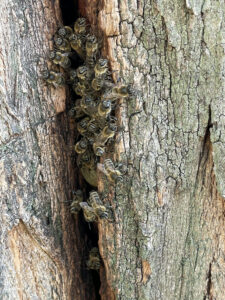
The body is still, the antennae hang loosely downwards, the legs are bent, and the body lies closer to the surface beneath it. At times, sleeping bees do not respond to stimuli. They sleep directly on the honeycomb, hanging or wedged between the combs. Jürgen Tautz, a bee researcher at the University of Würzburg, has observed that bees support themselves with their heads and abdomens. According to Amann-Jennson, such a sleep bout lasts up to about 30 minutes.
The brain also changes: in honey bees, the activity and responsiveness of nerve cells differ between sleep and wakefulness. More recent studies even measure bees’ brain waves. As in humans, sensory processing is active when awake, while during sleep the neural networks synchronise.
Young hive bees sleep more often in honeycomb cells near the brood area, probably because of the warmth. Older forager bees tend to sleep outside the cells, at the cooler edge of the nest. Bees also take short naps during the day, for example on a flower. These may last a few minutes, until something disturbs them, such as a person or an animal nearby.
According to Amann-Jennson, sleep deprivation has effects on several levels. In his view, the scientific findings to date make it entirely plausible that honey bees can also suffer from sleep and regeneration problems.
The speaker compares what disrupts human sleep with the situation facing bees. Where he says that direct evidence is lacking, this is noted.
Certain plant protection products target receptors in bees’ nervous systems and disrupt signal transmission. This affects sleep and the internal clock. A 2020 study in “Scientific Reports” reached a similar conclusion: neonicotinoids disrupt honey bees’ daily rhythms and sleep (Tackenberg et al. 2020). Amann-Jennson sums up: pesticides endanger bees through their acute toxic effects, and certain active substances can also disrupt sleep and the internal clock.
More and more beekeepers are placing hives in cities, for example on roof terraces. There, traffic, trains and construction machinery expose colonies to noise and vibrations. According to Amann-Jennson, bees perceive vibrations mainly through their legs and the honeycomb. He considers it possible that such prolonged exposure could cause colonies to swarm. On the subject of sleep, he says:
“Although direct evidence of sleep disturbances is still lacking, it makes sense to me from a logical point of view …” Günther W. Amann-Jennson (from 31:39)
According to Amann-Jennson, light is the most important biological regulating factor for humans, animals and plants. Artificial light has a particularly negative effect in the evening and at night. Research on honey bees shows that constant light affects sleep and shifts the internal clock. This is also demonstrated by a 2024 study in “Scientific Reports”: foragers exposed to constant light slept less, and their sleep rhythm shifted (Kim et al. 2024). His advice to beekeepers: check whether there is artificial light at the location of the hives.
When discussing electromagnetic fields, Amann-Jennson distinguishes between what has been studied and what remains a hypothesis. He refers to a 2025 field study: weak electric fields, such as those measured near high-voltage power lines, reduced honey bees’ flower landings by 71% (alternating current) and 53% (positive direct current), respectively (Mallinson et al. 2025, iScience). The study examines foraging behaviour, not sleep. On the subject of sleep, he says:
“… as of now, we cannot say that there is any direct indication or evidence that electromagnetic fields immediately disrupt bee sleep.” Günther W. Amann-Jennson (from 39:37)
He believes that the combination of different influencing factors ultimately disrupts bees’ sleep and regeneration.
As possible approaches, he suggests shielded and grounded hives, for example using metal mesh. According to him, there is no evidence so far that these benefit bee sleep. In humans, Amann-Jennson says, scientific studies show that grounding the body can significantly reduce electrically induced body voltages. His own many years of experience and measurements also point to positive effects on sleep and regeneration. Whether this applies to bees remains an open question and a possible research topic. In his view, it would be particularly interesting to investigate in more detail the natural bioelectrical properties of tree cavities, as well as the possibilities for grounding and shielding bee hives.
To conclude this topic, he says in essence: avoidable environmental influences that disrupt biological processes should be reduced as much as possible. Common sense is enough for him (from 41:35).
When discussing the choice of location, he mentions geopathic zones, often called underground water streams in popular usage. In the past, many beekeepers used dowsing rods to seek out specific places because bees felt comfortable there. For humans, the opposite was said to be true. Amann-Jennson wants to emphasise these traditional beekeeping experiences and advocates taking a holistic view of the location. At the same time, he qualifies this himself:
“There is no direct scientific evidence for these geopathic zones. This is experiential knowledge.” Günther W. Amann-Jennson (from 52:11)
A change of location can still make a difference. One audience member shared the experience that sometimes it is enough to move the hive site by one metre: the bees may then be less aggressive or develop better.
At the end, Amann-Jennson summarises their shared needs: peace and minimal disturbance, a natural day-night rhythm, a stable microclimate, low levels of exposure and, where possible, a natural, biologically rich environment.
“Healthy, restorative sleep is not an isolated matter, but the result of a well-functioning overall system—and that applies to bees and to us.” Günther W. Amann-Jennson (from 56:43)
In doing so, he connects with FreeTheBees’ vision: to protect honey bees as wild animals too and restore their natural habitats. Bees should be where they belong, “in nature and, if possible, in undisturbed nature” (from 42:33).
“Protecting natural habitats creates the conditions for healthy sleep and regeneration. For our bees, too.” Günther W. Amann-Jennson (from 57:53)
Based on current knowledge, bees also need biologically regulated sleep, and various environmental factors can impair it. That is why we should pay much more attention to the quality of the conditions in which they sleep and regenerate, says Amann-Jennson. In his view, we do not need to wait until every scientific detail has been answered before doing our utmost, today, to support bees’ natural living and regeneration conditions. At the same time, this opens up a very interesting field of research.
André Wermelinger asked whether a living tree cavity might already be a Faraday cage because it is grounded. Amann-Jennson replied that every tree is grounded through its roots. His hypothesis is that a grounded person—and, in this case, a grounded bee—has very good protection against low- and high-frequency electromagnetic fields.
One participant pointed out that although bees are drawn to radiation, they do not prefer all types of zones. Amann-Jennson agreed that there are different kinds of disturbance zones. How geopathic zones and electromagnetic fields affect bees together has not yet been scientifically studied.
The full conference (1 hour 7 minutes, in German) is available as a video and a podcast:
All conferences in the series can be found under Bees Without Borders.
Prof. Günther W. Amann-Jennson, Prof. Dr. med. h.c., is a sleep psychologist, sleep expert, author and founder of SAMINA. For more than 40 years, he has been working on holistic sleep health research and on the connections between sleep, health, regeneration and environmental influences.
FreeTheBees is a Swiss organisation that works to protect wild honey bees, promote bee keeping that meets their needs, and improve their habitats. Find out more about our work and how you can support us.
What Michelle Knecht’s report gets right, where the IUCN definition is imprecise—and why Switzerland should act now. ...
Every month, we introduce one of the volunteers in the “Wildlife Honey Bee” project. This time: Angelika. Her photo w...
In our conference series “Bees Without Borders”, renowned bee scientist and breeder Dr. Ralph Büchler showed on 28 Oc...
Important information
Important information: The original texts are published in German. The French, Italian and English versions are translated automatically and checked where possible. Please report any errors to bee@freethebees.ch.