A treasure hunt in nature
Bee-lining is a treasure hunt in the outdoors, similar to geocaching, where the aim is to find an object hidden somewhere in the surrounding area. But unlike geocaching, the clues you follow come from honey bees, not people. Bee-lining combines elements of careful observation, orienteering and problem-solving, and is great fun!
Tradition
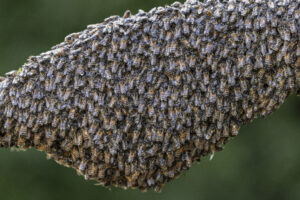
Bee-lining is also an ancient craft practised by people wherever honey bees lived, in order to obtain the world’s most delicious natural food: honey! Nowadays, however, people go bee-lining to find their nests, not to steal their honey.
You are out in nature and have a direct, emotional connection with it. Bee-lining is very similar to birdwatching or other forms of wildlife tracking, because it connects you with nature in a focused way. Our attention is directed towards carefully observing the behaviour of another species in its natural environment. For many of us, this kind of connection with the natural world is extremely enjoyable, perhaps because it engages parts of the human brain that were once very important for finding food, but are hardly used today.
Opening up new perspectives
If you are a beekeeper and already know a lot about honey bees, this will give you a different perspective on Apis mellifera: your attention is focused on a small group of individually identifiable bees, rather than an entire colony of anonymous bees. You observe and appreciate their individuality: some work quickly, others slowly; some are bold, others shy; some fly straight off, while others circle extensively before flying away.
You see how bees live in nature—not in the human-made environment of a hive, packed tightly among other hives in an apiary.
You work with bees that are not disturbed or annoyed, because you give them delicious food and do not break open their home.
Healthy
Bee-lining is good exercise for both body and brain.
Exploring new paths
Bee-lining often takes you to places of exceptional natural beauty that you probably would not otherwise explore. You go wherever the bees lead you, and so they draw you away from roadsides and paths.
Inexpensive
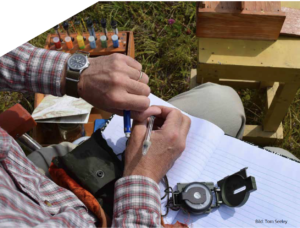
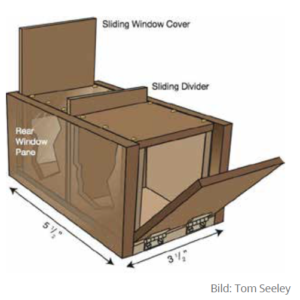
It is an inexpensive sport. The only specialised equipment is the bee box (used to introduce a swarm of bees to a piece of honeycomb filled with sugar syrup)—you can make one yourself. You will also need a compass, a bottle of anise extract, a lightproof cloth, a few coloured pencils, a watch, a jar of sugar water, a pipette, and a notebook and pens.
You will witness first-hand the remarkable navigational and communication abilities of honey bees. You will observe how bees can find their way to and from a food source that is a mile or more from their home. And you will see how the bees can
For everyone, everywhere
recruit their nestmates to a rich food source, while a swarm of bees gradually gathers at your feeding station to collect sugar syrup.
This activity can be done alone or in a group, by people of any age, in the countryside, the suburbs and even in the city… Anywhere there are bee colonies.
Prof. Dr. Thomas Seeley
As of 15 September 2026 On 20 May 2026, the Swiss federal popular initiative “For the Safeguarding of Pollination of...
On 30 July 2026, 44 donors accepted our invitation to Estavayer-le-Lac—the highest attendance ever at a FreeTheBees d...
Around 30 members and the board met on 25 July for the annual members’ gathering at Park Seleger Moor in the canton o...
Important information
Important information: The original texts are published in German. The French, Italian and English versions are translated automatically and checked where possible. Please report any errors to bee@freethebees.ch.