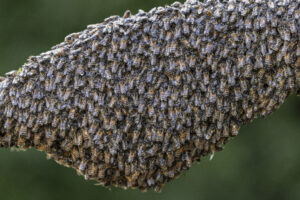
 Death’s-head hawkmoths are currently flying over the Alps to Africa to spend the winter. Some of them have fuelled up on honey in beehives beforehand.
A remarkable moth
The following briefly examines the biology, distribution and behaviour of the Death’s-head hawkmoth in the beehive. It can be concluded that it is hardly a pest to be feared, but rather a fellow creature to be admired for its fascinating qualities.
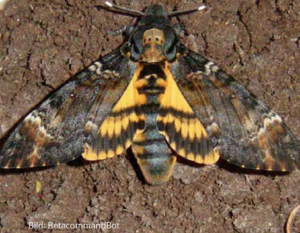
It is likely that long ago the bear, as a natural honey robber, drove bees to nest in tree hollows high above the ground. Less well known is that a flying honey lover occasionally visits beehives: the Death’s-head hawkmoth. It is remarkably well adapted to avoid being stung. Its wingspan measures 9 – 13 cm, and with a body length of 5 – 6 cm, it is the largest Central European butterfly in terms of body volume (Lepidopterologen-Arbeitsgruppe 1997). The moth has marbled, blackish-brown forewings, and its abdomen is ringed with yellow and blackish brown. The yellow marking on its back (thorax) resembles a skull, which gave it its name.
 Superstition
The Death’s-head hawkmoth (Acherontia atropos) is a butterfly (moth) in the hawkmoth family (Sphingidae). Its scientific name refers to the goddess Atropos («the inevitable») in Greek mythology, who was said to be able to cut the thread of life. The Death’s-head hawkmoth (Acherontia atropos L.) has the greatest body volume of all Central European butterflies; its early stages are the pupa and caterpillar. This species is native to North Africa and the Mediterranean region, from where it makes long annual migrations northwards into Europe. In Egypt, the moth is one of the best-known butterflies, where it is called «village elder» (Lepidopterologen-Arbeitsgruppe 1997).
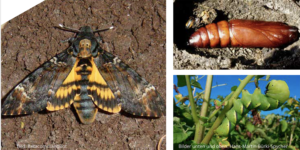
The Death’s-head hawkmoth (Acherontia atropos L.), with the greatest body volume of all Central European butterflies,
its early stages as pupa and caterpillar
In the past, the moths could frighten superstitious farmers in our latitudes as they fluttered around in the dim light of a room lamp. The moths were sometimes nailed to stable doors to ward off death and misfortune (Eis 2005). For a long time, the Death’s-head hawkmoth was considered an omen of ill fortune, a notion still sensationalised today by the film adaptation of Thomas Harris’s novel «The Silence of the Lambs». For example, in 1992, at dusk in San Bernardino GR, countless moths were seen on the accommodation buildings; frightened military recruits beat them to death, mistaking them for hornets (eyewitness P. Sonderegger, pers. comm. H.-P. Wymann). It has been established that the Death’s-head hawkmoth has no adverse effect on human life, or even on honeybees.
Occurrence in Switzerland
The distribution of apiaries in Switzerland is far denser than that of the moth, which is why it is little known among beekeepers. As records from the past 150 years held by the national data and information centre for Swiss fauna (Info fauna – CSCF) show, this moth can be seen in many places.
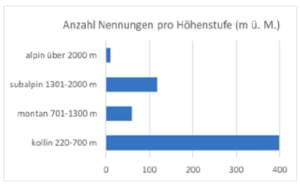
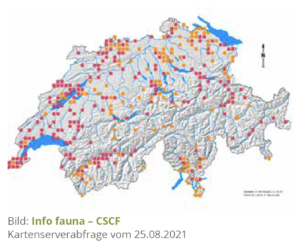 This nocturnal migratory moth makes an annual journey from its native tropical Africa and the Mediterranean region to Central Europe, reaching as far as northern Scandinavia at the Arctic Circle (Lepidopterologen-Arbeitsgruppe 1997, Weidemann & Köhler 1996). As with other migratory moths, such as the Painted Lady and the Red Admiral, mass arrivals from the south can occur between May and June (as in 2003, for example). However, these are far too rare to cause damage to crops. Beekeepers rarely, if ever, see adult moths in their apiaries, although records have become relatively more frequent (graph on the left). They can nevertheless be found on their migrations both in the lowlands (collin zone) and high in the Alps (graph on the right). They are regularly recorded in September at the migratory bird ringing station at Col de Bretolet VS, at an altitude of 1,900 m.
 Unique adaptation
However, the offspring of the migrants are most often spotted as beautiful, more or less conspicuous caterpillars feeding in potato fields and tomato crops from early summer until autumn. Nightshade plants are the caterpillars’ preferred food plants. After the eggs are laid, the caterpillar develops on the plants over three to four weeks, then pupates in the soil, after which the moth emerges and, if possible, begins its return flight south (this can happen as late as December, as records from before 1970 show). Before setting out on its long journey, however, it tries to fortify itself with plant juices and honey.
Distribution of the approximately 600 records across altitude bands (metres above sea level).
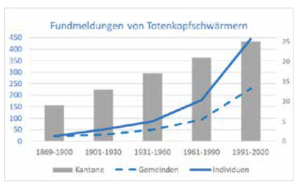 Records have been reported to Info fauna – CSCF from every Swiss canton except Appenzell Innerrhoden (AI) over the past 150 years, since 1869.
Distribution of the approximately 600 records across altitude bands (metres above sea level). The ability to produce sounds, generated by drawing air through the proboscis, is unique to the genus among hawkmoths. Another unusual characteristic is its ability to enter beehives to «tank up» on honey. Its short proboscis is too thick to suck nectar from flowers. However, it is robust and, in terms of length, precisely suited to the depth of a honeycomb cell. It can therefore be used like a stinger to pierce the wax capping of a sealed honey cell and empty it like a drinking cup (in 10 seconds!). During its 15-minute stay in the beehive, a moth can drink up to five cells dry (Heinig 1978, Eis 2005).
Records have been reported to Info fauna – CSCF from every Swiss canton except Appenzell Innerrhoden (AI) over the past 150 years, since 1869.
When honeycombs are unavailable, the moths pierce overripe fruit or sap flows at breaks in felled wood (observed on felled oaks, Eis 2005). The Death’s-head hawkmoth has an arsenal of mechanisms to protect itself from defending bees in the beehive (Eis 2005):
1. Advancing low to the ground while fluttering its wings (to shake bees off or keep them at a respectful distance),
2. Producing whistling sounds or chirping with its proboscis (to inhibit the bees’ aggressiveness),
3. High tolerance to bee venom (experimentally demonstrated, Eis 2005),
4. A very firm, dense and smooth covering of scales (Heinig 1978), as well as
5. A mixture of fatty acids forming a chemical
«cloak of concealment» on its chitinous skin (Moritz et al. 1991).
 Behaviour in the beehive
The butterfly guidebook says (Lepidopterologen-Arbeitsgruppe 1997): «Researchers assume that the chirping sound is intended to inhibit the bees’ aggressiveness when the moth enters a beehive. In addition, the males emit an intense odour reminiscent of dried mushrooms». Eis (2005) describes his film experiment: «When it reached the hive entrance, the guard bees seemed very nervous, but the moth, vibrating its wings, had no difficulty passing them and then entering the hive. It sometimes made chirping sounds as it did so. Eventually, like a helicopter that has just landed, it sat on the combs, keeping the bees at a respectful distance with the air turbulence from its vibrating wings, so that they had to sit in a circle around the moth and watch as it plundered the contents of several combs. Bees that came close and tried to grab its legs were simply shaken off. Finally, once satiated, it crawled chirping through the throng of bees, which did not seem hostile at all. The moth then left the hive through the entrance through which it had entered. It found its way out unerringly, despite having spent several minutes among the combs, and flew off unharmed without having been stung by a single bee.»
There are records of the wax-covered corpses of Death’s-head hawkmoths occasionally found in beehives. Could these moths, after feasting on honeycombs, have become so full that they could no longer escape through the narrow entrance of the hive?
The significance of the Death’s-head hawkmoth
Although the Death’s-head hawkmoth is widespread in Switzerland, its sporadic visits to beehives seem to cause little or no real harm to either bee colonies or beekeeping. Rather, the moth is fortunate if it avoids contact with pesticides used against Colorado potato beetles and fungi. It remains to be seen whether climate change and more frequent periods of unfavourable weather will have a lasting impact. Otherwise, the species is not currently a focus of nature conservation, as a migratory species it is not tied to any particular habitat. Its special adaptations as a honey lover, however, are particularly remarkable. Researchers Martin Wikelski and Myles Menz from the Max Planck Institute of Animal Behavior in Radolfzell and the University of Konstanz are still investigating specific questions about orientation during migration (Bürki-Spycher H.-M. 2011 and 2019; see also totenkopfschwaermer.ch).
Acknowledgements
Thanks are due to Hans-Peter Wymann for many practical anecdotes from earlier observations and for the specimen from the Natural History Museum of Bern, which was made available for photography. Thanks are also due to Jürgen Hensle, a specialist in migratory moths, and Hans-Martin Bürki-Spycher for the latest research information and for reviewing the text; to Yannick Chittaro for the data extract from the national observation database of Info fauna – CSCF; and to Jürg Sommerhalder and André Dunand for the inspiration.
Francis Cordillot
(1) Bürki-Spycher H.-M. 2019: The spectacular flight of the moths
. Wissen. Schweizer Familie magazine 42: 24 – 30.
(2) Bürki-Spycher H.-M. 2011: Messenger of the night. Wissen. Schweizer Familie magazine 40: 28 – 29.
(3) Eis R. 2005: Observations on the behaviour of the Death’s-head hawkmoth Acherontia atropos (Linné, 1758),
Lep.: Sphingidae. Wiss. Mitt. Niederösterr. Landesmuseum, St. Pölten, 17: 265 – 274.
(4) Heinig S. 1978: The Death’s-head hawkmoth (Acherontia atropos, Lep.: Sphingidae) in the beehive. Entomologische Zeitschrift, Stuttgart. 88: 237 – 243.
(5) Lepidopterologen-Arbeitsgruppe 1997: Butterflies and their habitats. Species – Threats – Conservation. Switzerland and neighbouring regions. Volume 2. Hesperiidae, Psychidae, Heterogynidae, Zygaenidae, Syntomidae, Limacodidae, Drepanidae, Thyatiridae, Sphingidae. Pro Natura – Swiss League for the Protection of Nature (ed.): 679 pp.
(6) Moritz R. F. A., Kirchner W. H., Crewe R. M. 1991: Chemical camouflage of the Death’s-head hawkmoth (Acherontia atropos
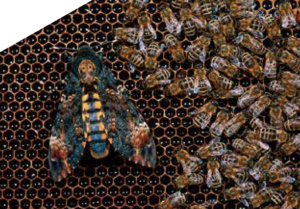
A corpse from a beehive, with its wings worn off and covered in wax scales (found by K. Beyeler in 2004 in Schwarzenburg BE, NMBE collection). Image: Francis Cordillot
L.) in honeybee colonies. Naturwissenschaften 78: 179 – 182.
(7) Weidemann H.J., Köhler J. 1996: Moths – Bombycoid and hawkmoth families. Naturbuchverlag, Augsburg: 512 pp.
Death’s-head hawkmoths are currently flying over the Alps to Africa to spend the winter. Some of them have fuelled up on honey in beehives beforehand.
Image 2
The Death’s-head hawkmoth (Acherontia atropos L.), with the greatest body volume of all Central European butterflies,
its early stages as pupa and caterpillar
As of 15 September 2026 On 20 May 2026, the Swiss federal popular initiative “For the Safeguarding of Pollination of...
On 30 July 2026, 44 donors accepted our invitation to Estavayer-le-Lac—the highest attendance ever at a FreeTheBees d...
Around 30 members and the board met on 25 July for the annual members’ gathering at Park Seleger Moor in the canton o...
Important information
Important information: The original texts are published in German. The French, Italian and English versions are translated automatically and checked where possible. Please report any errors to bee@freethebees.ch.