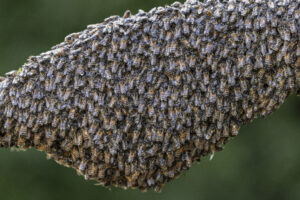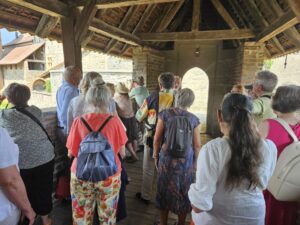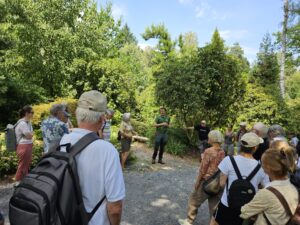
The first FREETHEBEES course on tracking down wild honey bee colonies was a great success! The historical method of beelining can be used to locate wild honey bee colonies. It also offers a profound opportunity to slow down outdoors in nature, with plenty of fun and laughter along the way.
Slowing down
Anyone who wants to track down wild honey bee colonies needs time and patience! From first catching a single honey bee on any flower to finding the entire colony in its natural habitat can take hours, often well over a day. But it is an enjoyable activity that helps you slow down profoundly. You sharpen all your senses and observe new aspects of bees. As a beekeeper, you are much more familiar with bee behaviour from the perspective of the beehive. Beelining teaches you a great deal about the behaviour of worker bees at a food source.
How it works
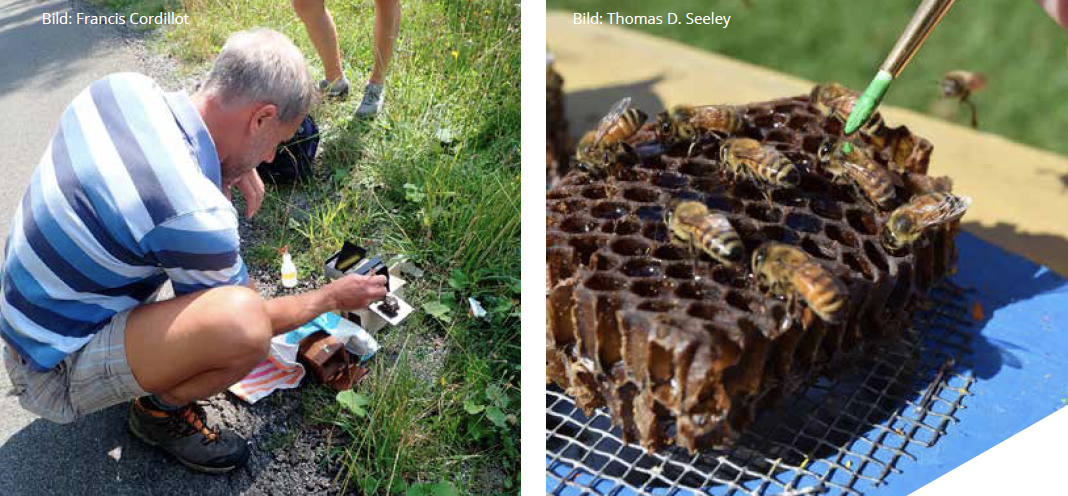
The principle is actually simple: you catch a bee on a flower and feed it a strong sugar solution. The bee flies back to the colony, recruits other bees to the newly discovered food source and brings them along. When the bees return, you start marking them with a dab of paint so you can recognise them. You record the arrival and departure times of individual bees and use a rule-of-thumb formula to calculate the flight distance to the nest. As they leave, you try to identify their direction of flight after they have circled the food source. Once several worker bees have become accustomed to the new food source, you confine the industrious bees for a few minutes and move about 100 m further in the direction of the estimated flight path. You release them there and repeat the same procedure. The bees remember the relocation and recruit others in the hive to the new location of the food source. In this way, you move step by step closer to the colony’s habitat until you find it.
Choosing the area in which to search for wild honey bee colonies is somewhat more complex. If you look for wild honey bee colonies in an area with many beekeepers, you are overwhelmingly likely to find managed apiaries rather than wild colonies. The course was therefore held on Glaubenberg, where the distance from managed honey bee colonies is greatest. The course leaders and participants were able to confirm this after a two-hour hike: not a single honey bee could be seen, but many fascinating wild bee species and hoverflies were observed on flowers. Since everyone at the course naturally wanted to learn the beelining technique, we did not spend hours in this area, which would certainly be of interest for wild honey bee colonies. Instead, we shifted the hike towards managed honey bee colonies and looked for honey bees on flowers there. It was hardly surprising—and quickly became clear after calculating the flight distances and determining the direction—that beelining would lead us to an apiary we could see on the map.
Knowledge sharing
The excellent course, led by bee researcher Benjamin Rutschmann, concluded that evening with an exciting presentation by him and his colleague Patrick Kohl on their latest, as yet unpublished research findings about wild honey bees. Francis Cordillot, co-initiator of the FREETHEBEES Swiss BeeMapping project and study director, also provided an update on the project, leading to an interesting exchange of expertise across projects.
Swiss-made Beelining Boxes
The beautiful, newly designed beelining boxes were also a highlight. Simon Müller, a joiner and carpenter, designed them for us over many hours of volunteer work. They will soon be available in the FREETHEBEES shop, or you can order them directly from Simon.
There was certainly no shortage of fun! We have rarely laughed so much, so heartily and for so long. Perhaps slowing down left its mark here.
FREETHEBEES will also offer beelining courses and workshops in 2022. Some are already listed in the course programme on the website, and more will follow.
André Wermelinger
More about Beelining
Book source:
Following the Wild Bees, Thomas D. Seeley
How to Find Wild Honey Bees
Interview with Benjamin Rutschmann
More Beelining Courses and Workshops
Buy a Beelining Box in the Online Shop
As of 15 September 2026 On 20 May 2026, the Swiss federal popular initiative “For the Safeguarding of Pollination of...
On 30 July 2026, 44 donors accepted our invitation to Estavayer-le-Lac—the highest attendance ever at a FreeTheBees d...
Around 30 members and the board met on 25 July for the annual members’ gathering at Park Seleger Moor in the canton o...
Important information
Important information: The original texts are published in German. The French, Italian and English versions are translated automatically and checked where possible. Please report any errors to bee@freethebees.ch.