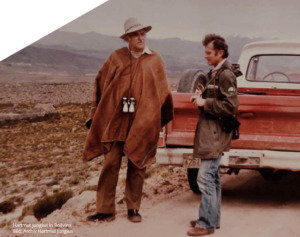
 Hartmut Jungius is a scientific advisor to FREETHEBEES, a biologist, geographer and nature and environmental conservationist working around the world
FTB: You are not only the person who brought forest beekeeping back to Central Europe, but you have also worked in countless countries around the world on species and environmental conservation. Did you already know as a child that you wanted to work in this field? Did you have a role model or a defining moment?
I grew up in a small village in Lower Saxony, very close to nature. This interest in nature also took shape at school and during my studies. My subjects were biology, geography and sports, with a focus on zoology. One day I went to Hanover Zoo, where I had often worked as an intern. Animals were still being brought straight in from Africa back then, something that has long since stopped. Seeing it was a great adventure for me: antelopes, zebras and monkeys fresh from Africa. I talked with the animal catchers and decided that I absolutely wanted to go to Africa too, to a national park where I could work with antelopes. This was only possible if I completed a doctorate, so I did just that. I ended up at Kruger National Park, where I learned an incredible amount about national parks and environmental conservation. I was able to build on this experience during a three-month stay in Canada and the USA, where I got to know many national parks. After that, I knew what I wanted to do: work in nature conservation.
FTB: You have worked in a wide range of countries: Bolivia (vicuña conservation), Canada, the USA, South America, Europe, Oman (reintroduction of the Arabian oryx), China, Kazakhstan (tigers), Mongolia (saiga), Russia, Jordan, Saudi Arabia and many more. What have been your most important insights from this global work in animal and environmental conservation? Are there any common themes? In your view, what are the key factors for successful environmental and species conservation?
The most important thing is to preserve habitats and protected areas. If the habitat is there, animals that have become extinct in the wild can also be reintroduced, of course only if the factors that led to their extinction have been eliminated.
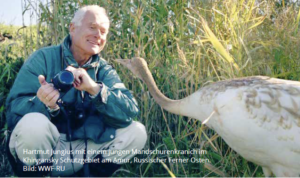 The second important point is to develop a strategy and a plan, and answer the questions: “How do I want to protect a species? And how do I want to protect its habitat?”
Next, you need money—usually a lot of money—and good cooperation with the responsible authorities and local people.
And the final point I would like to mention is the need for a very long-term commitment. There is no point in planning projects for just one or two years, as they often need at least ten years or even longer. There are numerous projects that you can never withdraw from if you genuinely want to ensure that a species, a protected area or a particular habitat is preserved.
FTB: How would you assess the current state of nature conservation in Switzerland in general? Where are we already doing well compared with other countries, and where do you see an urgent need for action?
Switzerland was a leader in animal protection in Europe from an early stage. As far as I know, the impetus came from Basel, particularly from university
professors. But what is interesting is that it also came from industrialists who were interested in nature conservation and began supporting conservation projects. The Swiss League for Nature Protection was among them. It was founded quite early and had protected areas of its own to manage from the outset.
The other very important achievement, where Switzerland was also a pioneer in Europe, was the establishment of the Swiss National Park, one of the first national parks in Europe, if not the world. Switzerland can be very proud of that. Looking at the densely forested slopes of the Jura behind me, Swiss forestry was also truly pioneering in protecting mountain forests and establishing protected forests. In doing so, Swiss forestry sent many positive signals to other forestry sectors in Europe.
Where does Switzerland fall short? Here, things are no different from the rest of Europe: agriculture. Swiss agriculture is far too intensive; we only have to look at the maize fields just outside my garden. It is very painful to see the pesticides being sprayed and the roadsides, where hardly a single flower grows anymore. When I arrived here 30 years ago, things looked quite different. There is an urgent need for action, and not only in Switzerland.
Sustainable agriculture is also important. That means providing more funding and giving it to farmers so that they are not paid for the volume they bring to market, but for how they care for the landscape. Farmers should also be compensated for landscape stewardship. This is already done for mountain farmers, but it should be done in other areas too.
But as I said, this applies not only to Switzerland, but to the entire EU.
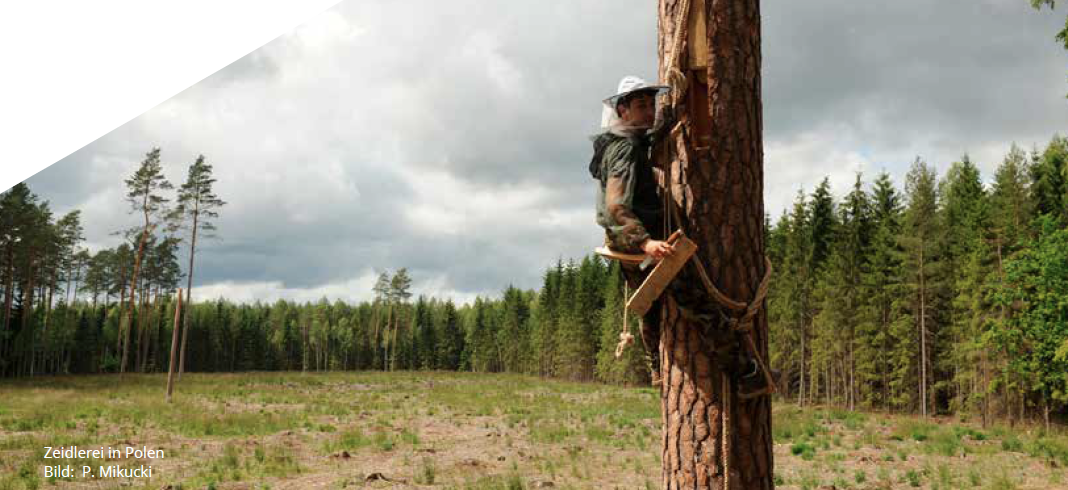 FTB: You have spent your entire career working for the largest international nature and environmental conservation organisations, such as WWF, UNESCO and IUCN. Why did you decide to support our small Swiss association, FREETHEBEES?
It has to do with my enthusiasm for forest beekeeping, or keeping bees in tree cavities. I first encountered forest beekeeping as part of a WWF project in Russia’s Ural Mountains. I was so enthusiastic and deeply impressed to see beekeepers working as rangers there and practising forest beekeeping. Forest beekeeping means managing free-living honey bee colonies. The beekeeper, or rather the forest beekeeper, makes a cavity in a suitable tree. This cavity is closed up, but a small entrance is left so that bees can settle there. Once a year, the forest beekeeper climbs up to the tree cavity to take some of the honey for personal use. The rest is left for the bees. This is a very old form of keeping wild honey bees that was widespread in Eastern and Central Europe until the 18th century, especially in Slavic countries. I was so fascinated by this incredibly old cultural tradition that my Polish friend Przemek Nawrocki and I began thinking about how we could bring it back to Europe and establish it here. This involves certain traditional techniques, but also a particular form of forest management: you need species-rich mixed forests with clearings, wetlands and, of course, old trees.
Then my wife read an article about FREETHEBEES in a magazine. She said, “Hartmut, take a look—isn’t this something for you?” And I said, “This is THE organisation!” It would be interested in forest beekeeping: it is about free-living bees, nature and natural, species-appropriate beekeeping. Then I called the founder, André Wermelinger. He was immediately enthusiastic and said, “Hartmut, let’s do it!” That is how I came to FREETHEBEES: through forest beekeeping.
FTB: In your opinion, what are the most important levers and necessary steps to enable free-living honey bees in Switzerland to cope with environmental conditions without human intervention?
First of all, we need near-natural, structurally diverse mixed forests. Structurally diverse means that these mixed forests must contain a range of different habitats. These include clearings and wetlands, so that a variety of food plants are available for bees. It is also essential to have a legal framework that allows conservationists to bring free-living bees back into forests. At present, there is no such framework. We are allowed to put up nest boxes to help birds breed, but we are not allowed to put up bee boxes or make tree cavities so that honey bees can settle there.
Foresters and beekeepers need to be willing to support this initiative. I can only say: look to Poland; the people there are showing us how it can be done. It is working very well there for precisely these reasons: the willingness of foresters and beekeepers.
It will surely always be painful for a forester to see a magnificent old oak, pine or spruce and know that a tree cavity is going to be made in it. But it is necessary. And besides, tree cavities do not harm the trees at all; they can continue to thrive and live for hundreds of years with the cavities. You can see this in Poland, for example, where many oak trees are still standing even though cavities were made in them a hundred years ago.
FTB: What are we already doing well as an association at FREETHEBEES, and what could we improve?
FREETHEBEES has a high level of expertise and credibility, dedicated and charismatic staff, and a strong strategic approach that provides the foundation for successful work.
What could be improved is fundraising. FREETHEBEES urgently needs more funding and more public outreach.
1 The vicuña (Vicugna vicugna), or Vicuña (Quechua: wik‘uña), is, alongside the alpaca, one of the two species in the genus Vicugna and belongs to the camel family.
Source
2 Oryx antelopes (Oryx) are a genus in the horse antelope subfamily (Hippotraginae). Species in this genus were originally found throughout the arid and semi-arid regions of Africa and the Arabian Peninsula.
Source
As of 15 September 2026 On 20 May 2026, the Swiss federal popular initiative “For the Safeguarding of Pollination of...
On 30 July 2026, 44 donors accepted our invitation to Estavayer-le-Lac—the highest attendance ever at a FreeTheBees d...
Around 30 members and the board met on 25 July for the annual members’ gathering at Park Seleger Moor in the canton o...
Important information
Important information: The original texts are published in German. The French, Italian and English versions are translated automatically and checked where possible. Please report any errors to bee@freethebees.ch.