BEES – FOCUS
By André Wermelinger
The entire world is currently dominated by a largely monocausal discourse on diseases and how to contain them. Our fear of viruses, bacteria, parasites and fungal spores has probably never been greater. It is high time to open up the discourse and focus on the immune system, a topic that is entirely underrepresented. In this article, we look at the highly effective, multi-level immune system of a bee colony and show how to help the colony maintain an intact immune defence.
Viruses, bacteria, parasites, fungi: they were all on Earth long before humans. They are extraordinarily numerous. There seems to be no cm2 on Earth that is not colonised by fungal spores. Even more alarming: our entire bodies, both externally and internally, are practically teeming with bacteria. Many metabolic processes would not even function properly without them. And if we consider humans together with these “foreign organisms” as a superorganism, most of our genetic material is not even human, but dominated by bacteria. And yet we are afraid of falling ill because of external influences. The current discourse in the media, specialist journals and everyday conversations makes it clear, beyond any doubt, that strengthening the immune system is neglected. We are waging a losing battle against a small, invisible enemy instead of strengthening the immune system.
Beekeepers fear for the health of their bees, particularly because of the Varroa mite, a parasite. This is immediately followed by fear of European foulbrood, a bacterial disease. They inspect, fight and disinfect as much as they can. If, for once, we look at naturally living bee colonies without being influenced by our own emotions or vested interests, we are left thoughtful and humbled. They survive without our compulsion to control and treat them, in a hollow tree, all on their own, despite being exposed to untamed, harsh nature! How is this possible?
In their study Socialized medicine: Individual and communal disease barriers in honey bees, Evans Jay D. and Spivak M. (2020) analyse the highly fascinating immune system of honey bees. The title already points to the substance of the study: socialized medicine at the individual and colony levels. They describe the bees’ physiological, immunological and behavioural responses to pathogens and parasites, which reduce the risk of disease. What sounds complex becomes much clearer in the visualisation (Figure 1).
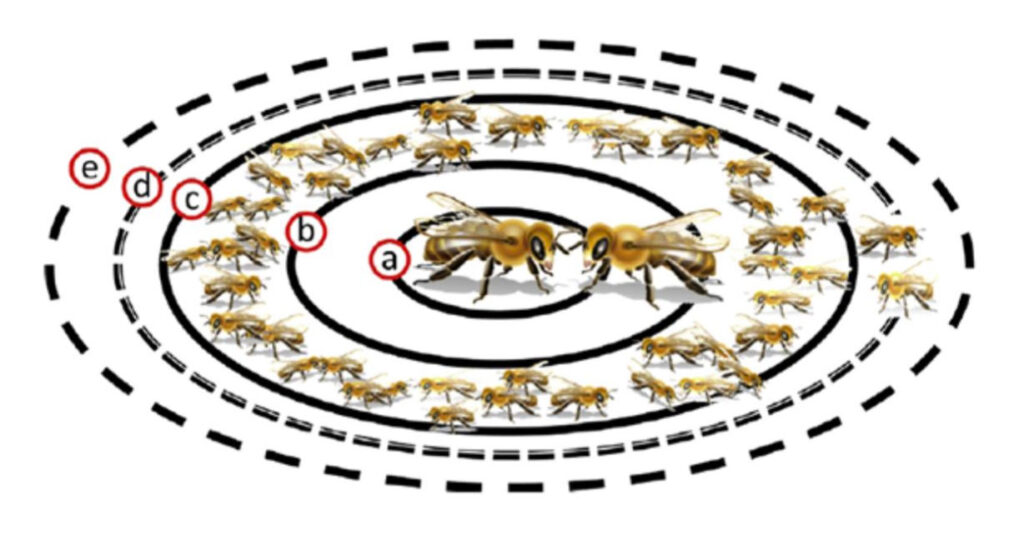
The bee colony therefore has a multi-level defence system, structured as follows:
Equally fascinating is the perspective presented by Ehrler S. and Moritz RFA (2016) in their study Pharmacophagy and pharmacophory: mechanisms of self-medication and disease prevention in the honeybee colony (Apis mellifera).
Figure 2 illustrates how a honey bee colony can heal itself and prevent disease.
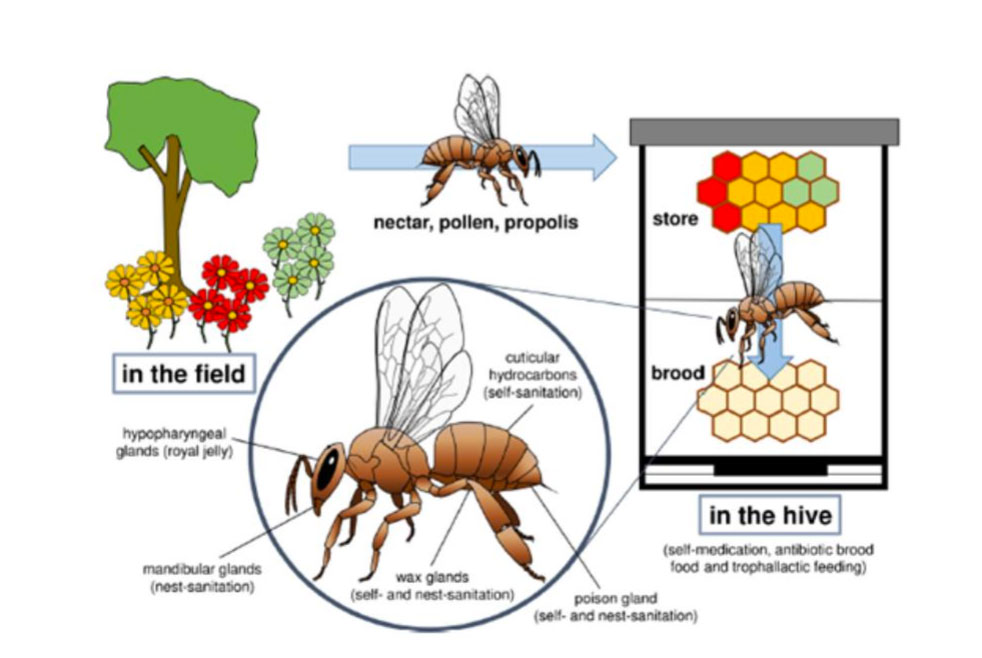
A honey bee colony has a whole range of substances that are important for self-healing, nest hygiene and brood rearing. Secondary plant metabolites with antiviral and antibiotic potential are brought into the hive from the environment, for example in nectar, pollen and resins. The bees themselves produce glandular secretions with antibiotic activity.
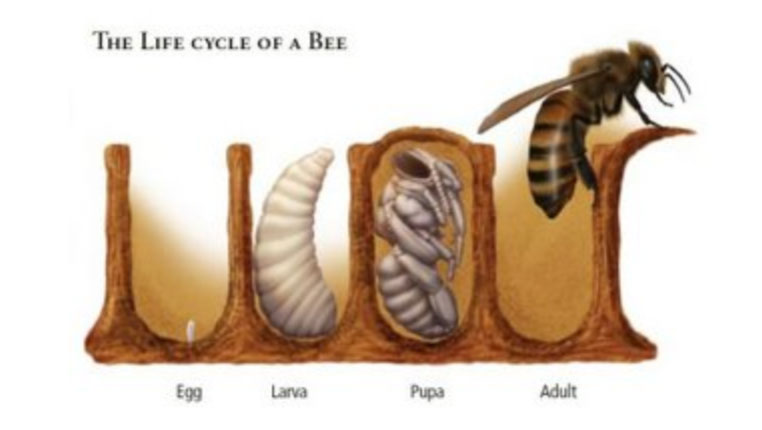
In their study Antibacterial Immune Competence of Honey Bees (Apis mellifera) Is Adapted to Different Life Stages and Environmental Risks, Gätschenberger H., Azzami K., Tautz J. and Beier H. (2013) express surprise at the complete absence of a cellular or humoral immune response in worker and drone pupae following artificial bacterial contamination. Larvae are exposed to pathogens and have a defence system. They are fed royal jelly, which contains various antimicrobial compounds, including the bee-specific AMP defensin 1, which minimises bacterial and fungal infections. The pupa is largely protected in its capped wax cell, which is why it normally passes through the pupal stage successfully even without an immune system. Interestingly, not only pathogenic bacteria but also “good” and “neutral” bacteria can be dangerous to the pupa. According to a verbal statement by Professor Jürgen Tautz, the complete absence of an immune response in the bee pupa is unique in the fungal, plant and animal kingdoms. The discussion of the study results concludes that honey bees take no risks and have apparently found a balance between the urgency of activating defence responses and the feasibility of conserving energy.
The links between beekeeping and the immune system are an integral part of the FREETHEBEES beekeeping methodology, presented in a somewhat simplified form. The methodology distinguishes between the internal and external immune systems, as well as the integrity of the hive biocoenosis (species diversity in the bee habitat), the habitat climate and life performance at the individual and colony levels (Figure 4).
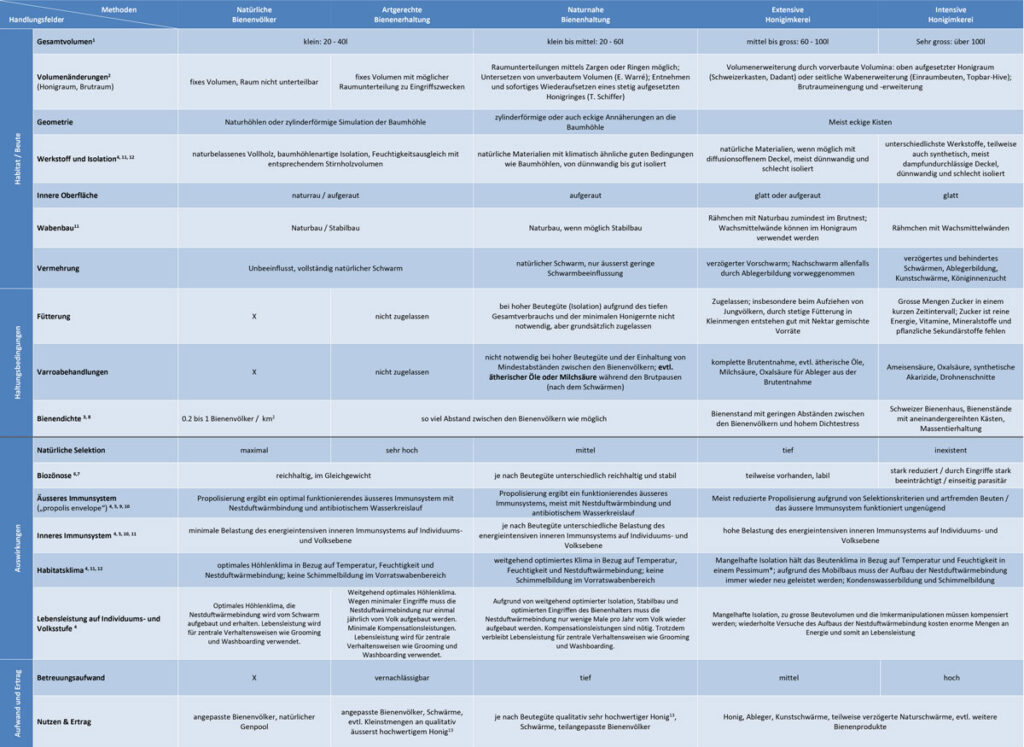
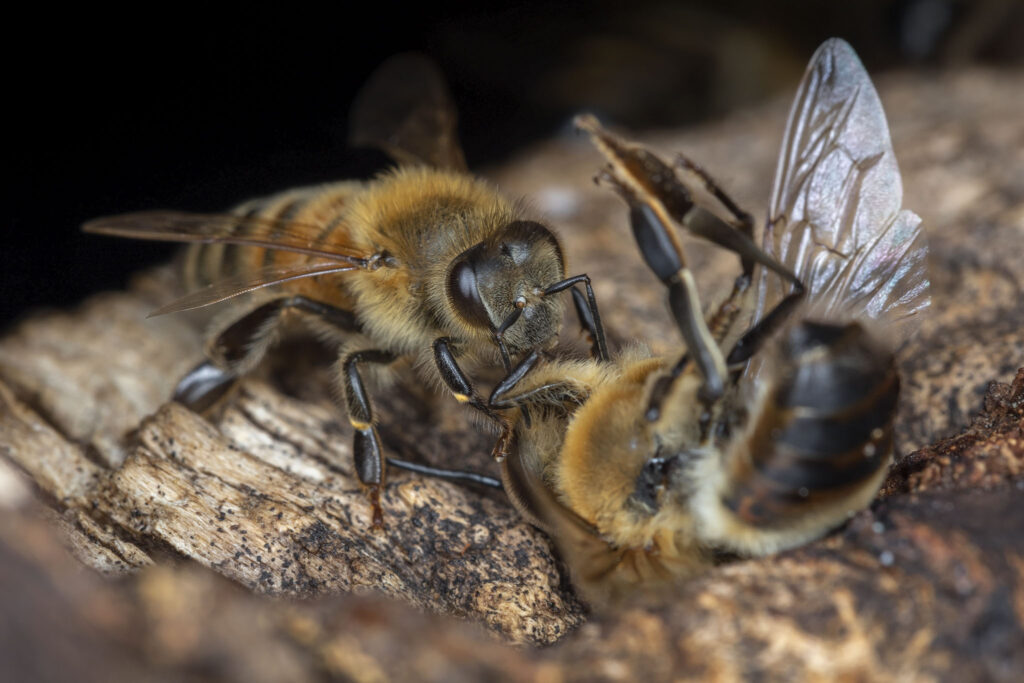
As is readily apparent from the beekeeping methodology, in addition to the surrounding environment (environmental toxins, abundance of flowers), the habitat and beekeeping methods are particularly crucial to a bee colony’s immune system functioning well. For example, bee colonies coat1 rough surfaces in tree cavities with propolis. Sterile air in the hive, described by Johann Thür as nest scent and heat retention, can only develop in an optimal habitat and under conditions that allow natural comb construction. Under optimal conditions, the bee colony has sufficient life performance for bees, for example, to rid one another of parasites through grooming.
Anyone who keeps a bee colony in an unsuitable habitat, feeds it empty calories such as industrial sugar, prevents it from swarming by adding honey supers, and also uses formic and oxalic acids 3–4 times a year should not be surprised if the colony loses all its immune capacity and can no longer protect itself against viruses, bacteria, fungi and parasites. Pathogens are not our main problem; they have always been here and will always be here, everywhere. The cause of diseased bee colonies lies in a failure to understand multicausal relationships. Bees in their natural habitat and in an intact ecosystem can cope with external influences. This is also borne out by Hinshaw C., Evans KC., Rosa C. and López-Uribe MM. (2020) in The role of pathogen dynamics and immune gene expression in the survival of feral honey bees. They show that managed honey bee colonies have a low probability of survival in the absence of disease treatments, while feral bee colonies generally survive in the wild. The bee colony responds to the higher pathogen pressure with a stronger immune response.
Evans, Jay & Spivak, Marla. (2009). Evans JD, Spivak M. Socialized medicine: Individual and communal disease barriers in honey bees. Journal of Invertebrate Pathology. Journal of invertebrate pathology. 103 Suppl 1. S62-72. 10.1016/j.jip.2009.06.019.
Erler, S., Moritz, R.F.A. Pharmacophagy and pharmacophory: mechanisms of self-medication and disease prevention in the honeybee colony (Apis mellifera). Apidologie 47, 389–411 (2016). https://doi.org/10.1007/s13592-015-0400-z
Gätschenberger H, Azzami K, Tautz J, Beier H (2013) Antibacterial Immune Competence of Honey Bees (Apis mellifera) Is Adapted to Different Life Stages and Environmental Risks. PLoS ONE 8(6): e66415. doi:10.1371/journal.pone.0066415 FREETHEBEES beekeeping methodology, https://freethebees.ch/Imkermethoden/
Hinshaw C, Evans KC, Rosa C and López-uribe MM(2020) The role of pathogen dynamics and immune gene expression in the survival of feral honey bees. Front. Ecol. Evol. 8:505. doi:10.3389/fevo.2020.594263
As of 15 September 2026 On 20 May 2026, the Swiss federal popular initiative “For the Safeguarding of Pollination of...
On 30 July 2026, 44 donors accepted our invitation to Estavayer-le-Lac—the highest attendance ever at a FreeTheBees d...
Around 30 members and the board met on 25 July for the annual members’ gathering at Park Seleger Moor in the canton o...
Important information
Important information: The original texts are published in German. The French, Italian and English versions are translated automatically and checked where possible. Please report any errors to bee@freethebees.ch.