How it all began
My first experience with natural beekeeping was a revelation. I have never been able to let go of this cause. A short while ago, I was looking for a practice project for my CNC router. Inspiration comes from what moves and occupies us on the inside. So contacting FREETHEBEES and offering support from the woodworking industry was an obvious step. Visionary André Wermelinger was not short of ideas, and after some focused correspondence he promptly sent me a model of a BeeLining box.
What is a Beelining box?
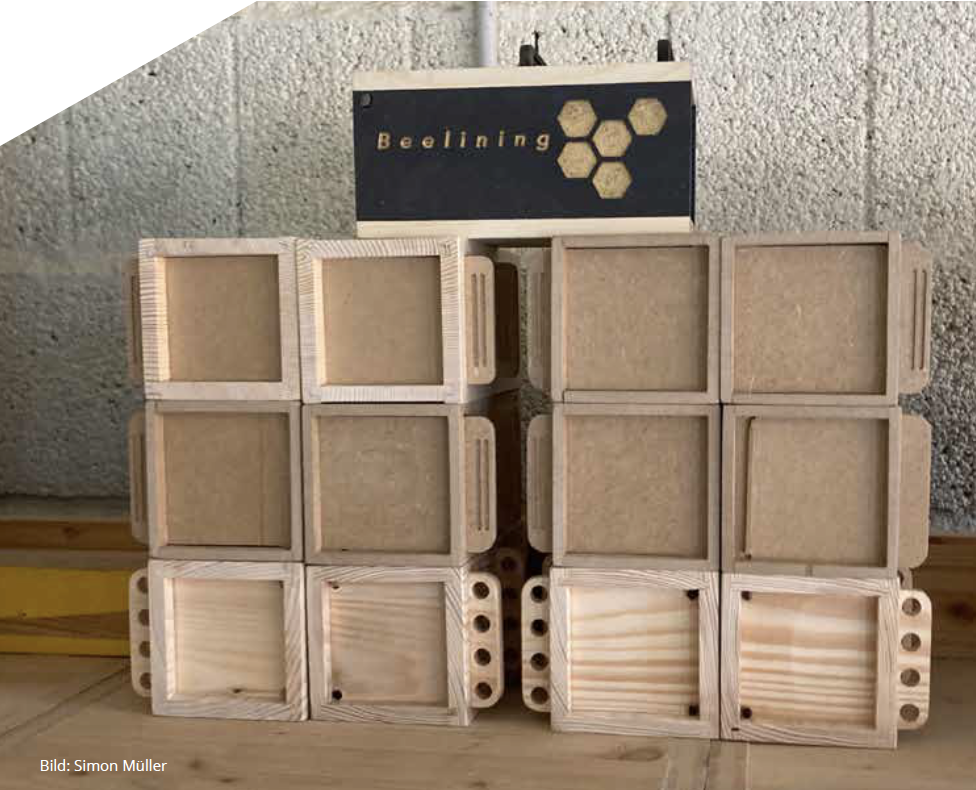
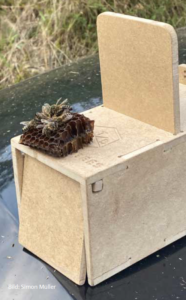
To be honest, I didn’t know either. A box divided into two chambers by two sliding panels. A closure flap at one end, a glass pane at the other. With a few vague theories about what this box might be for, I blindly embarked on the development process. Using André’s model as a basis, I drew up an initial design in CAD (Computer-Aided Design) and sent it to him. Apparently, my 3D animation of the box looked functional enough for André to give me the go-ahead to build a physical prototype. And so I began the initial production, without knowing the purpose or intended use of the Beelining box.
The development process gathered pace. Every milled part brought a new insight, and with each completed box, ideas for improvements began to pile up. André offered valuable guidance as I worked towards a Swiss-made Beelining box. The result was a natural version made from spruce moon wood (1). For strength, this model was made from wood one centimetre thick.
In the next stage of evolution, I milled a slimmer and lighter version from the industrial wood-based material MDF, short for
“medium-density fibreboard”. I also switched to a metal-free flap mechanism. The result was a natural moon-wood body with MDF sliding panels and flaps, without screws. Alongside the focus on functional improvements, I also experimented with the aesthetics.
 A fantastic reality
What Beelining really is far exceeded my ideas in terms of imagination and adventure. I could picture catching the bee myself. From there, things get wild: the two sliding panels are opened. The bee follows the daylight into the feeding chamber. The glass pane prevents her from escaping. The box is then darkened, calming the bee, who feeds on the sugar solution provided. After five to ten minutes, the front flap is opened so that she can return to her hive with the food. There, the bee recruits reinforcements from the worker population and sends them to the food source with the waggle dance. With each round, more bees join the flight, coming ever closer to the perfect straight-line route from the hive to the sugar source. The bees can now be marked so that the time taken for each flight can be recorded. A vector can be calculated by combining this with the direction of flight. These marked bees are then caught again in the box and transported to another location. Repeating the same process there gives a second vector. Triangulation can then be used to determine the approximate location of the bee colony (ideally, a wild-living honeybee colony).
With this Beelining technique, people are granted a glimpse into the living clockwork of the bee colony. Without the bee’s near-perfect way of life and organisation—the “bee” as a whole—the box would be a useless piece of wood.
(1) Moon wood is felled in winter, around the turn of the year, on one or two specific days when the moon is waning. This wood lasts longer, is less susceptible to pests and is more stable (it undergoes fewer changes in shape).
(2) Wood fibres and glue are pressed together to form a homogeneous material.
Simon Müller
As of 15 September 2026 On 20 May 2026, the Swiss federal popular initiative “For the Safeguarding of Pollination of...
On 30 July 2026, 44 donors accepted our invitation to Estavayer-le-Lac—the highest attendance ever at a FreeTheBees d...
Around 30 members and the board met on 25 July for the annual members’ gathering at Park Seleger Moor in the canton o...
Important information
Important information: The original texts are published in German. The French, Italian and English versions are translated automatically and checked where possible. Please report any errors to bee@freethebees.ch.