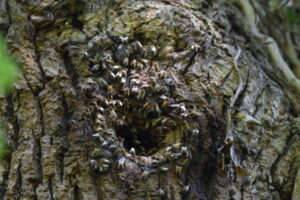
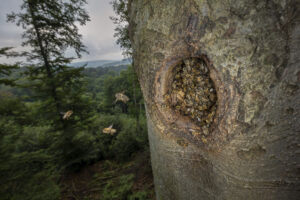
According to the latest scientific findings, one of the major problems in beekeeping today is moisture in conventional beehives. Emile Warré recognised this as early as the 1920s and 1930s and added the so-called Warré cushion to his Warré hive. This simulates a living hollow tree, in which, according to Torben Schiffer’s studies, humidity passes through the propolis on the hive ceiling (end grain) with virtually no resistance and is absorbed by the pores of the tree trunk.
Why not benefit from good and useful inventions and modify our conventional beehives too, for the benefit of bee health?
Here is my first version of a Warré cushion for the Dadant hive:


And this is what the cushion’s construction looks like:


To prevent the bees from sticking the cushion in place, a mosquito net is also placed on the Dadant brood chamber, following the Warré–style of beekeeping:

To allow the cushion to release moisture upwards as well, a small gap is left between it and the roof. For example, using twigs, as shown in the picture:

Background information: Unfortunately, wood in the form of boards hardly “breathes” at all. Whether made of wood or plastic, your Dadant is too damp either way, in winter as well as in summer. In nature, the tree trunk absorbs moisture through the end grain and its pores. The Warré cushion provides the best and simplest simulation of natural conditions.
Wild-living honey bees need old trees with cavities and structurally diverse forests. Raphaèle Piaget, member of the ...
A new study by the University of Hohenheim and Agroscope shows a significant decline in free-living honey bee colonie...
We would like to extend our sincere thanks to 20 Minuten and Reto Bollmann for the article published on 7 October abo...
Important information
Important information: The original texts are published in German. The French, Italian and English versions are translated automatically and checked where possible. Please report any errors to bee@freethebees.ch.