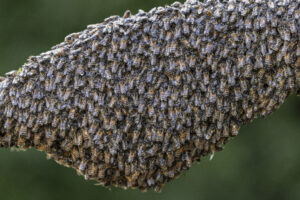
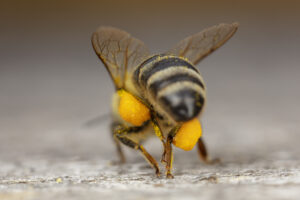
Martin Ott is convinced: We know enough to solve ecological crises. What is missing is a relationship with this knowledge. In our conference series “Bees Without Borders,” the farmer and author showed on September 8, 2026, what humans and honeybees share through evolution, what sets them apart, and what this means for how we treat bees.
After decades of research, there is no shortage of data. For Martin Ott, the problem lies elsewhere:
“I believe we know enough to change the world or understand animals. The problem is that we do not apply what we know; we do not form a relationship with our knowledge.”
Anyone who enters into a genuine relationship with an animal or with nature acts differently. They no longer shift responsibility onto the state or the future.
Evolution is often understood either as the result of random mutations or as a fixed plan. Martin Ott presents another approach: the model developed by geneticist Eva Jablonka in the book “Evolution in Four Dimensions,” which she co-authored with Marion J. Lamb. According to this model, information is passed on at four levels:
· Genetics: Information passed on through DNA.
· Epigenetics: The environment and food influence which genes are read. In a bee colony, the brood food determines whether a larva develops into a worker or a queen.
· Behavior: Animals learn from and imitate one another, for example in birdsong or within a bee colony.
· Symbols: Complex cultural patterns of behavior and symbols are passed on.
“Evolution is neither a rigid plan nor blind chance, but is best compared to a symphony that writes itself during the performance, in resonance with the orchestra.”
According to Martin Ott, the bee colony as a whole, “the bee,” displays characteristics of more highly developed animals and in some respects surpasses them in its ability to adapt:
· A skeleton that hangs: We humans stand on the ground supported by an internal skeleton. By contrast, the bees’ comb structure hangs from above and is flexible below. Bees largely avoid direct contact with the ground.
· Warmth like that of warm-blooded animals: The colony keeps its brood nest at a precise temperature of around 36 °C. The bees generate heat together through muscle activity. Through the warmth of the brood, the colony influences how capable the bees will be of learning later. Studies, including those by Jürgen Tautz, show that the temperature during pupal development shapes the behavior of adult bees.
· Milk from the head: Nurse bees produce a nutrient-rich fluid in glands in their heads, “head milk,” and use it to rear the brood. Brood care is entirely socially organized, without individual traumas or ego structures, as Ott emphasizes.
· No waste: Unlike human civilization, the bee colony produces no waste that remains in the ecosystem. All organic residues return to the humus cycle.
How do we interact with animals? Martin Ott describes a model from the social sciences with five levels:
1. Manipulation: One side controls the other. Historically, this has often been the norm in beekeeping: smoke makes the bees think there is a forest fire, so that the colony abandons its defense.
2. Passivity: Complete submission, along the lines of “Please manipulate me.”
3. Information: We tell the other party what we intend to do.
4. Consultation: We ask, notice the other party’s response, and take it into account.
5. Cooperation: A shared space emerges, from which unexpected developmental steps can arise for both sides.
“When living beings enter into genuine cooperation and make use of this space, evolutionary new ground emerges—a completely new continent between beings.”
The discussion made clear just how young the relationship between humans and bees is. The honeybee is many millions of years older than humans and domesticated animals such as cattle. Humans are not encoded in its genetic makeup. When a bee flies warningly toward someone’s head, this is an innate defense against enemies.
Historically, beekeeping has often operated at the lowest level: manipulation. Anyone who wants to treat the honeybee as a wild animal appropriately must raise the relationship to higher levels. Consultation begins with paying attention to the colony’s subtle signals: take warning flights seriously, observe the entrance, and adapt one’s actions. Cooperation means allowing the colony room to develop, for example through natural comb building or swarming.
The discussion also addressed whether every act of observation is already an intervention, and how humans can give the honeybee back more scope to shape its own life as a wild animal and partner in cooperation.
Martin Ott is a farmer and the author of the book “Understanding Cows: A New Partnership Begins”. You can find the full conference, including the discussion that followed, on our YouTube channel. You can post questions and thoughts directly below the video.
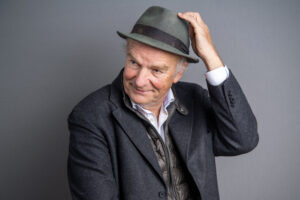
Frick 01.12.2020 – Board of Trustees of the Research Institute of Organic Agriculture (FiBL). Switzerland. © Marion Nitsch/Lunax
“Bees Without Borders” takes place online every month. On November 18, for example, sleep expert Günther W. Amann-Jennson will talk about the sleep of bees.
In our conference series “Bees Without Borders”, renowned bee scientist and breeder Dr. Ralph Büchler showed on 28 Oc...
As of 15 September 2026 On 20 May 2026, the Swiss federal popular initiative “For the Safeguarding of Pollination of...
Important information
Important information: The original texts are published in German. The French, Italian and English versions are translated automatically and checked where possible. Please report any errors to bee@freethebees.ch.