“I observe how nature works”
For over 15 years, Heinz Weder has been observing free-living honey bee colonies. He has been involved in Swiss BeeMonitoring since it began in 2021. The retired pharmacist and livestock homeopath tells us why a guard bee stung his earlobe and why he believes we need to look at honey bee colonies in a new way.
As part of the “Wild Honey Bee – researching tree hollows & protecting habitats” project, volunteers across Switzerland observe wild-living honey bees through the Swiss BeeMonitoring programme. Three times a year, they visit their nesting site, note the time, temperature and wind speed, assess the bees’ flight activity and send us photos and videos of the entrance. These observations feed directly into our research. Without our volunteers, we would have no data on colonies living wild in nature.
That is why we would like to introduce them regularly in future. We’re starting with Heinz from the canton of Thurgau. He has been involved from the beginning, and we are proud of that. We were delighted by his answers to our questions and are pleased to share them here.
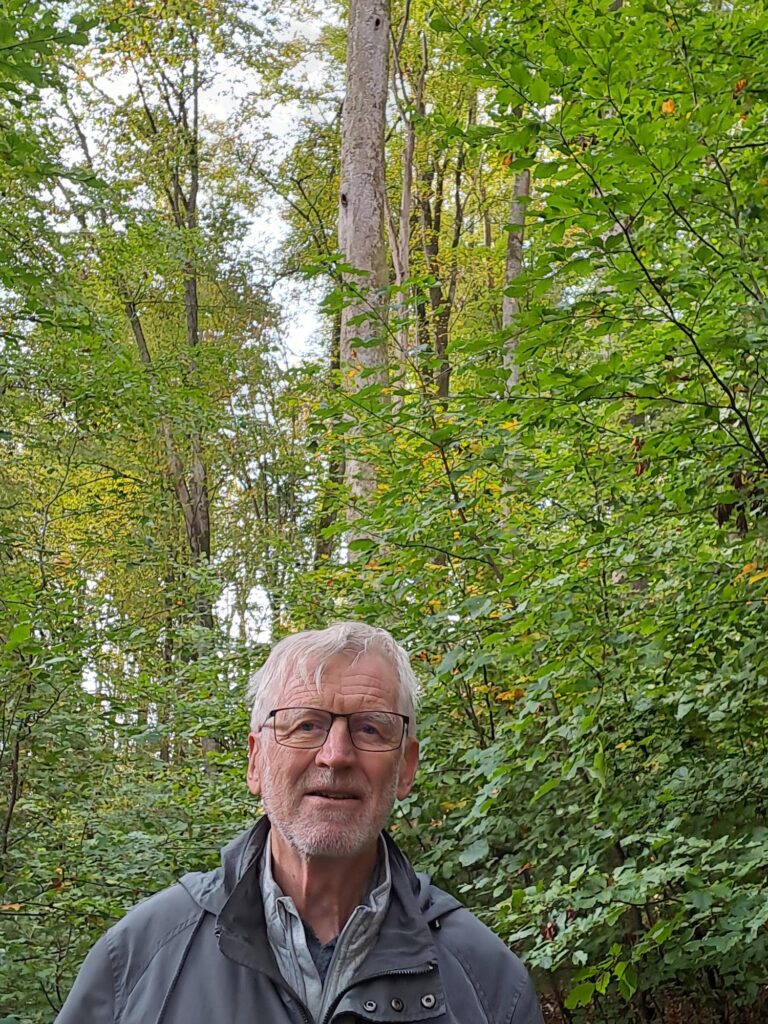
Heinz in front of his favourite nesting site: a tree with two woodpecker holes
My name is Heinz, and I live in the canton of Thurgau. I am a retired pharmacist and livestock homeopath. My main activity in retirement is observing nesting sites of wild bees and wild-living honey bees. From the bees’ perspective, I am concerned with the question of why honey bees are so weakened that they become ill and can no longer keep parasites in check.
I have been observing free-living honey bee colonies for over 15 years. I have been involved in Swiss BeeMapping since the project began. This is how I came to FreeTheBees.
I currently observe two nesting sites in Thurgau, with four to five colonies.
The round trip to one of the nesting sites takes about two and a half hours. When I arrive, I first check whether the surroundings have changed since my last visit and whether anything else catches my eye. Then I get my equipment ready: my phone camera, binoculars, a thermometer and, possibly, a spotting scope. I note the time, air temperature and wind speed, and assess the level of flight activity at the entrance. Can I see guard bees? Are the foragers bringing in pollen? Pollen being brought in shows that the colony is rearing brood and, therefore, that a queen is active. I enter everything in the electronic observation log. I also take a photo and usually a video of the entrance, and send both along with the log.
Back when I still travelled by car, I was often greeted on arriving at the nesting site by a guard bee stinging my right earlobe. It surprised me every time. I wondered whether the guards recognised me by the sound of the engine.
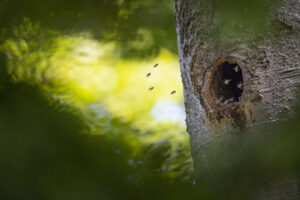
At a nesting cavity in a beech tree, I observed a pair of tits take it over first, followed a year later by a pair of great spotted woodpeckers. That’s how things work in the wild.
That wild-living honey bee colonies apparently survive and reproduce by swarming even in places where intensive agriculture, with its insecticides and fungicides, shapes the surroundings.
The project prompted me to explore the history, biology and anatomy of the bee as a “superorganism” in depth. This means that a bee colony functions like a single organism: thousands of individual bees work together like one body. I am also concerned with the effects of the intensive management of bee colonies by beekeepers.
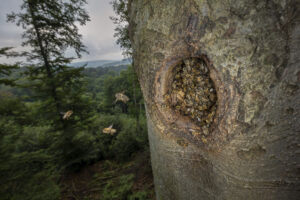
The nesting site in the beech tree. The tree has two woodpecker holes that are repeatedly occupied by different animals. That makes it particularly fascinating to me.
When they ask, I explain my relationship with honey bee colonies and the questions I have from the perspective of the bee as a “superorganism”. I also give talks about it.
Join in! It’s worth it. When you make observations, you see directly how nature works. You gain an exciting and meaningful leisure activity, and help ensure that bee colonies are seen from a new perspective. This is important if wild-living honey bee colonies are to have a future.
What role does a bee colony play in the ecosystem: soil, water, air, soil microbiome, plant, bee, food for humans and animals?
Dear Heinz, thank you very much for your time, your observations and your commitment to the project. We’re passing Heinz’s question on to you: What role does a bee colony play in the ecosystem? Send us your thoughts at marie.hallmann@freethebees.ch. We will publish a selection of the answers in our next profile.
Would you also like to observe wild-living honey bees? You can sign up here.
On 9 October, a class from Collège du Sud came on a school trip to our site in Vaulruz, right among the bees. The stu...
A new study by the University of Hohenheim and Agroscope shows a significant decline in free-living honey bee colonie...
Where in Switzerland do honey bees still live in the wild, without beekeepers? Honey bee colonies still live without ...
Important information
Important information: The original texts are published in German. The French, Italian and English versions are translated automatically and checked where possible. Please report any errors to bee@freethebees.ch.