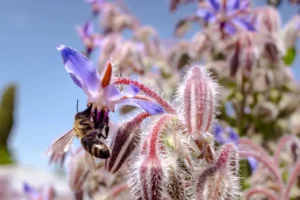
“Bees Without Borders”: Online Conference in German, free of charge
Bees sleep. And, as is the case with us humans, sleep is far more than a period of rest for them, too. But what happens when their sleep is disturbed?
For decades, we have observed how artificial light, electromagnetic influences, environmental changes and our modern lifestyle can alter people’s natural sleep-wake rhythm. At the same time, our bees are facing growing pressure from numerous environmental factors.
Could there be a previously overlooked connection between these two developments?
Sleep expert Prof. Dr. med. h.c. Günther W. Amann-Jennson takes us on an unusual exploration at the intersection of sleep research and the world of bees. What do we actually know about bee sleep? What happens when bees do not get enough sleep or their sleep is disturbed? And could the quality of their sleep be an underestimated factor in a colony’s orientation, communication, health and resilience?
An evening exploring a surprising commonality between humans and bees—and a question that may offer a new perspective on the challenges facing our bees.
After the talk, Günther W. Amann-Jennson will answer your questions in an open Q&A session.
The talk is part of our monthly conference series “Bees Without Borders”. You can find all previous recordings in our YouTube playlist.
Günther W. Amann-Jennson has been working in the fields of sleep and sleep psychology for over 40 years. After studying psychology, he ran his own psychological practice for 13 years. In 1989, he founded the company SAMINA, which he managed as CEO until 2022. Since then, he has served as its scientific director. He developed the “Bioenergetic Sleep® Concept” and has been training certified Sleep Health Coaches since 2020. In 2012, Armenian-Russian International University “Mkhitar Gosh” awarded him an honorary doctorate, and from 2014 he held a professorship in philosophy and sleep psychology at Mesrop Mashtots University in Yerevan. His book Simply Sleep Well was published in 2024. He works in Frastanz, Austria.
Günther W. Amann-Jennson is also personally closely connected to nature and the world of bees. He lives at an altitude of around 700 metres, surrounded by a largely intact natural landscape where wild bees and bumblebees are still a natural part of the environment. His wife cares for around ten of his son Clemens’s bee colonies; Clemens is a dedicated beekeeper who keeps between 30 and 40 colonies himself. This family connection also built a bridge between his decades of work on human sleep and the fascinating question: How do bees actually sleep—and what disturbs their sleep?
Date: Wednesday, November 18, 2026
Time: 7:00 p.m. CET
Format: Online conference (K-Meet)
Language: German
Series: “Bees Without Borders”
Admission: Free of charge
Participation is free of charge. Simply register using the form below, and we will email you your personal link to the live conference.
Can’t attend live? Register anyway, and we will send you the recording.
This event has already ended. Registration is no longer possible.
Martin Ott: Spectacular similarities, surprising contrasts in the evolution of bees and humans “Bees Without Borders”...
Dr. Ralph Büchler: Sustainable selection as an essential aspect of natural beekeeping “Bees Without Borders”: Online ...
Important information
Important information: The original texts are published in German. The French, Italian and English versions are translated automatically and checked where possible. Please report any errors to bee@freethebees.ch.