Is the honey bee not at risk outside beekeeping in Switzerland, or is it already extinct? A look at the Red List of threatened bee species should be enough to answer that question. But that is not the case, because the honey bee’s distinctive characteristics and relationship with humans mean that it cannot yet be assessed in the same way as all other wild bees. It has apparently been overlooked in the wild, and risk assessments struggle with this supposedly domesticated species, which is used on a massive scale in beekeeping.
Whether most have become feral or perhaps are survivors from the past, all the honey bee colonies remaining in the wild are under immense pressure:
Like other wild bees, they struggle with a lack of nesting sites and food plants. Pollutants and insecticides, as well as pathogens and parasites (such as the introduced Varroa mite), also take their toll. If the wild-living honey bee goes extinct, a valuable gene pool within native biodiversity and an efficient pollinator ‒ ultimately for honey and crop production too – will be lost forever.
Unlike the other 600 wild bee species in Switzerland, however, there seems to be little interest in clarifying whether the native honey bee merits protection and in regulating this by law.

The revised Red List of threatened bees in Switzerland is due to be published this year. But, as was the case 30 years ago, the latest edition will not assess the threat level of the wild-living honey bee either. Its status will simply be recorded as “Not assessed”. At least it is recognised as a wild bee species, since taxonomically it is clearly defined and was originally considered a forest insect and part of the native fauna. However, nature conservation requires clear evidence of a threat; without it, species conservation projects generally cannot be justified. For now, therefore, the focus is on measures to improve habitats, from which a broad range of plant and animal species can benefit, regardless of their risk status.
For most animal species that fit neatly into the agreed species and subspecies framework, it is relatively easy to distinguish between threatened and not threatened, native and non-native, wild and domesticated. The honey bee, however, stands apart in many respects.
Intensive honey bee keeping in agricultural and urban areas began in Switzerland in the early 20th century. Within a few decades, this forest-dwelling animal had been bred into a highly productive honey producer as part of industrial food production. As a result, most honey bees in Switzerland live under human care. Nevertheless, individual unattended honey bee colonies are still occasionally seen in the wild, though less often than before.
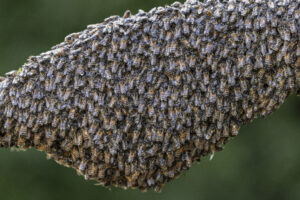
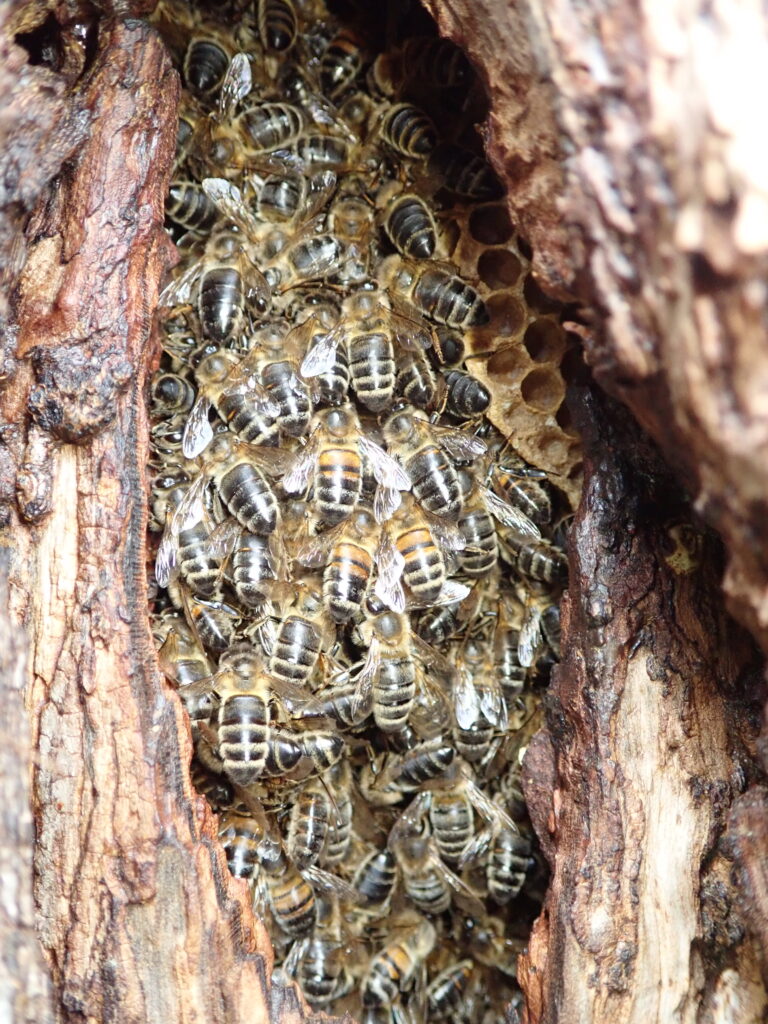
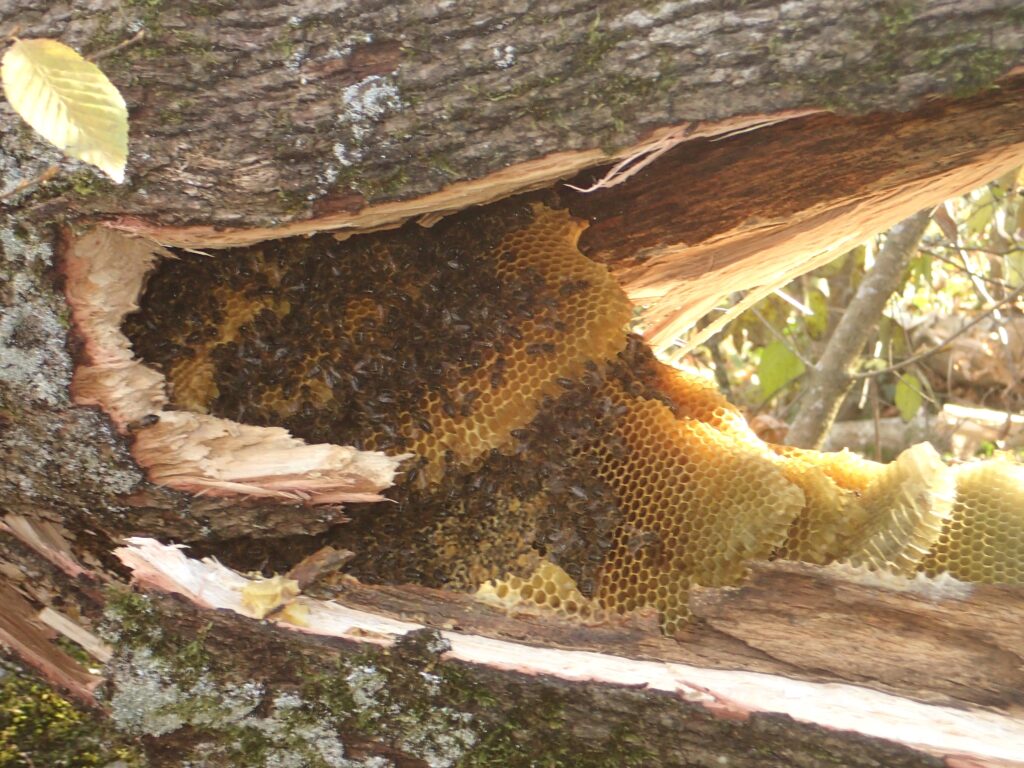
As they have for millions of years, honey bees nest in tree cavities and rock crevices. Where these are absent, they use unused cavities in walls, roofs, chimneys and masts. It is not easy to tell whether these wild-living bees are feral, originally wild, or even self-sustaining colonies. And this is precisely where the difficulty lies.

Originally, two honey bee subspecies lived in Switzerland: Apis mellifera north of the Alps and Apis ligustica south of the Alps. Since the 1950s, in the wake of the honey boom, beekeepers have increasingly introduced other subspecies, such as carnica, and breeding strains such as Buckfast from other parts of Europe, which have crossbred with the established mellifera and ligustica bees. This new genetic mix in the Swiss landscape is now known as “Swissmix”.
Nevertheless, pure mellifera colonies still exist – but only in certain areas where keeping other subspecies is not permitted and mating is relatively well controlled by the terrain. This is the case, for example, in the Glarnerland Mellifera Conservation Area. In all other regions of Switzerland outside breeding zones (including Carnica conservation zones around mating stations north of the Alps), it is assumed that honey bees inside and outside hives are mostly in contact with Swissmix. Consequently, some wild bee conservationists argue that wild-living honey bees can no longer be wild bees, because they have long since mixed with Swissmix bees from hives and therefore, as “beekeepers’ bees”, do not need any conservation measures.
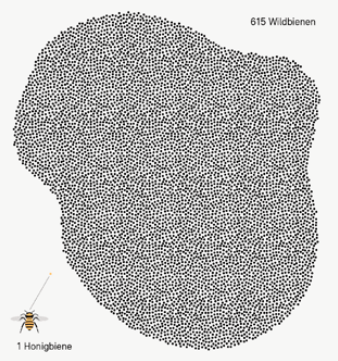
At first glance, this conclusion may seem plausible. The density of honey bees in Switzerland is indeed very high, at over four managed colonies per square kilometre. From this perspective, honey bees would be abundant compared with other wild bees and therefore would not need protection. However, this is based on the untested assumption that all honey bees share the same gene pool, living conditions and chances of survival. Furthermore, we must not forget that the independence of wild-living honey bee colonies, which are subject to natural selection, is itself an important distinguishing characteristic.
In fact, too little is still known about wild-living bees to trace their true origins and evolutionary history. A scientifically sound assessment has yet to be carried out.
Anyone who takes a closer look at wild-living honey bees knows that they can activate more self-healing abilities than managed honey bees. In the wild, honey bee colonies can draw on their natural survival instincts, which are taken away from them by life in a conventional beekeeper’s hive: for example, free mating over long distances, periodic swarming and the nomadic colonisation of new nesting sites. This natural behaviour across a wide-ranging and changing distribution area enabled honey bees to withstand climate change, diseases and parasites for 30 million years.
Wild bees may by now have mixed genetically with managed bees – but the ancient traits of wild-living bees still stand out in their behaviour. Sigurn Mittl (2022, Sustainable Beekeeping) therefore concludes: “Research has taught us that honey bees are healthier when they can live as undisturbed as possible and when beekeeping practice takes their biological mechanisms for maintaining their health into account as much as possible.”
However, differences in behaviour compared with managed bees are not enough to assess the risk status of wild-living honey bee colonies. It must still be clearly demonstrated that wild-living honey bees areable to surviveindependently and without input from managed bees. The problem is that in a country with such a high density of honey bees as Switzerland, it is not easy to study managed and wild-living colonies separately in order to produce the necessary evidence.
A great deal of research and investigation is still needed before the risk status of the honey bee can be assessed. Unfortunately, there are still too few resources and incentives in bee research to resolve the outstanding questions. Current research priorities for bee specialists focus either on protecting other wild bee species or on bee breeding and treatment in beekeeping. But as long as it is not recognised as a wild bee that is not managed by beekeepers, the wild-living honey bee remains overlooked by beekeepers and the public.
There is hope, however. A shift in thinking is slowly emerging beyond Switzerland’s borders. Projects are currently under way in Germany, Austria, France, Spain, Great Britain and the USA to document and scientifically study wild-living bee colonies. Concrete steps are also being taken in preparation for the revision of the European Red List of bees to locate colonies and enable the classification of the wild-living honey bee. So far, the International Union for Conservation of Nature (IUCN) has listed the wild-living honey bee in Europe as “Data Deficient”. As with the Swiss status “Not assessed”, this can be understood as a call to improve the available data. After all, you can only protect what you know.
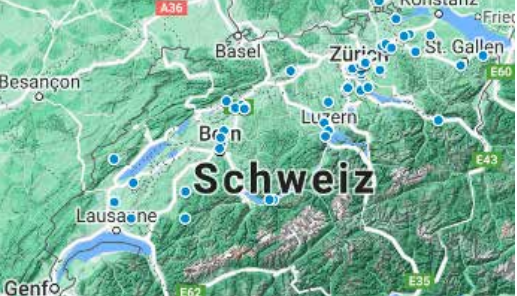
An unprecedented initiative with great potential is also building a data base for Switzerland: the FREETHEBEES Citizen Science project “Swiss BeeMapping”, which carries out important fieldwork thanks to many attentive members of the public.
Over 120 nesting sites have been recorded by project participants since 2021 and are being verified and analysed by specialists. The project defines wild-living as all feral and long-term wild-living honey bee colonies that are neither tended nor used for production. The locations found shed light on the distribution and survival strategies of the wild-living honey bee in forests and landscapes, including settlements. They also highlight gaps in knowledge that will need to be filled in the future, including the regulatory gaps in nature conservation discussed here. The project also encourages people to look beyond taxonomic boundaries and share ideas about effective ways of implementing ecological habitat improvements for cavity-dwelling animal species.

Securing the future of the honey bee requires a good understanding between naturalists and beekeeping groups, extending beyond national borders. Healthy wild-living bee populations subject to natural selection and able to develop local adaptations are as valuable to beekeepers as wild plants are to cultivated crops. This is an argument for conserving wild bee diversity.
In the long term, it would benefit all interest groups to take wild-living bee colonies into account, conserve and promote them, and work together to make the necessary practical and legal adjustments.
Ultimately, all bee enthusiasts, beekeepers and bee conservationists share a common responsibility: to secure the future of all bees and conserve native biodiversity.
Read the full article by Francis Cordillot, “Honey bee: extinct or not threatened”, in the Summer 2022 Bulletin.

On 9 October, a class from Collège du Sud came on a school trip to our site in Vaulruz, right among the bees. The stu...
5 November 2026
0 comments
“I observe how nature works” For over 15 years, Heinz Weder has been observing free-living honey bee colonies. He has...
30 October 2026
0 comments
As of 15 September 2026 On 20 May 2026, the Swiss federal popular initiative “For the Safeguarding of Pollination of...
24 September 2026
0 comments
Important information
Important information: The original texts are published in German. The French, Italian and English versions are translated automatically and checked where possible. Please report any errors to bee@freethebees.ch.