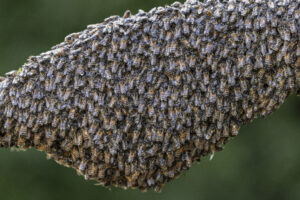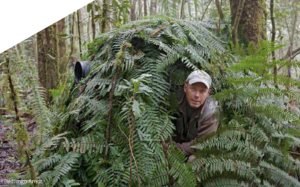
Ingo Arndt published his book “Honeybees – Mysterious Forest Dwellers” in 2020 together with renowned bee researcher Prof. Dr. Jürgen Tautz. It reveals many unknown behaviours in unique images that encourage readers to look at beekeeping from a new perspective.
Ingo Arndt was born in Frankfurt am Main, Germany. From his earliest childhood, he spent every spare minute outdoors in nature. He soon realised that photography was a useful tool for environmental protection, and after finishing school in 1992, Ingo embarked on the adventurous life of a professional photographer. Since then, he has travelled the globe for extended periods as a freelance wildlife photographer, capturing stories that portray animals and their habitats. In recent years, he has mainly worked on assignments for GEO and National Geographic Magazine. We at FREETHEBEES are also fortunate to be able to use many of his images in our bulletin and on social media.
FTB: After photographing pumas, bears, rhinos and alligators face to face, how did you come up with the idea of photographing wild honeybees?
The last major photo story I photographed before the honeybees was about pumas. I spent a total of seven months in the Torres del Paine area of Patagonia, photographing these beautiful big cats in the breathtaking landscape. It was clear that I had to do something completely different afterwards, because the pumas simply could not be topped. That was how I came to honeybees. A small insect, not a big cat. The setting was not a vast wilderness area, but my own garden and the remnants of beautiful natural landscapes in Germany. At first, I wanted to photograph “just” the everyday lives of honeybees in all their facets. But then, through Prof. Jürgen Tautz, I was put in touch with Benjamin Rutschmann and Patrick Kohl, who were researching wild honeybee colonies in the forest, the original home of honeybees. I was immediately hooked, and from then on I focused this photography project primarily on wild honeybees.
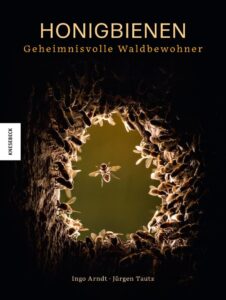 FTB: For the book “Honeybees – Mysterious Forest Dwellers”, you turned your home garden into a photo studio. How did that come about, and how did the work in your garden go, even though you are a wilderness enthusiast?
Soon after I first learned about the wild colonies, I was hanging from a climbing rope, 20 metres up a beech tree, in front of a black woodpecker cavity inhabited by bees. This is how I got my first impressive images, but the most interesting things were happening inside the cavity, beyond my reach. Naturally, I could not saw open the tree cavity from behind, 20 metres up, to get pictures
of the inside. The disturbance to the bees would have been far too great. I had to come up with another solution. With permission from the relevant forestry authorities, I set out to find a tree trunk with a black woodpecker cavity. After a lot of searching, we actually found a fallen tree in the Steigerwald with an intact woodpecker cavity. The cavity was salvaged using heavy equipment, and the trunk was sawn to a transportable size. I set up the tree trunk in our garden and introduced a honeybee colony into it. I made an opening at the back of the black woodpecker cavity, which led directly into a small observation hut. I spent countless hours there photographing the natural nest-building process and the many different behaviours of honeybees. But over the following two years, I also built all kinds of setups outside the cavity to photograph the bees.
FTB: What special insights did you gain about honeybees during this time? How did your perspective change?
On Professor Tautz’s advice, I had not learned much about bee behaviour beforehand, as he and I were working closely together on this project. So I was completely open-minded. I observed and photographed the honeybees in their “wild” nest as they presented themselves to me. There were a whole range of behaviours that had not yet been explained, which I was able to photograph and which suddenly made sense in the context of the naturally built nest.
“Planing” turned out to be extremely important for “cleaning” the cavity and preparing it to be lined with antibacterial propolis. Or the so-called
“construction chains” were actually something you could observe all the time. They enveloped the nest, sometimes more tightly, sometimes more loosely. This is an important factor in regulating the nest temperature. I was even able to photograph the bees hanging onto one another as they built a kind of false floor inside the cavity, greatly reducing its volume and allowing them to regulate the temperature much more effectively; they had far less space to heat or cool. Over the two years, I made many more fascinating observations. They are described and captured in images in our book “HONEYBEES – Mysterious Forest Dwellers”.
FTB: Which animals are you planning to photograph in the future? Will you keep your beehives in your garden and continue photographing the bees?
We have since moved to the countryside and brought the bees and the black woodpecker cavity with us. The animals are doing very well out here. And of course, alongside many other subjects, I will continue to photograph honeybees. This year and next, I am even making a brief foray into filmmaking. ZDF and Netflix have contacted me and would like me to film various bee behaviours. It’s an exciting task.
FTB: What makes a successful bee photograph for you?
My favourite images are of honeybees displaying unexpected behaviours. Things you might not immediately think of when you think about honeybees. There is so much to observe in these fascinating animals; they are always full of surprises.
As of 15 September 2026 On 20 May 2026, the Swiss federal popular initiative “For the Safeguarding of Pollination of...
On 30 July 2026, 44 donors accepted our invitation to Estavayer-le-Lac—the highest attendance ever at a FreeTheBees d...
Around 30 members and the board met on 25 July for the annual members’ gathering at Park Seleger Moor in the canton o...
Important information
Important information: The original texts are published in German. The French, Italian and English versions are translated automatically and checked where possible. Please report any errors to bee@freethebees.ch.