
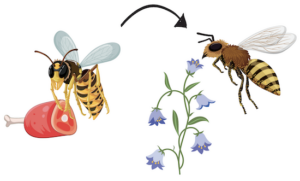
 From meat to honey
More than 30 million years ago, a group of wasps decided to change their diet. They turned away from meat and towards flowers. Gradually, bees evolved from this group, collecting nectar and pollen.
Honey made from nectar serves as:
Resources: the “dearth”
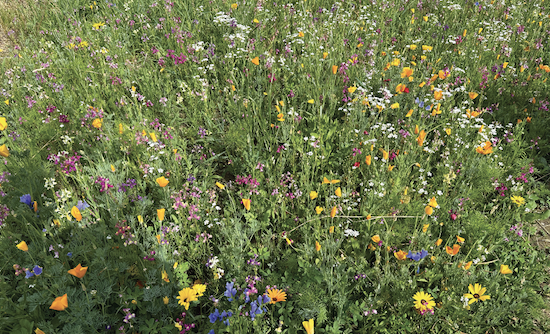
May, with the blossoms of fragrant fruit trees and colourful fields, is a month rich in food for bees and other insects. During this time, the colony is in its best shape.
Afterwards, food—and especially nectar—becomes scarce. The fruit trees lose their blossoms and the fields are mown. For a while, the colony can hardly find any food. A famine may follow.
“Deart” is the term for a period when bees go hungry and there are far fewer flowers to visit.
👉 Tip: To help bees, plant a nectar-producing tree or sow flower seeds before buying a beehive.
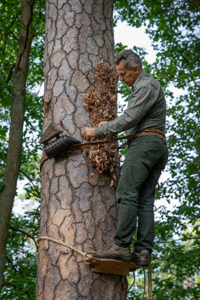 A natural tree cavity in a tree trunk is the ancestral habitat of the bee. This habitat develops from a wound in the tree trunk, which is usually turned into a tree cavity by a woodpecker and processes of decay.
The ideal forest has varied structures and old trees, or is a mixed forest with clearings and wetlands. Here, bees find shelter and a rich supply of “honey-sweet” flowering plants all year round.
In the Middle Ages, Zeidler were forest beekeepers. In Western and Central Europe, the “Zeidler” guarded the honey harvest in forests belonging to the lord, armed with a crossbow.
In the Urals, Zeidler still continue the tradition of forest beekeeping today. In Poland, it was reintroduced around 2009 thanks to WWF.
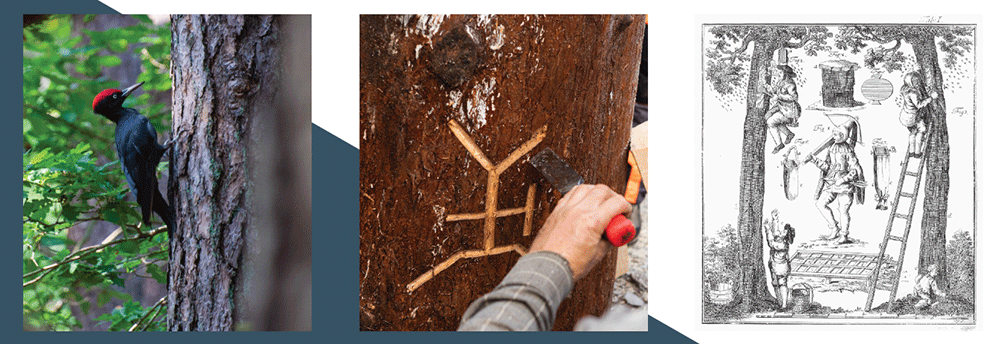
Centre: Zeidler inscription
Right: Forest beekeeping – historical depiction of forest beekeeping from Adam Gottlob Schirach’s Forest Bee-Keeping, 1774. Source: Wikipedia, 1 August 2022

Throughout their evolution, bees have faced challenges (enemies, diseases, …) and had to find resources to overcome them. The quality of their immune system and their defence strategy are therefore of great importance.
Current challenges
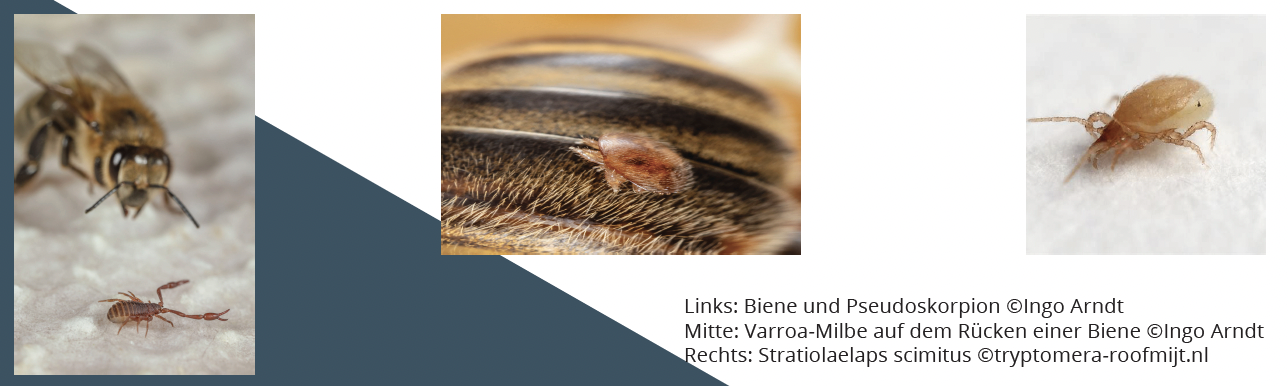
Here, bees and Stratiolaelaps scimitus, a predatory mite of the Varroa mite, can live in symbiosis. Stratiolaelaps scimitus attacks and eats the Varroa mite. Otherwise, it lives and reproduces in compost. Below you can see the pseudoscorpion, Chelifer cancroides, another predator of the Varroa mite.
 Honey and winter
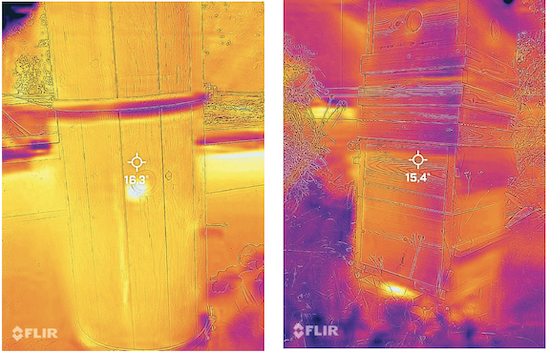
The colony maintains a temperature between 20 and 35 degrees, so the insulation of the beehive is of great importance. Honey consumption therefore varies greatly from one habitat to another, depending on the insulation (between 3–4 kg in a good tree cavity or a SwissTree and 20 kg in a conventional beehive).
Comparison
using FLIR One software and a thermal imaging camera, between a SwissTree with 8.5 cm-thick walls and a Warré beehive with standard walls.
Description
In nature, honey bees naturally choose tree cavities in old trees to build their nests. Creating or preserving such cavities in forests or orchards provides a habitat that comes close to their original way of life in the wild.
Advantages
⦁ A completely natural microclimate for the development of the colony
⦁ Excellent thermal and hygrometric insulation
⦁ Promotes rich biodiversity and bee resilience
⦁ No human intervention, no relocation, no stress for the colony
⦁ Avoids competition with intensive beekeeping
Disadvantages
⦁ Observation is not possible without greatly disturbing the nest
⦁ No honey harvest for people
⦁ Creating tree cavities takes time and requires specialist knowledge
⦁ Vulnerable to tree felling and storms
Did you know?
Wild honey bee colonies can still be found in centuries-old trees in Switzerland’s natural forests. Preserving or creating these habitats helps promote the survival and diversity of bees!
————————
Description
Carved from solid wood, the bee skep imitates as closely as possible the natural tree cavity that bees would choose in a forest. It is a traditional habitat that has been used in Europe for centuries.
Advantages
⦁ Excellent thermal insulation, stable microclimate
⦁ Promotes the health and natural instincts of bees
⦁ Very little human intervention, minimal maintenance
Disadvantages
⦁ Virtually no honey harvest
⦁ Very heavy and difficult to transport
⦁ Complicated to observe the colony’s development inside
Did you know?
The bee skep embodies FreeTheBees’ vision: giving the bee back its rightful place—as a wild insect!
————————
Description
The SwissTree is a modern bee skep designed to offer bees a habitat close to a natural tree cavity, while incorporating innovative and sustainable materials.
Advantages
⦁ Designed with bee welfare in mind; natural microclimate
⦁ Very few interventions: stability, biodiversity
⦁ Excellent thermal insulation
Disadvantages
⦁ Virtually no honey production
⦁ Limited view of the inside
⦁ Requires special materials and expertise
Did you know?
The SwissTree makes it possible to observe bees living as they would in a hollow tree, without disturbing them. Nature comes first!
————————
Description
This traditional model from southern France is carved from a thick tree trunk and is perfectly suited to harsh climatic conditions.
Advantages
⦁ Extremely resilient to temperature fluctuations
⦁ Respects natural seasonal cycles
⦁ Draws on centuries-old know-how
Disadvantages
⦁ Heavy and difficult to transport
⦁ Very limited honey harvest
⦁ Requires special maintenance techniques
Did you know?
Used in the Cévennes for centuries, this bee skep embodies the simplicity and unpretentiousness of traditional beekeeping.
————————
Description
Made from fired clay, this bee skep keeps things cool and regulates humidity, recalling the natural habitats of warm regions.
Advantages
⦁ Natural humidity regulation
⦁ Ecological, abundant and inexpensive material
⦁ Authentic Mediterranean tradition
Disadvantages
⦁ Vulnerable to impacts and frost
⦁ Limited thermal insulation outside warm climates
⦁ Relatively fragile, with a shorter lifespan
Did you know?
Bees love terracotta because of its softness! This type of housing contributes to pollinator diversity.
————————
Description
Designed by Abbé Warré, this stackable beehive aims to balance simplicity, respect for the natural rhythm and moderate honey production.
Advantages
⦁ Modular and easy to make
⦁ Little intervention: respect for the cycle
⦁ Possible honey production while preserving bee populations
Disadvantages
⦁ Moderate insulation
⦁ Caution needed in humid climates
⦁ Sometimes requires monitoring the colonies to prevent swarming
Did you know?
The Warré beehive allows extensive beekeeping with almost no chemical interventions!
————————
Description
Inspired by East Africa, the Kenyan beehive (with horizontal bars, “Top Bar”) allows bees to build their comb freely beneath glazed or unglazed bars. This model prioritises the natural development of bee colonies.
Advantages
⦁ Easy and inexpensive to build yourself
⦁ Honey can be harvested without removing the comb: gentle on the bees
⦁ Respects the natural structure of the hive, with few interventions
⦁ Ideal for observation and raising awareness of biodiversity
Disadvantages
⦁ Lower thermal insulation: better suited to temperate/mild climates
⦁ The internal volume must be monitored to prevent swarming or overcrowding
⦁ Limited mobility once the hive is occupied (not easy to transport)
⦁ Honey harvests are often limited compared with conventional hives
Did you know?
The Kenyan beehive is used particularly in educational projects and rural areas because of its simplicity and low cost—it enables a direct connection with the nature of honey bees!
————————
Description
Handcrafted from straw or willow, the woven bee skep, also called a “Skepp”, was the standard beekeeping model in Europe before the advent of frame hives. It resembles the nests of many wild bees.
Advantages
⦁ Natural, renewable material; entirely environmentally friendly
⦁ Light and easy to carry over short distances
⦁ Good ventilation, prevents moisture
⦁ Promotes genetic diversity (makes it easier for swarms to leave)
Disadvantages
⦁ Short lifespan (material deteriorates quickly)
⦁ Requires regular maintenance (repairs, protection from rodents)
⦁ Destructive harvesting: requires destroying the nest, resulting in the loss of the colony
⦁ Not well suited to modern, continuous beekeeping (no frames)
Did you know?
Woven bee skeps were already in use in the Middle Ages and were placed on the roofs or in the gardens of abbeys and villages. Today, their use is a living testament to the history of beekeeping … and to the need to vary habitats in order to protect bees!
————————
Description
This beehive with removable frames was developed by Charles Dadant at the end of the 19th century and is now the most widely used in Europe. It aims to maximise honey production and simplify apiary management.
Advantages
⦁ High and consistent honey production
⦁ Easy colony management: simple inspections, disease monitoring
⦁ Easy multiplication, queen rearing and harvesting thanks to movable frames
⦁ Compatible with most standard beekeeping equipment
⦁ Suitable for large-scale operations
Disadvantages
⦁ Little resemblance to a natural nest (artificial structure, predetermined spaces)
⦁ Frequent interventions and intensive management
⦁ Frequent use of treatments and artificial feeding
⦁ The colony is often forced into a particular rhythm, with little regard for natural behaviour
Did you know?
Although the Dadant beehive revolutionised honey production, its “industrial model” differs greatly from the bee’s natural living conditions. A balance between yield and respect for the animal is possible: this is the lesson behind the diversification recommended by FreeTheBees!
FreeTheBees is a non-profit association based in Zitz, Fribourg, that operates on a not-for-profit basis and is recognised as a charitable organisation. Since its founding in 2013, its mission has been to give the honey bee a voice in society, protect and promote it as a wild animal in nature, improve its habitat in the forest, and manage it more sustainably and appropriately as a farmed animal in beekeeping.
These three pillars guide the work of FreeTheBees:
Important information
Important information: The original texts are published in German. The French, Italian and English versions are translated automatically and checked where possible. Please report any errors to bee@freethebees.ch.