More than 10 years ago, André Wermelinger took over around 5,000 m² of meadow. Previously, a farmer had used it intensively as pasture for over a decade and fertilised it several times a year. Accordingly, there were very few different flower species. To put it somewhat bluntly: dandelions in May, followed by a green wasteland.
“No problem,” the author thought. “A few years without fertilising and mowing only twice a year, following the principles of extensively managed meadows in agriculture, and the flowers will come.”
Unfortunately, that was not the case, and the author was proved wrong. Five years later, the meadow still looked just like the neighbouring plot, which continued to be intensively managed by the same farmer.
This was followed by several attempts at sowing and planting, with results that were sometimes questionable. After initial successes, species diversity declined again without continuous effort. The extent of the decline varied depending on the area where the attempts were made.
But after many years, the results are finally visible! Species diversity has increased significantly, without any further intervention by the author. On the left is an image of the neighbouring meadow, which is now managed extensively by the neighbouring farmer. On the right is the author’s meadow. The difference, and thus the increased value for insects, speaks for itself. 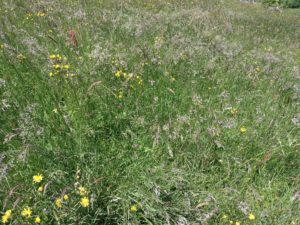
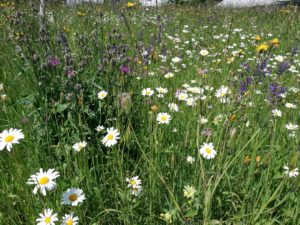
Conclusion: Increasing plant species diversity in a meadow is a long-term project! Without additional efforts to increase biodiversity, the ecological value of extensively managed meadows remains extremely low.
Management of the flower meadow: The author follows the recommendations of Wildblumenburri. The wildflower specialist recommends mowing between 5 and 20 June, as soon as a window of at least 3 days without rain or thunderstorms opens up. The meadow is mown and the hay is left to dry in place for three days, during which it is turned several times. This allows the seeds to ripen and disperse.
Wild-living honey bees need old trees with cavities and structurally diverse forests. Raphaèle Piaget, member of the ...
A new study by the University of Hohenheim and Agroscope shows a significant decline in free-living honey bee colonie...
We would like to extend our sincere thanks to 20 Minuten and Reto Bollmann for the article published on 7 October abo...
Important information
Important information: The original texts are published in German. The French, Italian and English versions are translated automatically and checked where possible. Please report any errors to bee@freethebees.ch.