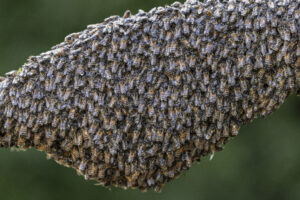
For years, FREETHEBEES has asked participants the following question in practically every one of our talks and courses: “Do we know what we are causing in the long term.. ?” By this, we mean the excessive density of honey bees, the competition with other wild bee species, the increased risk of disease and parasite transmission, etc.
A new study by the University of Vermont, published in PLOS One, once again demonstrates the relevance and importance of our question: viruses are transmitted from managed honey bee colonies to bumblebees. The two species do not even need to come into direct contact with one another; the viruses can be deposited on flowers and transmitted.
https://journals.plos.org/plosone/article?id=10.1371/journal.pone.0217822
Biochemist Berly McCoy has provided a clear summary of the study (in English).
https://www.pbs.org/newshour/science/are-commercial-honeybees-making-wild-bees-sick
The solutions proposed are also in line with those advocated by FREETHEBEES since 2013:
As of 15 September 2026 On 20 May 2026, the Swiss federal popular initiative “For the Safeguarding of Pollination of...
On 30 July 2026, 44 donors accepted our invitation to Estavayer-le-Lac—the highest attendance ever at a FreeTheBees d...
Around 30 members and the board met on 25 July for the annual members’ gathering at Park Seleger Moor in the canton o...
Important information
Important information: The original texts are published in German. The French, Italian and English versions are translated automatically and checked where possible. Please report any errors to bee@freethebees.ch.