It has been demonstrated that bees become ill after exposure to comb mold. The infection affects the internal organs and can lead to the collapse of the bee colony. Most mold toxins also have an immunosuppressive effect. Many hives do not live up to their reputation as “species-appropriate” because their design (geometry / lack of insulation / unoccupied space) causes increased heat loss—and also creates thermal bridges in the area of the food combs. Condensation first forms here, which in turn leads to the growth of comb mold. The bees open the contaminated combs with their mouthparts and become infected with the mold pathogens.
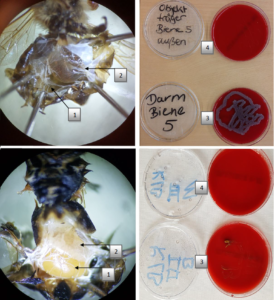
Image above: Winter bee from a bee house with typical winter mold growth on the food combs. The internal organs are severely affected (1/2), and the rectum is empty (1). The sterile swab and the culture incubated in the incubator show clear evidence of infection of the internal organs by mold pathogens (3). The upper control culture (4) shows that sterile procedures were followed and that contamination from the tools used or from dissecting the bees can be ruled out. Significantly, the infection rate among the bees tested was 100%.
Image below: Winter bee(s) from a tree cavity for comparison. The organs are in excellent condition. The formation of comb mold can be almost entirely ruled out in tree cavities / straw hives. The samples (right) show no signs of infection.
Original article and source, Torben Schiffer / Beenature-Project.com: Beenature-Project: Effects of Comb Mold on Bee Health
The full study will be published in early 2019.
A New Departure in Beekeeping, Manfred Schmitz How can we provide bees with living conditions that keep them healthy?...
The Beekeeping Revolution, Torben Schiffer For 45 million years, eusocial honeybees have carried a large part of our ...
Honeybees – mysterious forest dwellers, Jürgen Tautz, photographer Ingo Arndt Wild honeybees do exist, even in our fo...
Important information
Important information: The original texts are published in German. The French, Italian and English versions are translated automatically and checked where possible. Please report any errors to bee@freethebees.ch.